
The writer, Dr. Tiema Haji is an academic, researcher, author, journalist, communication specialist and an accomplished poet.
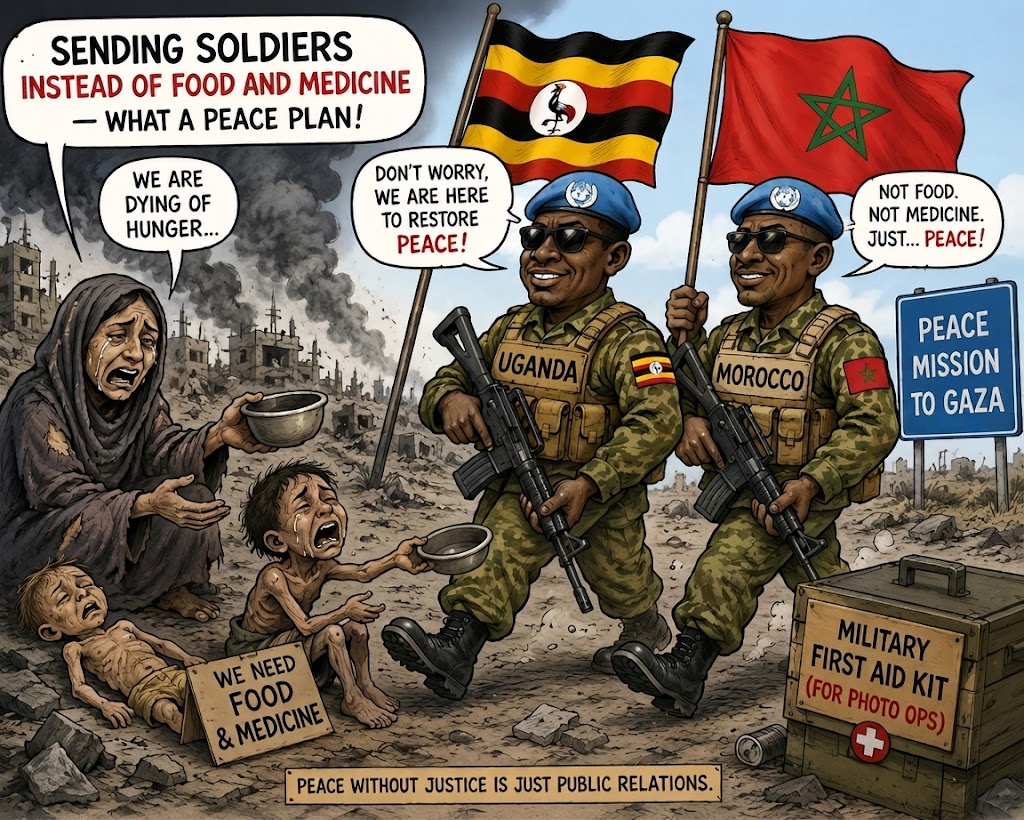
There is something deeply troubling about the spectacle now unfolding in Gaza: African countries are preparing to send soldiers to a territory whose people urgently need food, medicine, shelter and reconstruction.
Gaza does not primarily need another foreign military presence
Uganda has received parliamentary approval to deploy troops to Gaza as part of the proposed International Stabilization Force, while Morocco signed an agreement in July to participate in the force. The force is authorised under UN Security Council Resolution 2803 and is intended to help stabilise Gaza, protect civilians, support humanitarian operations, train Palestinian police and oversee the demilitarisation of armed groups.
On paper, this is called peacekeeping. But Africa should be asking a more fundamental question: what kind of peace is being constructed, and for whom?
Gaza does not primarily need another foreign military presence. It needs an end to occupation, genuine Palestinian self-determination, unrestricted humanitarian assistance and a massive reconstruction programme. The UN has reported that food insecurity remains a serious concern and that declining aid coverage threatens fragile improvements. The Board of Peace itself estimates that about 85 percent of Gaza’s buildings and infrastructure have been damaged or destroyed, with roughly 70 million tons of rubble requiring clearance and more than one million people needing permanent shelter and essential water, sanitation and hygiene infrastructure.
That should be Africa’s priority.
The timing is particularly difficult to understand. During the period when Gaza was being devastated by Israeli military operations, when Palestinian civilians were being killed on a massive scale and when humanitarian access was repeatedly restricted, African governments were not deploying armies to protect Palestinians from the consequences of the war. Now that the proposed settlement requires Palestinians to surrender their weapons and international troops to police the territory, African soldiers are being mobilised.
This raises an uncomfortable question: where were these soldiers when Gaza was being bombed?
The distinction matters. A force deployed after a genuine ceasefire to protect civilians and humanitarian workers can have a legitimate peacekeeping function. But a force that becomes primarily responsible for disarming Palestinians while Israel’s withdrawal remains conditional on that disarmament risks being perceived as enforcing the security requirements of the occupying power rather than securing Palestinian freedom.
Resolution 2803 explicitly links Israeli military withdrawal to progress on demilitarisation. It also requires the International Stabilization Force to work in consultation with Israel and Egypt. That arrangement deserves serious scrutiny because Palestinians could reasonably ask why the international community is placing so much emphasis on removing Palestinian weapons while the underlying political question of occupation and self-determination remains unresolved.
The African Union should be particularly uncomfortable with this arrangement.
Africa’s own history gives it a powerful reason to approach the Palestinian question through the lens of liberation, sovereignty and self-determination. The African Union has previously argued before the International Court of Justice that Israel’s occupation of Palestinian territory is unlawful and that it must end to allow Palestinians to exercise their right to self-determination. The African Commission on Human and Peoples’ Rights has likewise reaffirmed Palestinian self-determination and condemned the occupation, while calling for humanitarian access and accountability.
That history creates a serious contradiction.
Africa cannot consistently proclaim solidarity with Palestine as a people struggling for freedom and then participate in an arrangement whose immediate security architecture is centred on controlling Palestinian territory and disarming Palestinian armed groups.
This is not an argument for Hamas to retain weapons indefinitely. Palestinian civilians deserve security, and any credible peace settlement must address armed groups, Israeli security and the protection of civilians. But demilitarisation cannot become a substitute for decolonisation, self-determination and statehood.
Africa should therefore be demanding a different contribution from Uganda, Morocco and other African governments.
- Send doctors.
- Send engineers.
- Send food.
- Send water-treatment specialists.
- Send reconstruction experts.
- Fund hospitals.
- Rebuild schools.
- Clear rubble.
- Support Palestinian institutions.
- Provide scholarships for Palestinian students.
- Help restore electricity, sanitation and housing.
And use African diplomatic influence to demand that the rights of Palestinians are treated as central to the peace process.
The African Union should also make clear that individual African participation in an international force does not constitute a blank cheque for any party to the conflict. The AU’s own 2025 decisions called on African countries to support urgent relief for Gaza and lift the siege. That humanitarian commitment should remain at the centre of Africa’s response.
Uganda and Morocco are sovereign states and have the right to make their own foreign-policy decisions. Their soldiers may genuinely be intended to protect civilians rather than fight Palestinians. But intentions are not enough. The political consequences of the mission matter.
If African troops enter Gaza while Palestinians remain deprived of genuine political freedom, Africa risks becoming associated with the policing of a devastated population rather than the liberation and reconstruction of that population.
Africa has lived through colonialism, occupation, apartheid and liberation struggles. It therefore knows that peace cannot simply mean the absence of shooting.
Sustainable peace requires justice, sovereignty, dignity and political equality. Palestinians need those things now.
They need bread before bullets, hospitals before barracks, homes before military checkpoints and freedom before foreign armies are asked to police their future.
Africa should not send soldiers to Gaza merely to manage the consequences of a political problem it has failed to help solve. It should send everything necessary to help Palestinians rebuild their lives and achieve the freedom and statehood that the African Union itself has repeatedly affirmed as their right.