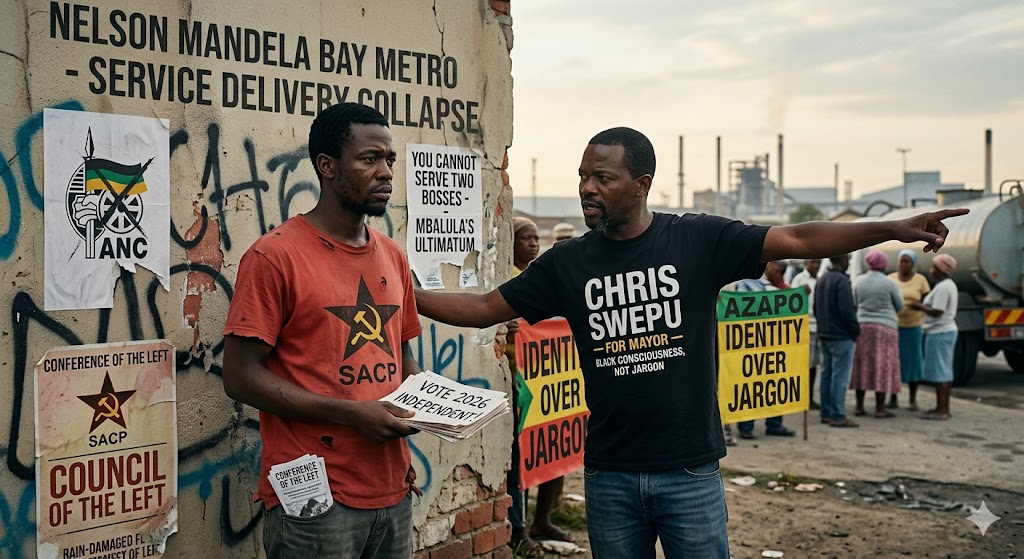

For over three decades, the South African Communist Party operated as the comfortable, state-subsidized conscience of the African National Congress (ANC). Shielded by the Tripartite Alliance, its leadership regularly enjoyed ministerial perks, while offering boilerplate Marxist critiques of the very neoliberal policies they consistently voted into law. Now, with the ANC forced into a corporate-friendly coalition referred to as the Government of National Unity (GNU) alongside the Democratic Alliance (DA), the SACP has experienced a sudden jolt of survivalist panic. Their response – a resolution to contest the upcoming 2026 local government elections autonomously- is being marketed as a grand socialist awakening. In reality, it is a desperate attempt to jump out of the ANC’s titanic sinking ship; complicated by empty coffers, internal divisions and a deeply fragmented leftist landscape.
THE FINANCIAL CHOKEHOLD: Fighting a War With Empty Pockets
The most glaring flaw in the SACP’s independent electoral strategy is financial. Modern political campaigns require immense capital, a reality that clashes brutally with the party’s current state of operational paralysis. It is an open secret that the SACP is facing a severe internal cash crisis. National leadership has already been forced to postpone major organizational gatherings due to an inability to cover basic operational expenses. Historically, the SACP never had independent financial machinery of its own. It plugged directly into the ANC’s massive, corporate-backed electoral war chest, utilizing its logistics, transport networks and media infrastructure. There also arises the issue of state purge in the form of the ANC demanding that its members who also hold membership in the SACP declare which party they will campaign for in the 2026 local government elections.
The SACP has rejected this ultimatum, describing it as an attempt at intimidation
Following the SACP’s decision to contest the 2026 elections independently, the ANC declared that “you cannot serve two bosses” and mandated that dual members submit in writing their intention to campaign exclusively for the ANC or for the SACP. Key aspects of the ANC’s position include:Ultimatum on Campaigning: The ANC stated that while it recognizes dual membership, it cannot permit individuals to campaign for a party that is running against it. The ANC’s National Executive Committee (NEC) subsequently gave affected members 10 days (from April 23, 2026) to declare their choice, particularly regarding the ability to stand as candidates, according to reports.”Not Excluded” but Action Expected: ANC Secretary-General Fikile Mbalula said communists are welcome within the ANC, but those who choose to fight for the SACP’s campaign cannot simultaneously represent the ANC’s interests. It was resolved that affected SACP members should recuse themselves from joint election strategy structures. “You cannot serve two bosses,” declared the ANC Secretary General, Fikile Mbalula. In fear of risking their state-funded salaries, some SACP members such as Minister of Mineral and Petroleum Resources, Gwede Mantashe, Minister of Science, Technology and Innovation, Blade Nzimande and Minister of Higher Education and Training, Bhuti Manamela resigned from the SACP. The SACP has rejected this ultimatum, describing it as an attempt at intimidation and a violation of the traditional alliance relationship.
THE Bilateral Talks With AZAPO: Ideological Truce, Electoral Zero
In a desperate bid to build an alternative power bloc, the SACP has recently initiated high-profile bilateral talks with the Azanian People’s Organization (AZAPO). Led by AZAPO President, Nelvis Qekema, the meetings have been heralded by both sides as “historic and long overdue.” While the bilateral talks have produced fiery joint statements condemning the “neo-colonial” GNU, their practical effect on the 2026 elections is negligible. Historically, the Marxist-Leninist framework of the SACP and the race analysis of the Black Consciousness have been uneasy bedfellows. More importantly, AZAPO itself commands a microscopic fraction of the national vote. Combining the SACP’s unproven independent machinery with AZAPO’s historically negligible electoral footprint creates an alliance of rhetoric rather than a formidable voting bloc.
The “Conference of the Left”: Echos in an Empty Room
The culmination of these bilateral maneuvers is the upcoming Conference of the Left, scheduled for 29-31 May 2026 at Birchwood Hotel in Boksburg. Driven by an SACP concept note warning that “capital holds the commanding heights” and “the left is fragmented,” the event aims to establish a permanent “Council of the Left” to coordinate joint anti-imperialist and anti-capitalist campaigns. While stronger organizations like the EFF have established a working task team with the SACP to finalize details of their cooperation ahead of the conference, the conference already sufferers from a structural paradox. It would most certainly avoid a unified electoral strategy. In view of the fact that each participating organization still insists on maintaining its own independent identity and ballot presence, the conference cannot birth a cohesive leftist coalition. On the contrary, it functions as a therapeutic shelter for marginalized factions – a platform where leaders locked out of the GNU can swap revolutionary slogans without having to reach consensus on any unified electoral strategy.
CASE IN POINT: The Nelson Mandela Bay Theatre of the Absurd
Nowhere do these national contradictions collide more violently with regional realities than in the Nelson Mandela Bay Metro (NMBM). The Eastern Cape has historically been the Tripartite Alliance stronghold, but Gqeberha has devolved into an unstable political environment defined by institutional collapse, a R1, 3 billion operating deficit and fragile, transactional coalitions.
In this industrial hub, the local SACP has been completely sidelined, watching from the periphery as the ANC swaps mayoral chains with minority partners in order to survive. The local prolitariat has long since stopped looking to the communist vanguard for municipal service delivery. The absolute fragility of the left’s alignment in the Bay is exposed by the solo mayoral candidacy of Chris Swepu. The former AZAPO Secretary General has launched an independent bid as the AZAPO Mayoral Candidate for the Metro in the upcoming 2026 local government elections. Swepu’s campaign highlights the exact regional factors that will neutralize the SACP’s independent run.
Constituency Cannibalisation: Swepu appeals directly to the same disillusioned, Black working-class voters that the SACP needs to court.
Identity Over Jargon : Swepu utilizes sharp Black Consciousness language that addresses local struggles over land and identity, contrasting with the SACP’s dry, outdated Marxist-Leninist terminology.
Agility vs Inertia: While the local SACP remains paralyzed by central funding shortages and fears of potential ANC expulsions, independent mavericks can run nimble , hyler-localized grassroots campaigns.
VERDICT: A Silent Microphone
SACP General Secretary, Solly Mapaila, has quietly managed expectations, admitting that the 2026 local government elections are a “tactical test” to gauge independent strength ahead of the 2029 general elections. However, this tactic risks exposing the ultimate weakness of the party. Entering a brutal municipal election underfunded, structurally disorganized, out-muscled by rivals like the EFF and crowded out by independent actors like Chris Swepu will likely demonstrate that the SACP has no independent voter base. In fact, the Nzimande-era leadership of the SACP worked tirelessly for decades preserve the party, not because they believed in achieving a socialist order in South Africa, but merely to silence other organizations with strong socialist sentiments. It is in the same spirit that they have ensured that its existence depends

MP Khwezi Ka Ceza is Gqeberha-based independent political commentator, community leader and a social activist.