
Prof. Narnia Bohler-Muller is an Advocate of the High Court of South Africa and Distinguished Research Specialist at the Human Sciences Research Council. She joins the University of the Free State as Professor in the Flourishing Life Research Theme in June 2026, and writes here in her personal capacity.
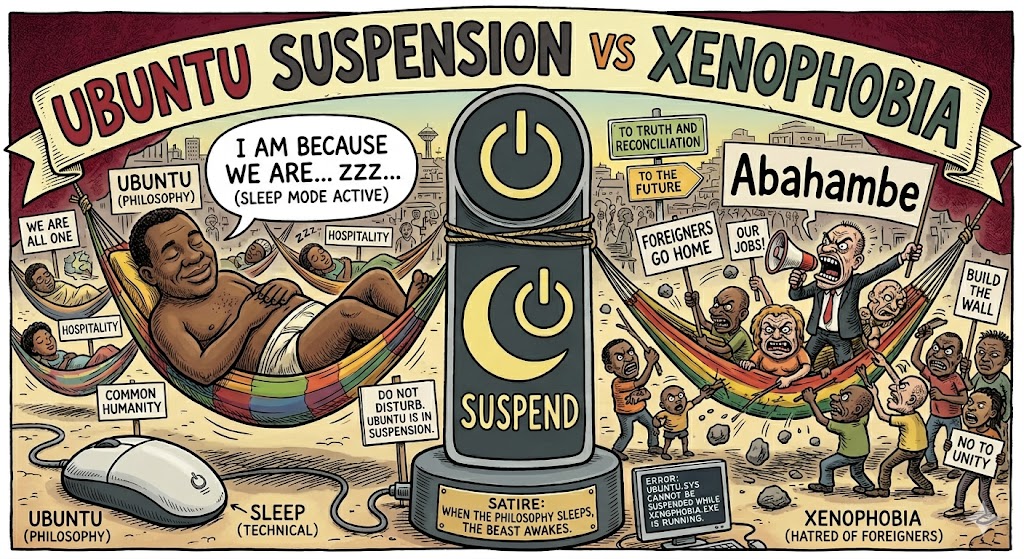
When the leader of an anti-immigrant movement told her supporters in Bellville last weekend that “Ubuntu is suspended until further notice,” she was not merely being inflammatory. She was attempting something more ambitious, and more dangerous, than a hard line on migration. She was trying to revoke the moral grammar of the country.
Jacinta Ngobese-Zuma, addressing a March and March crowd that had walked Voortrekker Road demanding the arrest of undocumented immigrants, framed it as a withdrawal of generosity. South Africa was the rainbow nation, she said; its harmony was mistaken for an invitation; outsiders “took advantage of our Ubuntu.” And so, the conclusion: ubuntu suspended, until further notice.
I want to be precise about why this should alarm anyone who takes our constitutional order seriously. The danger is not in the word “suspended.” It is in the quiet assumption underneath it, that ubuntu is a favour the in-group extends and may withdraw at will. That assumption is wrong, philosophically and constitutionally, and the people who govern us are letting it pass with a silence that is starting to look like consent.
A concept being turned against itself
Ubuntu is not South African hospitality. It is not a national mood of welcome that can be switched on for friends and off for strangers. In the philosophical tradition that gives the word its weight, in the work of Mogobe Ramose, of Thaddeus Metz, in the jurisprudence our own Constitutional Court has built, ubuntu names a claim about what a person fundamentally is. Umuntu ngumuntu ngabantu: a person is a person through other persons. My humanity is not a possession I own and dispense. It is constituted, continuously, through my recognition of yours.
Read that carefully and the slogan collapses. You cannot “suspend” ubuntu toward a category of people while keeping it for yourself, because the suspension is not something you do to them. It is something you do to your own personhood. To declare that the stranger no longer counts is, on ubuntu’s own terms, to unmake yourself as a moral being. The movement that thinks it is defending the nation’s humanity by withdrawing it from migrants has, by the only definition that matters, already forfeited the thing it claims to protect.
This is why the appropriation is so insidious. It does not reject ubuntu. It wears it. It invokes the most cherished concept in our public moral vocabulary, drapes itself in the language of a generosity betrayed, and then uses that borrowed authority to license exclusion. It is ubuntu turned inside out and worn as a mask by its opposite.
And there is a particular kind of harm in that mask, one we do not name often enough. A person is not a finished thing. We are each of us still becoming, unfolding through the people who raised us, teach us, work beside us, recognise us in the street. Ubuntu is simply the truest name for the relational conditions that make that becoming possible. To flourish is not to arrive at some secured state; it is to be sustained, continuously, in the slow work of becoming who we might yet be. When that sustenance is deliberately withdrawn from a category of people, when they are denied shelter, work, safety, the ordinary recognition of being seen as fully human, what is denied is not merely a service or a right. It is their flourishing, at the level of their being. This is the wrong beneath the slogan: not only exclusion, but flourishing denied. And because we become through one another, to obstruct the becoming of the stranger is to corrode the very web through which we ourselves are still becoming. There is no version of this in which we wound only them.
The boundary they are quietly redrawing
There is a deeper move here, the one that makes this rhetoric so portable. “They took advantage of our Ubuntu” is a claim about boundaries, about who belongs inside the circle of mutual recognition and who stands outside it. The xenophobic argument does not abandon ubuntu. It shrinks it, drawing the circle tightly around the nation and recasting everyone beyond it as an intruder who abused a kindness they were never truly inside.
It must be met head-on, because a communitarian ethic does live or die by the question of who counts as community. But here is what the capture gets wrong. In the tradition, and emphatically in our jurisprudence, the stranger is not the exception that tests the limits of ubuntu. The stranger is the test case of whether you have understood it at all. In S v Makwanyane, the judgment that abolished the death penalty and installed ubuntu at the heart of our constitutional reasoning, the Court extended dignity to the condemned murderer, the person the majority found least deserving of it. That was the entire point. Ubuntu proves itself precisely where recognition is hardest. An ubuntu that holds only for those who already belong is no ubuntu at all. When a movement says the circle stops at the border, it is not offering a stricter version of our ethic. It is offering its negation, and counting on us not to notice because the packaging is familiar.
The silence that frightens me more than the slogan
I could leave it as a philosophical correction. But there are people sleeping outside government buildings in Durban right now, many of them Congolese, in the country lawfully, because they are afraid to go home. We have placards in Cape Town reading “Enough is Enough.” We have the South African Human Rights Commission writing to the police, invoking, by name, the scenes of 2008, when xenophobic violence killed more than sixty people. Everyone in this story knows what that reference carries. We have been here. We know how the sentence ends.
What we do not have, in any volume that matches the danger, is moral leadership. The Police Minister has said the right procedural things about the limits of protest. The Human Rights Commission has done its duty. But where are the voices of national authority willing to say plainly that “Ubuntu is suspended until further notice” is not a policy position but a renunciation, that it asks South Africans to become less than themselves? The scandal is not only that a movement leader said it. It is that she could say it, on a public road, draped in our highest moral language, and be met largely with managerial caution about public order rather than the unequivocal rejection the moment demands.
Silence here is not neutrality. When the foundational ethic of the Constitution is publicly declared revocable and those entrusted with that Constitution decline to answer, the declaration starts to harden into permission. The 2008 dead are not a rhetorical flourish. They are a warning about what follows when the circle of “us” is allowed to contract unchallenged, one slogan at a time.
What must be said, plainly
Let me say the thing the moment requires, in case it needs saying by someone whose life’s work is this concept.
Ubuntu cannot be suspended. It is not within the gift of any movement, any majority, or any leader to switch off the humanity of another person, because that humanity is the very ground on which their own stands. To target the migrant, the refugee, the undocumented, the poor African neighbour, is not to defend our personhood. It is to corrode it. The people camped outside Home Affairs in Durban are not abusing our ubuntu. They are people in the middle of their own becoming, afraid, displaced, still reaching for a life, and they are the measure of whether we still have any ubuntu at all.
“Until further notice,” she said. Let the notice be this: the suspension does not, and cannot, take effect. Not because we are generous enough to forgive the attempt, but because the thing they tried to suspend was never theirs to switch off. It is what makes us persons. We are none of us finished, none of us arrived; we are still becoming, and we become only through one another. A nation that suspends ubuntu does not protect its own becoming. It forecloses it. We would not be defending who we are. We would simply be the latest people to discover how quickly a country can talk itself out of its own unfinished, shared, still-possible humanity.
Narnia Bohler-Muller is an Advocate of the High Court of South Africa and Distinguished Research Specialist at the Human Sciences Research Council. She joins the University of the Free State as Professor in the Flourishing Life Research Theme in June 2026, and writes here in her personal capacity.