

MP Khwezi Ka Ceza is Gqeberha-based independent political commentator, community leader and a social activist.
Since Ayatollah Ruhollah Khomeini returned to Tehran in 1979, it is an undeniable truism that Iran’s claim to self-determination has been a recurring migraine for every occupant of the Oval Office. Some would mistake it for a diplomatic hiccup but it isn’t. It’s a glaring structural fault line. History reminds us that Jimmy Carter was the first casualty, his presidency unravelling on live TV with the embassy hostage crisis. Subsequent to that, a string of U.S. presidents chose distance covert sabotage, sanctions, and proxy boxing over a direct street fight with a nation that wears its pride on its sleeve.
Then in came the overzealous Donald “the Tariff Terminator” Trump. Convinced that “maximum pressure” combined with a spectre of war could crack Iranian resolve, he miscalculated the opponent’s capabilities entirely. The gamble didn’t force surrender. It backfired. Washington looked boxed in. Tehran dug deeper, hardened, and came out with leverage. In South African terms: Trump thought he could klap Iran into line. Instead, he got a geopolitical skrik.
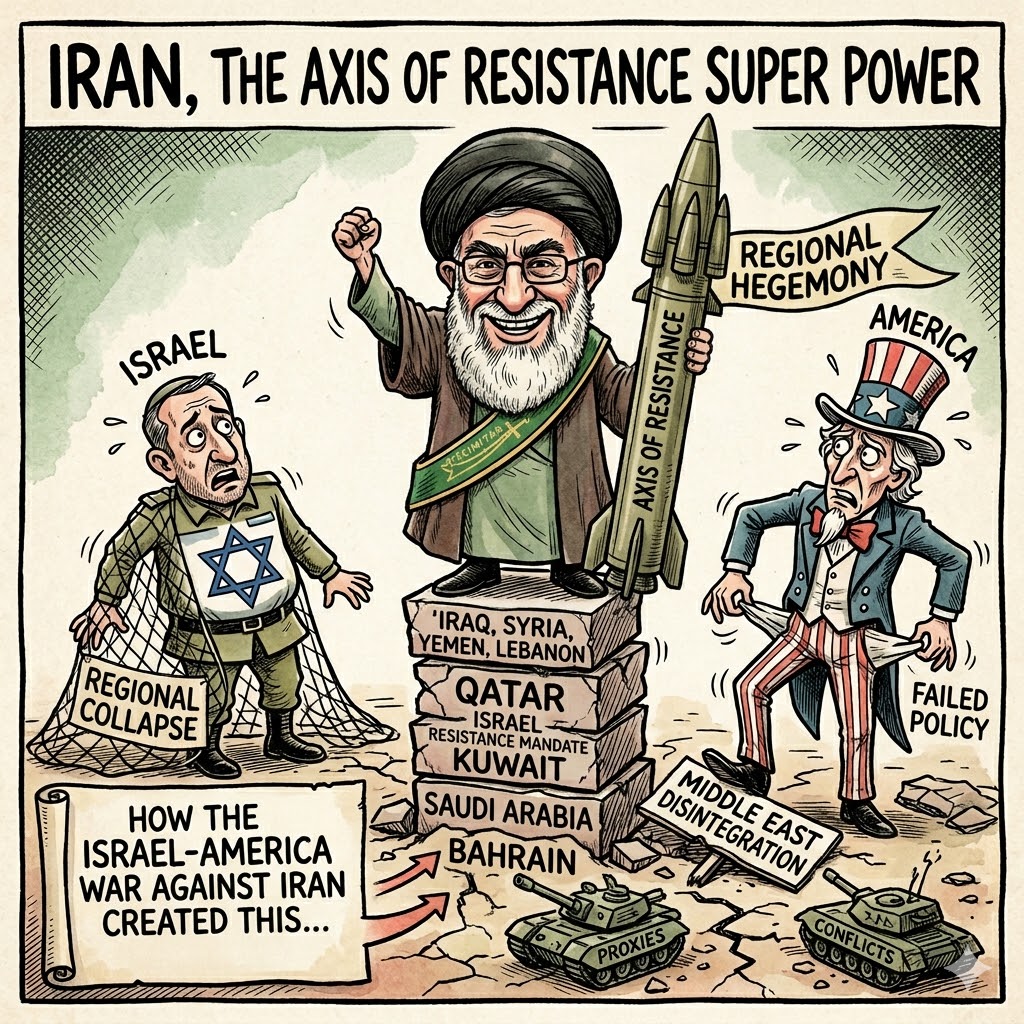
The Fourth Pole: How Iran Out-manoeuvred Washington and Forced a New World Order
For decades, policy in Washington, London and Jerusalem rested on one bet: squeeze hard enough, rattle sabres loud enough, and Tehran buckles. That assumption is now dead. From global newsrooms to universities seminars, think tanks and international security agencies , a new consensus is forming. Iran didn’t just survive pressure. It escaped the cage. Through economic improvisation and asymmetric warfare, it has muscled its way into the room with the U.S., Russia, and China as a rising superpower — a disruptive fourth pole that never was envisioned. According to standard established protocol, a superpower requires, at least, a blue-water navy, trillion-dollar GDP, and Silicon Valley-style tech giants. Iran has none of that.
However, by turning isolation into a crash course in economic guerrilla tactics, it did what few conventional militaries could have ever imagined, it cracked the unipolar order. Here’s the uncomfortable truth many Western planners now admit, albeit Nicodimously. Maximum pressure bullying tactics dismally failed. The strategy assumed that sanctions and targeted strikes would force capitulation. Instead, they forced unprecedented adaptation.
Tehran buried critical infrastructure, accelerated partnerships across Eurasia, and learned to operate without the West. The result? Washington now finds itself in a draining cycle of backchannel talks and quiet concessions. Roles have reversed. By dragging the world’s dominant military power away from the war room and onto the negotiating table, Iran secured what it wanted most; recognition as a permanent, impregnable actor.
The strategy assumed that sanctions and targeted strikes would force capitulation.
The ‘Axis of Upheaval’ Goes to Work
Iran didn’t do this solo. It positioned itself as the streetwise hub of a transactional trio with Russia and China — what analysts call the “Axis of Upheaval.” This isn’t a friendship pact. It’s cold arithmetic.
On one hand, Beijing quietly breathes life into Iran’s economy by buying its oil and keeps the industrial pipeline open. Meanwhile, Moscow provides diplomatic cover at the UN, nuclear latitude, and advanced hardware on the other. Iran is a fortified buffer state that sits on the world’s energy chokepoints and does the disrupting. Together they have built an ecosystem sanctions cannot easily touch and elusive .
How to Fund a Rise Without the Bank
Cut off from SWIFT, Iran didn’t fold. It built a parallel economy.
First, they have masterminded a shadow banking through rotating shell companies across Asia and the Middle East, moving billions beneath the Western radar. It pairs that with hawala — a centuries-old, trust-based transfer system that leaves no digital trace and state-tolerated crypto to shift capital fast.
Additionally, a sanctions-proof oil route to China. Under a 25-year strategic pact, independent Chinese refineries have become permanent buyers. Delivery comes via a “dark fleet” of hundreds of aging tankers, flags of convenience with transponders off. Payment are settled in yuan, not dollars, a steady, but quiet erosion of U.S. financial dominance.
The Myth of the American Shield
For 50 years, Gulf monarchies banked on a rule that hosting US military bases buys safety. Iran systematically shattered that assumption.
In a coordinated drone and missile salvos, Tehran showed that those bases are not impenetrable shields. They are fixed, high-value targets. The math is brutal. A drone that costs under US 20,000 dollars can force the launch of Patriot interceptors priced at US 3–5 million dollars each. You can’t win that exchange rate. Tehran proved it can outlast Western magazines with cheap, mass-produced systems, effectively bankrupting air defence in real time.
The Gulf’s Collateral Bill
The biggest losers go far beyond only the Washington and Jerusalem. Casualties stretched across Riyadh, Doha, Manama, Cairo, and Amman. Most tried to stay neutral, even denying airspace for U.S. operations. Nothing mattered.
Gulf visions of a post-oil future, tourism, tech hubs and foreign capital stalled when risk spiked. Airlines rerouted. Investors paused. Saudi Arabia’s Vision 2030 struggled for the Foreign Direct Investment it requires to diversify. Egypt’s Suez revenue bled as shippers avoided the Red Sea. Jordan’s tourism dried up while missiles crossed its skies.
Cracks Inside the Kingdoms
The deeper threat became domestic. The pillars of authoritarian stability rests on perceived invincibility. Once citizens saw low-cost drones bypass billion-dollar defences, that aura cracked. Fear gave way to potential emboldened activism, tribal blocs, and online networks.
That comes as the Gulf social contract frays. The deal has always been simple; trade political rights for tax-free salaries, subsidies, and state jobs. With growth hit and defence bills rising, the cash for that bargain is thinning. Raising taxes or cut benefits to foot the bills for more Western hardware could possibly hand opponents a rallying cry. In some sections of the societies in Gulf region, the message is swiftly finding traction that the state cannot protect you and may not be able to provide for you either.
From Proxies to Power Brokers
A quick glance at Beirut and Sana’a indicates as to who benefitted most in the region. Tehran’s long-time allies graduated from proxies to entrenched regional powers.
Despite Hezbollah absorbing Israel’s heaviest blows, it kept its command intact and retained a precision missile arsenal. It can now prides itself of holding an armed veto over Lebanon’s political life. Any Israeli campaign against it risks unacceptable costs at home.
It would be disingenuous to ignore that the Houthis achieved something rare by bending global trade. Dismissed once as a tribal insurgency, they choked traffic at the Bab el-Mandeb, pushing ships away from the Suez, affecting the normal flow. The Houthis now govern northern Yemen as a de facto state that the world has to deal with.
The Counterfactual That Didn’t Happen
On could imagine if the West had broken Tehran. The “Axis of Resistance” would have surely buckled, given that Hezbollah and the Houthis do not run self-sustaining economies. They depend on Iranian fuel, cash, and engineering. If that that artery is cut, supply lines dry up. Hezbollah would have to face disarmament by their domestic rivals. The Houthis would have to retreat back into the highlands.
The fact that the pillar held meant that the periphery didn’t just survive. It simply hardened into a permanent feature of the regional map.
It is currently in a messy, quadripolar world.
A Quadripolar Reality
There seems to be no restoration of the old order. The world is not sliding into what was predicted to be a tidy US –China Cold War. It is currently in a messy, quadripolar world. By becoming a nuclear-threshold state with a de-dollarized trade network, Iran is raising its hand and claiming its seat.
The sharp irony of decades-long pressure designed to isolate Tehran ended up isolating the policy. Identifying gaps in the American security umbrella, Gulf states are hedging, with Saudi Arabia proposing Cold War-style non-aggression and security framework with Iran that is modelled after the 1975 Helsinki Accords. That stance is a clear signal for dialling down confrontation. They did not lose a war. They lost the stability they need to keep their fragile societies calm.
Iran has demonstrated that it is not a feeble state that can only be managed through media de-campaigns, sustained economic strangulation and arbitrary military incursions anymore. The fourth pole is anchored, its creators and the rest of the world has to learn to live with it.
MP Khwezi Ka is a Gqeberha-based independent political commentator, community leader, and social activist