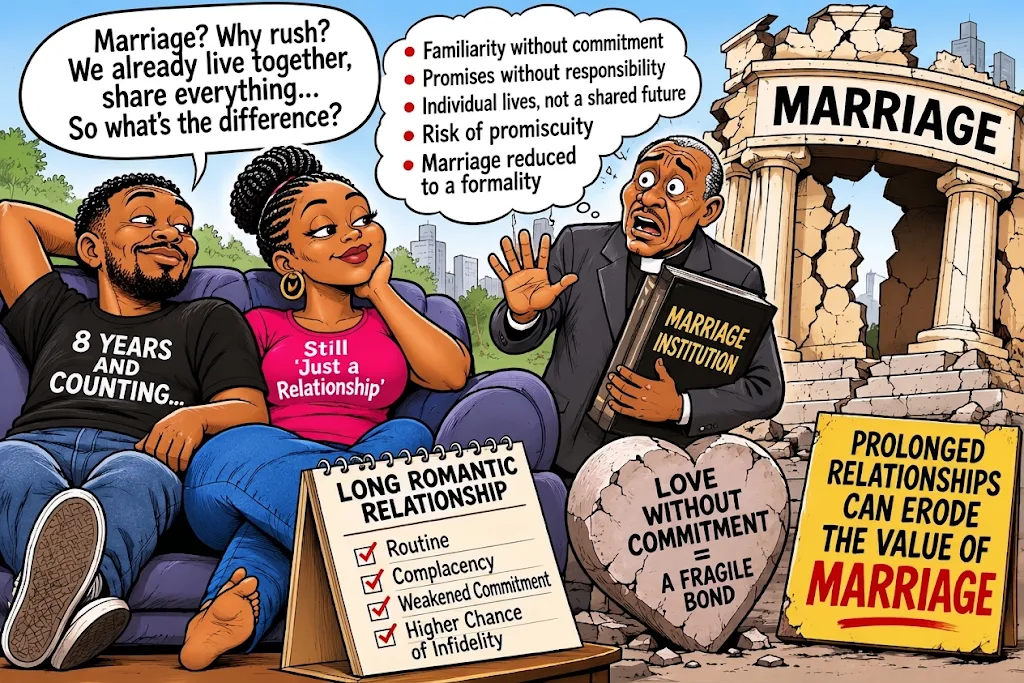

The paradox of being together without necessarily belonging together
Contemporary society has increasingly normalised romantic relationships as a necessary stage in the process of finding a marriage partner. Couples meet, become emotionally attached, establish intimate associations and, in many instances, spend several years together before considering marriage. This arrangement is generally understood as a period of discovering compatibility, understanding one another and determining whether two individuals can build a future together. However, an important sociological question deserves greater attention: can a romantic relationship that extends over many years gradually undermine the very institution of marriage that it is supposedly preparing the couple to enter?
a romantic relationship that extends over many years gradually undermine the very institution of marriage that it is supposedly preparing the couple to enter
The assumption that prolonged romantic association necessarily produces stronger marital foundations deserves critical examination. Time spent together does not automatically translate into deeper commitment, greater responsibility or readiness for marriage. In some circumstances, the opposite may occur. The extended duration of a romantic relationship can cultivate familiarity to such an extent that the prospect of marriage loses its distinctive social, emotional and institutional significance. What was initially an exciting association between two individuals gradually becomes an established arrangement in which companionship, intimacy and individual interests coexist without necessarily developing into a shared commitment to a common future.
This raises an interesting paradox: two people can spend years together, share intimate experiences, maintain regular communication and even organise their lives around one another, yet remain fundamentally separate in their understanding of commitment. They are together in their relationship, but not necessarily united in their lives. In other words, they may experience the privileges of companionship without fully embracing the responsibilities of marital partnership.
The sociology of familiarity and the erosion of commitment
One of the less examined consequences of prolonged romantic relationships is the way familiarity can alter the psychological and social meaning of intimacy. At the beginning of a relationship, emotional attachment is frequently accompanied by excitement, anticipation and a conscious desire to maintain the other person’s affection. Individuals make efforts to impress, accommodate and reassure one another. The relationship is often characterised by a heightened awareness of the possibility of losing the other person.
The extended duration of a romantic relationship can cultivate familiarity to such an extent that the prospect of marriage loses its distinctive social, emotional and institutional significance.
However, as the relationship continues over several years, these initial conditions can change. Familiarity becomes routine, expectations become established, and the emotional urgency associated with maintaining the relationship may gradually diminish. Each individual becomes increasingly accustomed to the other’s presence, behaviour, habits and availability.
Familiarity itself is not necessarily destructive. Indeed, it is an important component of successful marriage. The problem emerges when familiarity develops without a corresponding growth in responsibility, mutual accountability and commitment. When individuals become comfortable with one another without consciously developing a shared understanding of their future, the relationship risks becoming an arrangement sustained primarily by habit.
The sociological distinction here is between emotional attachment and institutional commitment. Emotional attachment concerns the feelings and personal connections that bring individuals together. Institutional commitment, however, involves accepting responsibilities, obligations and expectations that extend beyond immediate emotional satisfaction.
Marriage introduces a different framework of association. It places the relationship within a recognised social institution that carries expectations concerning fidelity, mutual support, responsibility, family formation and long-term partnership. Although these expectations vary across cultures and individuals, marriage generally represents a public and socially recognised declaration that two people intend to organise significant aspects of their lives around one another.
A prolonged romantic relationship may therefore produce emotional familiarity without necessarily preparing individuals for this institutional transition. The couple may already know how to spend time together, but that does not mean they have learned how to build a life together.
Being one without being together: The contradiction of modern romantic relationships
The concept of a relationship itself deserves closer sociological interrogation. A relationship, in its broadest sense, describes an association between individuals based on particular connections, interests, expectations or shared experiences. However, the existence of such an association does not automatically mean that the individuals involved have surrendered their separate orientations towards life.
This distinction is particularly evident in contemporary romantic relationships. Two individuals may identify themselves as a couple while maintaining substantially independent lifestyles, priorities, financial arrangements, social circles and future aspirations. They share certain dimensions of their lives while retaining considerable autonomy over others.
There is nothing inherently wrong with individual independence. Marriage should not require the destruction of personal identity. Nevertheless, a meaningful partnership requires some degree of integration in the way individuals understand their responsibilities, make decisions and approach their collective future.
The difficulty arises when the relationship becomes an arrangement of convenience, emotional fulfilment and reciprocal needs rather than an undertaking towards a shared life. One individual may seek companionship, another emotional security, while both may derive sexual satisfaction, social recognition or practical assistance from the association. These interests can sustain a relationship for years without producing a common understanding of where it is going.
A prolonged romantic relationship may therefore produce emotional familiarity without necessarily preparing individuals for this institutional transition.
Consequently, the couple can appear united socially while remaining divided in their individual expectations. They are together when companionship is required, but separate when questions of responsibility, sacrifice and long-term direction emerge.
This is what makes some prolonged romantic relationships sociologically interesting. They establish the appearance of togetherness without necessarily cultivating the substance of partnership. The individuals become familiar with each other’s presence, but familiarity does not always produce a willingness to reorganise their lives around a common undertaking.
When marriage becomes a formality rather than a transition
Another important consequence of prolonged romantic relationships concerns the changing significance of marriage itself. Traditionally, marriage has represented a recognised transition from individual courtship into an institutionalised partnership. It establishes a new social identity for the couple and introduces a set of obligations that are distinct from those associated with dating or courtship.
However, when couples remain in romantic relationships for many years, marriage can gradually lose this transitional significance.
After spending five, seven or even ten years together, a couple may approach marriage with the understanding that very little will actually change. They already live together, share intimate experiences, know each other’s families and have established routines that resemble those of married couples. Marriage consequently becomes a formal acknowledgement of an arrangement that has existed for years.
The concern is not that marriage should necessarily transform every aspect of a couple’s lives. Rather, it is that the institutional significance of marriage risks being reduced to a ceremonial endorsement of an existing relationship.
Instead of representing a conscious decision to assume a different level of responsibility, marriage may become the final administrative step in a relationship that has already exhausted much of its emotional novelty and symbolic significance.
This creates an important sociological contradiction. If a couple has spent many years enjoying the privileges associated with intimate partnership without clearly defining their mutual obligations, what precisely changes when they marry? Is marriage an actual transition into a new social arrangement, or merely the public recognition of an existing private arrangement?
The question becomes particularly relevant when one or both individuals approach marriage without having developed a clear understanding of marital expectations. The wedding ceremony may change their social status, but the underlying attitudes towards fidelity, accountability, sacrifice and responsibility may remain unchanged.
Marriage, in such circumstances, risks becoming a change of title without a corresponding change in the understanding of partnership.
The relationship culture and the normalisation of sexual permissiveness
Perhaps one of the more controversial dimensions of prolonged romantic relationships concerns their possible relationship with sexual exclusivity and promiscuity.
Romantic relationships are frequently understood to imply some degree of emotional and sexual exclusivity.
Romantic relationships are frequently understood to imply some degree of emotional and sexual exclusivity. However, unlike marriage, the expectations governing exclusivity within dating relationships are not always clearly negotiated or consistently observed. Some couples understand their relationship as strictly monogamous, while others operate with less defined expectations. In certain circumstances, individuals maintain the identity of being in a committed relationship while continuing to pursue sexual or romantic interests outside it.
This raises questions about the strength of the commitment supposedly holding the couple together.
Where a romantic association is sustained primarily by emotional attachment, sexual attraction, convenience or reciprocal personal needs, its capacity to withstand competing interests may be limited. The relationship may continue because the individuals find it beneficial, rather than because they have developed a deeply internalised sense of responsibility towards one another.
This does not mean that unmarried couples are inherently unfaithful or that marriage automatically guarantees sexual fidelity. Infidelity exists within marriages, just as fidelity exists within relationships outside marriage. However, the sociological concern is whether a relationship culture that places greater emphasis on personal satisfaction than mutual obligation can weaken the value attached to sexual exclusivity.
When individuals become accustomed to treating relationships as arrangements that can be maintained, renegotiated or abandoned according to changing personal needs, commitment itself may become increasingly conditional. The question shifts from what one owes the other person to what one continues to receive from the association.
This transactional understanding of intimacy can encourage a culture in which alternative romantic or sexual opportunities are entertained even while an existing relationship remains intact. The individual may continue to identify as being in a relationship while simultaneously maintaining emotional or sexual connections elsewhere.
Over time, such attitudes can become normalised, particularly where the couple has never established a clear and mutually accepted understanding of exclusivity.
The argument, therefore, is not that prolonged relationships necessarily produce promiscuity. Rather, relationships that lack clearly negotiated boundaries, accountability and a shared commitment to exclusivity may create conditions in which sexual permissiveness becomes easier to rationalise. The same weakness in commitment can also persist after marriage if the underlying attitudes are never confronted.
Marriage cannot automatically correct behaviours that individuals have spent years normalising.
The problem of commitment without accountability
One of the fundamental distinctions between a temporary association and a durable partnership concerns accountability. A relationship may be sustained by promises, emotional reassurance and declarations of affection. Yet promises are only meaningful when individuals accept responsibility for honouring them.
The difficulty with some prolonged romantic relationships is that they create expectations without establishing sufficiently clear obligations. Individuals expect loyalty, attention, financial assistance, emotional support and sexual exclusivity, but may resist the responsibilities that accompany these expectations.
This produces an imbalance in which the benefits of partnership are desired while its obligations remain negotiable.
The contradiction becomes particularly visible when one partner demands fidelity but refuses to discuss the future, expects emotional availability but avoids responsibility, or seeks the security of a committed partner while maintaining the freedom of an unattached individual.
Such arrangements can survive for considerable periods because both individuals may derive something from the association. However, the continuation of the relationship should not be confused with evidence of its strength.
A relationship can endure because neither individual is prepared to leave, because they fear loneliness, because they have invested considerable time in it, or because the practical consequences of separation appear inconvenient. These circumstances can sustain an association even when the underlying commitment has weakened.
Marriage cannot automatically correct behaviours that individuals have spent years normalising.
This is where the concept of commitment requires a more critical understanding. Commitment should not be measured exclusively by the number of years two people have remained together. It should also be evaluated through their willingness to accept responsibility, negotiate differences, make sacrifices and remain accountable to mutually established expectations.
The danger of confusing relationship duration with marital preparedness
Society frequently treats the duration of a romantic relationship as evidence of compatibility. Couples who have been together for many years are often assumed to understand each other sufficiently to enter marriage. However, this assumption overlooks an important distinction between knowing someone and being prepared to build a marriage with them.
Knowing another person’s preferences, habits, temperament and social background does not automatically demonstrate an ability to manage shared responsibilities. Marital preparedness requires more than familiarity. It requires an understanding of financial obligations, conflict resolution, family expectations, sexual boundaries, emotional responsibilities and the capacity to make decisions that consider the interests of both partners.
Two individuals may have dated for eight years without ever having a serious discussion about how they intend to manage household finances, raise children, care for ageing parents or resolve disagreements involving extended family members.
Conversely, a couple may have spent a shorter period together but developed a more deliberate understanding of their expectations and responsibilities.
The problem, therefore, is not necessarily the length of the relationship. It is what the couple does with the time available to them.
When the years are spent reproducing the same routines without developing a shared direction, the relationship may become stagnant. The couple becomes increasingly familiar with one another but not necessarily better prepared for marriage.
This also explains why some marriages experience difficulties shortly after the wedding. The individuals may have successfully maintained a romantic association for years but discover that sustaining a marriage requires a different level of cooperation and accountability.
They may have mastered the experience of being lovers without adequately preparing for the responsibilities of being spouses.
Reclaiming marriage as a social institution
The criticism of prolonged romantic relationships should not be interpreted as an argument against courtship, dating or taking time to understand a potential marriage partner. Rushing into marriage without sufficient knowledge of another person can produce equally serious consequences. Courtship serves an important social purpose by allowing individuals to assess compatibility, values, expectations and intentions.
However, courtship should have direction. It should involve an ongoing assessment of whether two individuals are prepared to establish a shared life, rather than becoming an indefinite arrangement sustained by emotional and physical attachment.
Marriage also requires a conscious recognition that the relationship has entered a different institutional framework. It is not simply an extension of dating. It involves responsibilities that require negotiation, discipline and a willingness to consider the collective interests of the partnership.
Couples should therefore examine whether their relationships are developing towards a shared future or merely reproducing an arrangement that satisfies immediate individual needs. They should establish clear expectations concerning exclusivity, fidelity, financial responsibility, family involvement and the intended direction of their association.
Most importantly, they should distinguish between being comfortable with someone and being committed to that person.
Conclusion: Love may bring two people together, but commitment determines what keeps them together
The contemporary normalisation of prolonged romantic relationships raises important questions about the changing meaning of intimacy and marriage. Although extended courtship can provide opportunities for understanding and compatibility, it can also create conditions in which familiarity replaces intentional commitment, companionship becomes an end in itself, and marriage loses its distinctive institutional meaning.
The danger lies in assuming that because two people have spent years together, they have necessarily developed the attitudes and responsibilities required for marriage. Time can establish familiarity, but it cannot independently produce loyalty, discipline, accountability or a shared vision of life.
A relationship may bring two individuals together because they satisfy particular emotional, physical or social needs. Marriage, however, asks them to recognise responsibilities that extend beyond the immediate satisfaction of those needs. It requires a more deliberate understanding of partnership, one in which personal independence is balanced with mutual obligation.
Perhaps the more important question contemporary couples should ask is not how long they have been together, but what their years together have actually produced. Have they developed a shared purpose, or have they simply become accustomed to one another? Have they cultivated responsibility, or have they merely perfected the routines of companionship? Have they established a commitment to fidelity, or have they normalised an arrangement in which promises remain negotiable?
Ultimately, the institution of marriage should not become the ceremonial conclusion of an indefinite romantic relationship. It should represent a conscious decision to enter a recognised social partnership founded on responsibility, mutual respect, fidelity and a shared understanding of the future.
Being in a relationship for many years does not necessarily mean that two people have learned how to be married.
They may have mastered the art of staying together without ever fully understanding what it means to build a life together.
Editorial assessment: The strongest sociological contribution of this argument is the distinction between relationship duration, emotional familiarity and institutional commitment. These are three different dimensions of intimate association and should not be treated as interchangeable. The article deliberately advances a critical argument without suggesting that all long-term relationships undermine marriage or that marriage automatically guarantees fidelity.

MP Khwezi Ka Ceza is Gqeberha-based independent political commentator, community leader and a social activist.