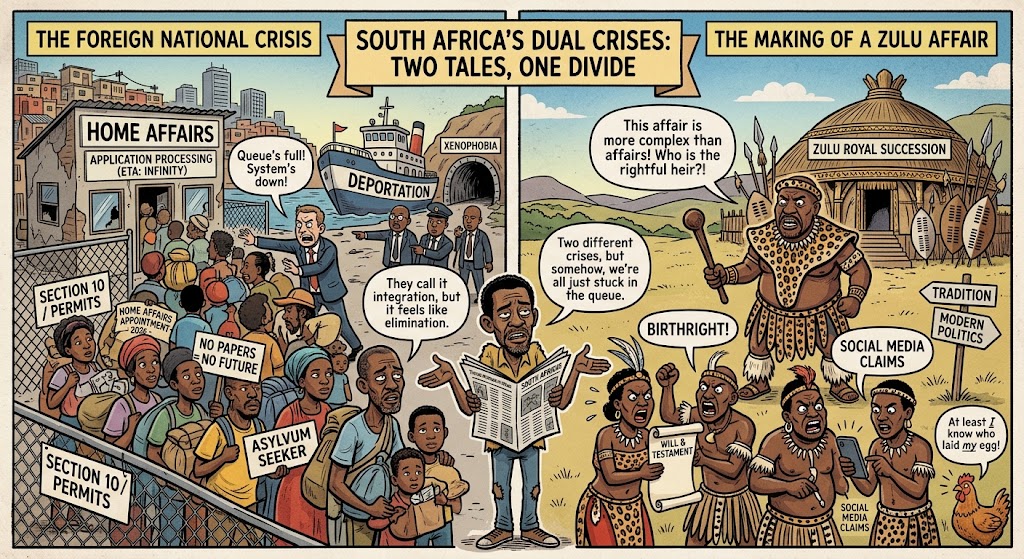

Every time anti-foreigner violence flares in South Africa, the same question follows: whose anger is this? This week, with vehicles burning in Durban and a Somali-owned shop looted in Soweto, some voices have called it a Zulu grievance and others a KwaZulu-Natal problem. The first claim fails on the evidence. The second is half right, and the half that is right deserves a closer look.
The case for KwaZulu-Natal is real. March and March, the group at the front of the 2026 campaign, was formed in Durban. It began by checking identity documents at public clinics in the province before taking its 30 June deadline for undocumented migrants to the rest of the country. The 2015 attacks also started in Durban, after remarks attributed to King Goodwill Zwelithini that foreigners should leave, though he later called the violence vile. July 2021 adds a third data point. Jacob Zuma’s imprisonment set off unrest in KwaZulu-Natal that spread to Gauteng, with shops looted and dozens dead within days.
It began by checking identity documents at public clinics in the province before taking its 30 June deadline for undocumented migrants to the rest of the country.
Those three episodes should not be treated as one story. The 2021 unrest was not an anti-immigrant uprising. It was triggered by a jailed former president, and the looting was indiscriminate, fed by poverty, political anger and plain opportunism. What it shares with the 2026 marches is a pattern rather than an ethnicity: a province with deep joblessness, a charged political culture and organisers who can turn a grievance into a crowd within days. That is my reading of the record, but it explains more than a label that points at one people.
The geography argues against a provincial reading as well. Operation Dudula began in Johannesburg, and March and March has since marched in Tshwane and Johannesburg with its backing. Deaths have been recorded in Mossel Bay in the Western Cape, and protests have reached the Free State. This week’s violence broke out in Soweto and Durban on the same day. Even the 2008 attacks, the worst before 2015, began in Alexandra township in Johannesburg. KwaZulu-Natal has seen the largest displacement, particularly of Malawians, but it is one centre among several.
KwaZulu-Natal has seen the largest displacement of foreign nationals in South Africa
Attitudes are national too. The Inclusive Society Institute’s survey found that distrust of African immigrants rose from 62.6% in 2021 to 73.1% in 2025. Those numbers cannot come from one province or one language group.
A Zulu grievance would, by definition, carry a Zulu demand: land, representation, recognition, something that belongs to that community. No such demand has surfaced. The slogan is “Mabahambe”, isiZulu for “they must go”, but a language of mobilisation is not an ethnic claim, and isiZulu is spoken across the townships of Gauteng as well. The demands are for “South Africans” to be put first and for foreigners, overwhelmingly black African and South Asian ones, to be deported.
The movement says it targets illegal immigration. Yet those driven out have included long-term residents with papers, which is why rights groups call it xenophobic.
The Zulu label is tempting because the symbols line up: a king’s alleged words, an isiZulu slogan, a Durban base. It is also harmful for two reasons. First, it is bad analysis. It hides the political economy behind the marches. Local government elections fall between November 2026 and January 2027, ActionSA is campaigning largely on immigration, and analysts quoted by Daily Maverick argue that anti-foreigner rhetoric grows where parties offer no concrete plans on jobs, water and electricity. Second, it does what xenophobia does, which is to assign collective blame. Pinning a national failing on one group of South Africans lets everyone else off.
The marchers’ claims also deserve checking, because several fall apart. Migrant children are not being prioritised for school places, since the Constitution guarantees education regardless of nationality. Foreigners are entitled to public health services, and a court has ordered Operation Dudula to stop blocking them from clinics. The government’s own admission that asylum offices are overwhelmed points to a real administrative failure. That failure belongs to the state, and no shopkeeper is responsible for it.
So the answer is neither. This is a national grievance with a KwaZulu-Natal launchpad, a pre-election incentive and a state that has not delivered. The province may keep supplying the match, but the dry grass is everywhere. Asking “whose anger is this?” will keep getting the wrong answer. The better questions are what the anger is for, and who gains when it is aimed at foreigners, who are actually the scapegoats.

The writer, Dr. Aba Appiah is a Ghanaian academic, researcher, and lecturer in her mid-20s with a professional focus on media and communication. Her career spans journalism and communication consultancy. As an accomplished author and researcher, she contributes to academic discourse through peer-reviewed studies and published works.