

MP Khwezi Ka Ceza is Gqeberha-based independent political commentator, community leader and a social activist.
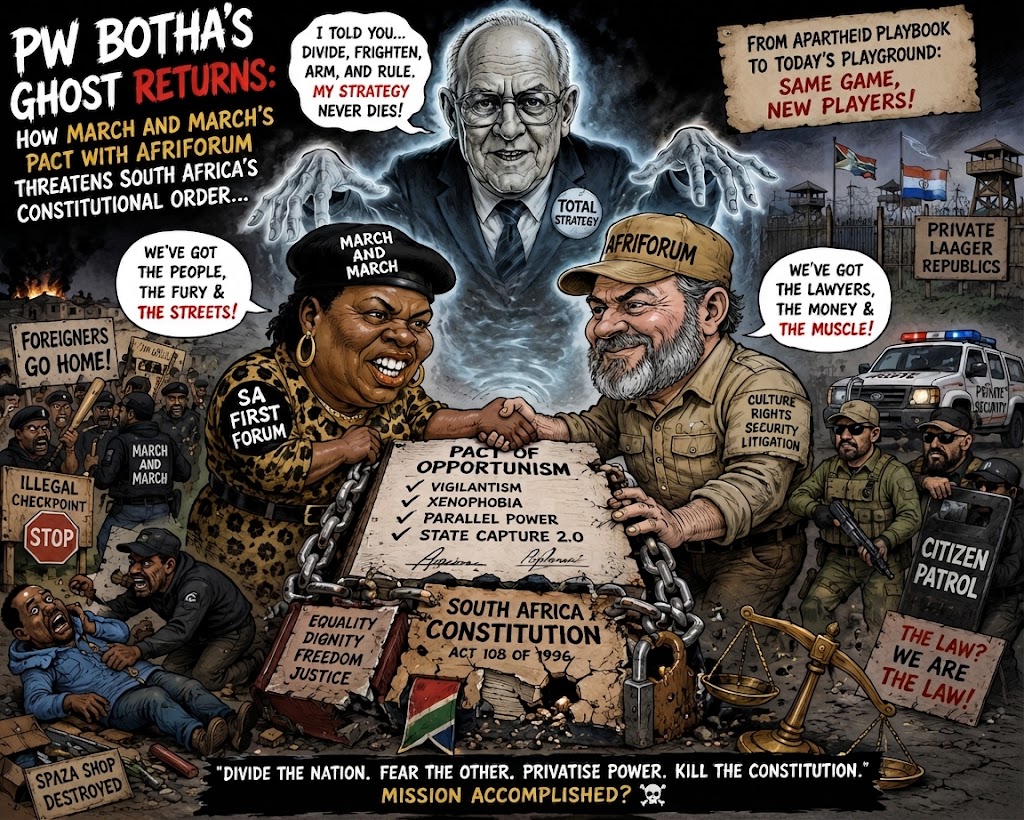
South Africa’s patronage network has produced plenty of strange bedfellows. Yet the political romance between Jacinta Ngobese-Zuma’s March and March movement and Kallie Kriel’s AfriForum takes the trophy for high-stakes opportunism.
On paper, this marriage of convenience looks like a clerical error. On one side stands March and March, a KwaZulu-Natal outfit built on xenophobic bluster, street intimidation, and township nativism. On the other stands AfriForum, the deep-pocketed, litigious bastion of Afrikaner self-reliance, private security, and cultural isolationism.
AfriForum, the deep-pocketed, litigious bastion of Afrikaner self-reliance, private security, and cultural isolationism.
As Ngobese-Zuma and Kriel formalize a joint working group, the historical echoes are deafening. The alignment mirrors the transition-era pact between Mangosuthu Buthelezi’s Inkatha Freedom Party (IFP) and the National Party (NP). Back then, the NP exploited conservative traditionalism in KZN to fracture liberation unity. The IFP, meanwhile, used state mechanics to carve out regional power. Critics dubbed these covert ties the “Third Force”. It was a transactional deal disguised as law, order, and traditional autonomy.
The Truth and Reconciliation Commission (TRC) meticulously documented the cost of that alliance. Far from securing peace, the deal weaponized regional enclaves and triggered bloodbaths like the 1990 Seven Day War in the Edendale Valley. That episode alone claimed over 100 lives, burned 3,000 homes, and displaced 30,000 residents.
That episode alone claimed over 100 lives, burned 3,000 homes, and displaced 30,000 residents.
TRC records show the IFP committed nearly 50% of all reported regional human rights violations between 1990 and May 1994, racking up roughly 9,000 gross abuses with state security backing. Data from the South African Institute of Race Relations recorded over 3,000 political deaths in 1990 alone. It remains a stark example of how state-backed alliances shatter the social fabric.
This dynamic grew out of PW Botha’s “Total Strategy.” Botha insisted a unified, non-racial South Africa was a delusion. He believed the country was a patchwork of incompatible ethnic factions destined to govern themselves in isolated enclaves or devolve into anarchy. By weaponizing regionalism against national unity, the National Party sought to prove its core thesis. It was that stability exists only when populations retreat into security laagers under local strongmen.
This dynamic grew out of PW Botha’s “Total Strategy.
Decades later, the strategic logic remains unchanged. Politicians age, but bad ideas simply get better PR.
To answer the classic political question—cui bono? follow the mutual convenience. For AfriForum, partnering with a Black-led nativist movement offers the ultimate ideological shield against accusations of white-minority isolationism. It rebrands Kriel’s model as a universal blueprint for self-reliance. For March and March, Ngobese-Zuma gets instant access to a legal war chest, institutional frameworks, and private security expertise through her newly announced SA First Forum. Why build institutional capacity over decades when you can franchise it from Pretoria?
The real cost of this political theatre is written in human collateral and statutory crime. Behind the rhetoric of citizen defence lies documented violence and explicit overreach.
Under the South African Immigration Act, inspecting identification and verifying status is strictly reserved for authorized police and Home Affairs officers. When vigilante mobs stop people on public roads, establish arbitrary checkpoints, or raid foreign traders, they cross directly into criminal conduct.
When vigilante mobs stop people on public roads, they cross directly into criminal conduct.
By falsely assuming state authority, wearing tactical
gear, and mounting unauthorized blockades, these activists commit the criminal offense of impersonating a law enforcement officer under Section 68 of the SAPS Act. They also commit severe constitutional violations against Chapter 2 guarantees of equality (Section 9), privacy against arbitrary searches (Section 14), and personal security (Section 12).
Enforcing arbitrary deadlines through physical force constitutes extortion and intimidation. Restraining foreign nationals or delivery drivers on public streets exposes organizers to charges of unlawful detention and assault. Organizing mobs to shut down township spaza shops involves theft and malicious damage to property. When leadership incites crowds to conduct these sweeps, the acts spiral into public violence. Unsurprisingly, law enforcement eventually opened criminal dockets against Ngobese-Zuma herself.
Starting as a clinic-gatekeeping campaign in KZN, March and March volunteers forcibly stationed themselves outside facilities like Addington Hospital and R.K. Khan Hospital. They demanded local ID to deny non-citizens healthcare. During these blockades, activists physically shoved and threatened 77-year-old Crispin Hemson at hospital gates. Pickets outside Addington Primary School disrupted education and forced police deployments, while targeted spaza shop raids gutted township livelihoods.
March and March volunteers forcibly stationed themselves outside facilities like Addington Hospita
In response, immigrant communities across Gauteng, the Western Cape, and KZN have abandoned passive endurance. In high-density trading hubs, migrant networks have organized private security patrols, established emergency defence coalitions, and armed themselves to repulse raids.
Foreign governments have stepped in where local law enforcement failed. Nigeria, Ghana, Malawi, and Mozambique issued diplomatic warnings, with some launching state-sponsored emergency evacuations that airlifted thousands of citizens home. Diplomatic channels are fraying as African Union partners threaten trade sanctions and legal recourse, proving how domestic vigilantism creates geopolitical fractures.
There is rich irony in a movement that preaches strict sovereignty bypassing traditional African governance. Instead of seeking counsel from the Zulu Royal Household or consulting traditional leaders on land and safety, Ngobese-Zuma’s first instinct was to travel straight to the Afrikaner right wing for operational orders.
Despite pitching itself as a national champion, March and March remains an elite KZN affair. Its leadership, hubs, and rhetoric are heavily concentrated in the province, lacking organic representation in the broader hinterland. What is framed as a national movement for border control looks far more like a regional vehicle seeking national relevance through high-profile legal stunts.
This is where the alliance performs its most dangerous trick. It quietly vindicates PW Botha.
On August 15, 1985, standing before the Natal Congress of the National Party in Durban, Botha delivered his disastrous “Rubicon” speech. Dismissing a unitary democracy, Botha barked that “the liberation of people cannot be achieved by forcing different communities into an artificial unit.” He warned that abandoning separate development would trigger ethnic warfare, economic collapse, and total anarchy.
When a township-based movement bypasses the constitutional state to learn “self-reliance” from an Afrikaner civil rights group, it surrenders to Botha’s core premise. Botha insisted a multi-racial democracy could never guarantee order, advocating instead for self-policing ethnic fiefdoms. When he bellowed that “we will not be forced into a system of one-man-one-vote in a unitary state,” he bet that a shared South African nationhood would buckle under tribal anxiety.
By trading national solidarity for parallel, privatized cartels, Ngobese-Zuma and Kriel are fulfilling Botha’s prophecy. They are declaring that the central state is dead, the constitutional promise is a myth, and South Africans must retreat into private laagers behind high walls to hire their own enforcers.
Ngobese-Zuma and Kriel are fulfilling Botha’s prophecy.
Transactional pacts like the March and March and AfriForum alliance do not fix state failure. They simply commercialize it. It is the ultimate symptom of a broken landscape where national unity is discarded so regional actors can build private fiefdoms. Thirty-two years after the democratic breakthrough, as public institutions crumble and neighbours turn on each other behind private security fences, PW Botha must be smiling in his grave.
MP Khwezi ka Ceza is a Gqeberha-based independent political commentator and social activist