
The writer, Dr. Tiema Haji is an academic, researcher, author, journalist, communication specialist and an accomplished poet.
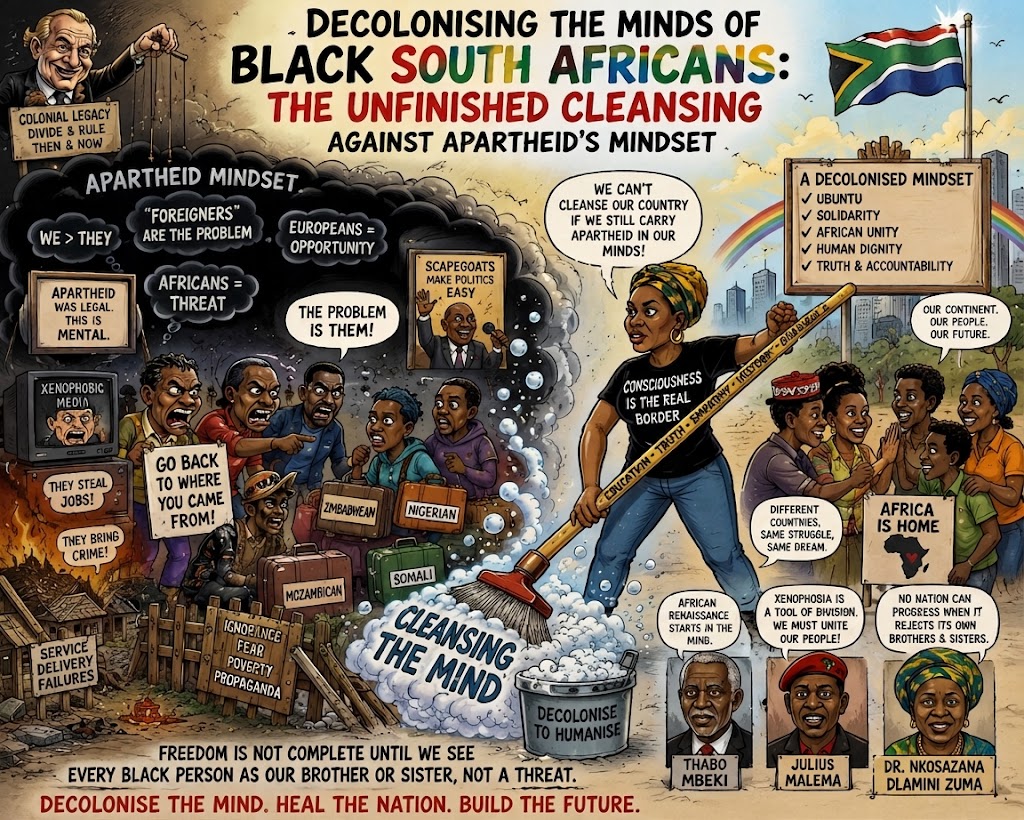
South Africa has spent more than three decades dismantling apartheid’s political architecture, yet one of apartheid’s most damaging legacies remains stubbornly alive: the psychological separation of Black people into categories of who supposedly belongs and who does not.
This contradiction is increasingly visible in South Africa’s treatment of Black Africans from other countries. A Black Zimbabwean, Mozambican, Malawian, Nigerian, Somali or Ethiopian can arrive in South Africa and discover that the colour of their skin does not necessarily translate into solidarity. Instead, nationality becomes a basis for suspicion, hostility and exclusion. The contradiction becomes even more uncomfortable when some of the same South Africans who express hostility towards other Africans appear considerably more welcoming towards Europeans.
A decolonised South Africa should not merely be a country governed by Black people
This is not merely xenophobia. It deserves a deeper interrogation as a post-apartheid identity problem rooted partly in the psychological consequences of colonialism and apartheid.
The apartheid mindset did not disappear in 1994
Apartheid did more than separate people geographically. It constructed racial and ethnic hierarchies and taught Black South Africans that their identity was fundamentally different from that of other Africans.
The apartheid state deliberately promoted ethnic divisions among Black people through policies of ethnic classification, homeland administration and political fragmentation. The objective was partly to prevent a unified Black political identity from threatening white minority rule.
Democracy dismantled the legal structure of that system. It did not automatically dismantle every idea embedded within it.
Consequently, some South Africans continue to perceive the African migrant as an outsider competing for employment, housing, business opportunities and public resources. The irony is profound: the person being treated as an outsider may come from a country whose people supported South Africa’s liberation struggle, sheltered exiles and paid substantial political and economic costs for opposing apartheid.
APARTHEID taught Black South Africans that their identity was fundamentally different from that of other Africans.
Why are Black foreigners targeted more visibly?
The pattern is difficult to ignore. Xenophobic violence and political rhetoric have frequently focused on migrants from elsewhere in Africa. Nigerians, Zimbabweans, Mozambicans, Malawians, Somalis and other African nationals have repeatedly been portrayed as criminals, job stealers or burdens on the state.
Yet the language of “foreigners” becomes considerably more complicated when the foreigner is European.
This exposes a deeply uncomfortable question: is South African xenophobia sometimes racialised?
A European expatriate may be described as an investor, professional, tourist or entrepreneur. A Black African migrant performing similar economic activity can be labelled an illegal immigrant or accused of taking opportunities from South Africans.
That distinction cannot be explained entirely by economics.
It points towards the persistence of colonial ideas about whose presence is valuable, respectable or desirable.
The uncomfortable process of decolonising Black South Africans
Decolonisation cannot simply mean removing statues, changing university curricula or renaming streets. It must also involve confronting internalised ideas about Blackness.
A genuinely decolonised consciousness should recognise a Zimbabwean, Malawian, Nigerian, Congolese or Mozambican as an African human being first, rather than reducing that person to nationality, immigration status or economic competition.
South Africa cannot demand African solidarity from the continent while simultaneously treating other Africans as disposable outsiders.
There is also a historical amnesia at work. South Africa’s liberation was never an exclusively South African achievement. The struggle against apartheid received enormous support from African states and societies. To welcome Europeans while despising Africans whose countries supported the liberation struggle represents a serious distortion of that history.
But migrants did not create South Africa’s structural unemployment or decades of institutional inequality.
Who benefits from the division?
The persistence of xenophobia also raises a political question: who benefits when poor and working-class Africans fight one another?
Unemployment, inadequate housing, poverty, failing municipal services and inequality are real problems. But migrants did not create South Africa’s structural unemployment or decades of institutional inequality.
Blaming migrants can therefore become a convenient political diversion.
A Zimbabwean street trader and an unemployed South African may compete for economic survival, but neither controls the country’s labour-market structure, immigration policy or distribution of wealth.
Political leaders who allow migrants to become convenient scapegoats avoid confronting the more difficult structural questions.
President Thabo Mbeki has repeatedly spoken about African identity and the dangers of continental fragmentation
Governmental laxity has consequences
South Africa’s government has repeatedly condemned xenophobic violence, yet condemnation alone has proved inadequate.
The state has a responsibility to enforce immigration law while simultaneously protecting the constitutional rights and physical safety of migrants. Illegal immigration should be addressed through lawful administrative mechanisms, not mob justice, political intimidation or collective punishment.
When perpetrators of xenophobic violence believe that consequences are unlikely, violence becomes normalised.
What is particularly troubling is the relative scarcity of sustained political leadership willing to confront Afrophobia directly. There have been important exceptions. Former President Thabo Mbeki has repeatedly spoken about African identity and the dangers of continental fragmentation. Julius Malema has also challenged xenophobic attitudes, while Dr Nkosazana Dlamini Zuma has publicly spoken against hostility towards fellow Africans.
But isolated statements from individual leaders cannot substitute for a coherent national programme.
The real battle is psychological
South Africa does not need another constitutional amendment to solve this problem. It needs a serious national conversation about identity.
The Cpountry needs a serious national conversation about identity.
Schools should teach the interconnected history of African liberation. Political parties should stop using migrants as convenient political targets. The media should challenge stereotypes rather than reproduce them. Government should distinguish immigration enforcement from collective hostility. Civil society should document xenophobic incidents and hold perpetrators accountable.
Most importantly, Black South Africans must confront an uncomfortable question: what does freedom mean if apartheid’s racial and exclusionary assumptions survive inside the minds of the formerly oppressed?
South Africa cannot claim to have fully decolonised while a Black African is considered less desirable because he comes from Zimbabwe, Nigeria or Malawi, while European foreignness is treated as sophistication, investment or opportunity.
The unfinished task of liberation is therefore not simply to remove apartheid’s laws. It is to remove its hierarchies from consciousness.
A decolonised South Africa should not merely be a country governed by Black people. It should be a society in which Blackness itself is no longer internally divided into categories of who is worthy of belonging.