
The writer, Dr. Tiema Haji is an academic, researcher, author, journalist, communication specialist and an accomplished poet.
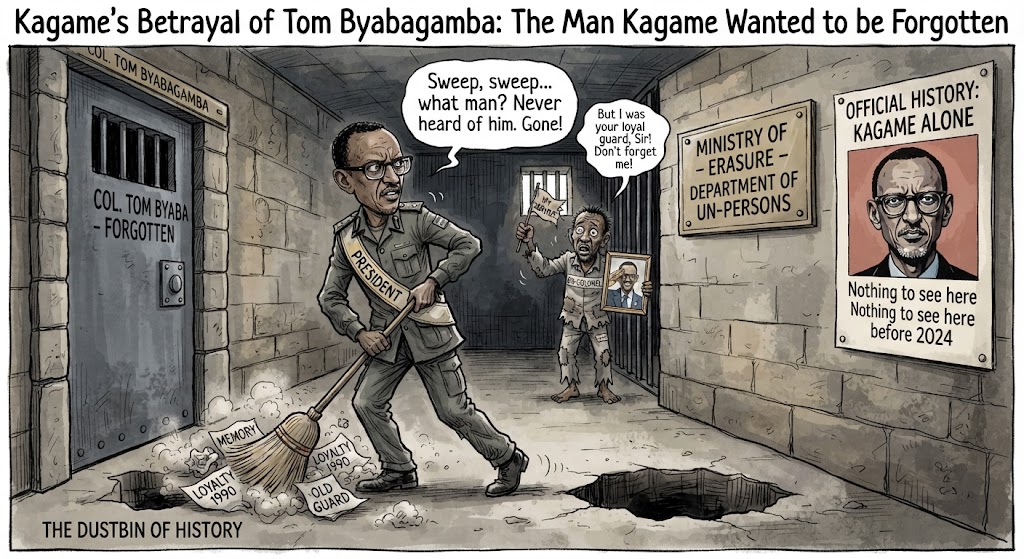
Tom Byabagamba stood between Paul Kagame and every bullet that might have been meant for him.
For twenty years, Tom Byabagamba stood between Paul Kagame and every bullet that might have been meant for him. He was Kagame’s personal protection officer from 1990, through the war that ended the genocide and the decade that followed, and he eventually rose to command the Republican Guard, the unit charged with the president’s life. Then, in August 2014, the state he had guarded turned on him. He spent almost twelve years in a Rwandan cell and died there, his family announced on 25 August 2026, without so much as an official cause of death from the government he once shielded with his body (ChimpReports, 2026).
There is something almost biblical about it, the man who carries the king’s sword ending up executed, slowly, by the king’s silence. But there is nothing mythical about how it happened. Byabagamba’s crime, according to the Kanombe Military High Court, was talking. He and his brother-in-law, retired Brigadier General Frank Rusagara, had made remarks to fellow officers that Rwanda was, in Byabagamba’s own reported phrase, “not well governed” (Freedom Now, n.d.). For that, in March 2016, he was convicted of inciting insurrection and tarnishing the government’s image and sentenced to twenty-one years (Human Rights Watch, 2016). An appeal in 2019 trimmed the sentence to fifteen, while upholding the conviction and stripping him of his rank (Human Rights Watch, 2020). He never came home.
he was convicted of inciting insurrection and tarnishing the government’s image and sentenced to twenty-one years
What makes this death land differently from the dozens of political prosecutions Rwanda has produced since 1994 is precisely who Byabagamba was. He was not an opposition figure who had spent a career antagonising the Rwandan Patriotic Front. He was the Front. He fought in its liberation war, guarded its president with his own body for two decades, and was, by every conventional measure, one of the system’s own. Filip Reyntjens’s landmark study of governance in post-genocide Rwanda argued that the RPF’s consolidation of power depended on treating any deviation from the party line, including from within its own ranks, as an existential threat to be neutralised rather than a disagreement to be managed (Reyntjens, 2013). Byabagamba’s case is that argument made flesh. Loyalty bought no exemption. If anything, his proximity to power seems to have made his private doubts more dangerous, not less.
The United Nations Working Group on Arbitrary Detention reached a similar conclusion in 2017, finding that Byabagamba, Rusagara, and their co-defendant had been prosecuted for nothing more than the peaceful exercise of free expression, and that their trial had denied them a fair hearing, among other things, they were permitted to cross-examine only a handful of the witnesses testifying against them (UN Working Group on Arbitrary Detention, cited in Human Rights Watch, 2020). Kigali rejected the finding outright. Byabagamba stayed in prison for nine more years.
He was the Front. He fought in its liberation war, guarded its president with his own body for two decades,
He was not even the first of the pair to die there. Rusagara, seventy years old and ailing, passed away in custody in March 2025 (Nilepost, 2025), prompting Human Rights Watch to publish a piece bluntly titled “The Lonely Death of a Rwandan General,” which noted that the M23 rebellion Rusagara had merely discussed over dinner a decade earlier was, by 2025, being armed and directed by the very state that imprisoned him for talking about it (Human Rights Watch, 2025). Rwanda’s most recent Human Rights Watch country assessment describes a 2025 in which opposition figures such as Victoire Ingabire were still being arrested and few civil society voices dared speak against the government or its war in eastern Congo (Human Rights Watch, 2026). Byabagamba’s death simply adds a name that should embarrass Kigali more than most, because it cannot be dismissed as the complaint of an outsider.
He was not even the first of the pair to die there. Rusagara, seventy years old and ailing, passed away in custody in March 2025
This is the part of the Rwanda story that the country’s admirers, and there are many, drawn in by clean streets, digital ambition, and a genuinely rebuilt state, tend to skip past. A government can deliver roads, hospitals, and an efficient bureaucracy while still treating the private conversations of its own soldiers as capital offences. Those two facts are not in tension in Kigali; they are the same governing method. Human Rights Watch’s own research on Rwanda’s reach into diaspora communities describes a state that polices criticism wherever it finds it, at home or thousands of kilometres away (Human Rights Watch, 2023, 2024). A man who never left the country, and who had spent his career at the president’s shoulder, had nowhere further to retreat to.
Byabagamba’s family has asked only for peace for him now. Rwanda’s government owes them, at minimum, an honest account of how a sixty-year-old man who once stood guard over the presidency came to die anonymously behind its walls. Whether that account will ever come is, going by the last twelve years, not a question worth holding one’s breath over.