

MP Khwezi Ka Ceza is Gqeberha-based independent political commentator, community leader and a social activist.
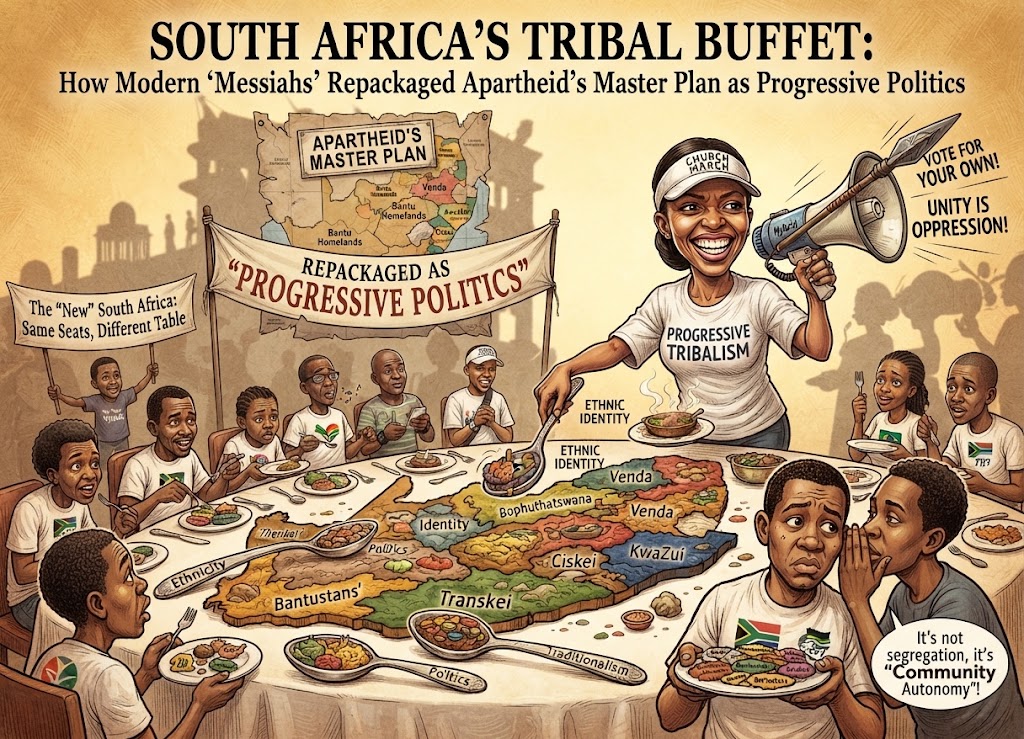
The long-promised, shiny, hyper-pigmented “Rainbow Nation” is looking less like a miraculous post-apartheid rainbow. It has become more like an oil spill on the N1. Slick, toxic and dangerously flammable. Thirty-two years into this constitutional experiment, our political landscape is no longer defined by the sweeping narratives of non-racial liberation. Instead, we are treated to the spectacle of political opportunists, cult leaders, and fringe demagogues offering us the ultimate bargain. A return to the Bantustans, rebranded as radical cultural self-determination.
Instead, we are treated to the spectacle of political opportunists, cult leaders,
Take the latest political farce from the March and March movement. Its leader, Jacinta Ngobese-Zuma, casually floated reorganising higher education along strict ethnic lines, envisioning compartmentalised universities for Zulu, Xhosa, and whatever other identities can be carved up for administrative convenience. The public reaction was swift, the backlash predictably visceral and the inevitable backpedalling arrived right on schedule. It was, we were assured, a nuance lost in translation.
Except there was no misunderstanding.
This was a deliberate provocation deployed by an ethno-populist machinery. It feeds directly on grievance, eroding national coherence by design.
Tactical flirting between such black ethno-nationalist voices and right-wing Afrikaner identity groups like AfriForum.
What makes this ideological circus surreal is the tactical flirting between such black ethno-nationalist voices and right-wing Afrikaner identity groups like AfriForum. On the surface, they sit at opposite ends of our national screaming match. One claims to champion the dispossessed African majority. The other masquerade as defenders of the cultural and economic redoubts of minority enclave politics. Yet, stripped of their dramatic posturing, they are twin souls. They share the exact same underlying premise. That premise is that multicultural integration is a lie, non-racialism is a failed liberal fairy tale. According to them, the only way forward is to retreat into fortified intellectual and geographical enclaves.
It is the horseshoe theory of South African politics in full, absurd action. The right-wing populist and the ethno-nationalist conservative lock hands across the aisle to declare in unison:
We simply cannot live together.
Steve Biko must be spinning in his grave at terminal velocity. When Biko wrote so fiercely about the psychology of oppression, he was not merely diagnosing white supremacy. He was warning against the internalization of colonial logic. Black Consciousness was an uncompromising rejection of the artificial divisions imposed by an apartheid state that used tribal compartmentalization as an instrument of the Verwoedian divide and rule. The apartheid regime understood intimately that as long as the Black majority viewed themselves primarily through the narrow lens of Zulu, Xhosa, Sotho, or Venda identity, they could never mount a unified challenge to the status quo.
When Biko wrote so fiercely about the psychology of oppression, he was not merely diagnosing white supremacy.
Fast forward to the present day. Self-proclaimed radicals, resurrected as modern cult leaders, are peddling the very same divide-and-rule logic under the guise of cultural preservation. They have internalized the colonial blueprint so thoroughly that they now present the architect’s original master plan as a blueprint for liberation. Reorganising tertiary institutions by tribe is not radical self-determination. It is intellectual surrender. It is a naked endorsement of the premise that the black majority is fundamentally incapable of sharing intellectual spaces, navigating linguistic diversity or building complex, multi-ethnic institutions.
This brings us to the uncomfortable question that polite political society prefers to avoid over dinner in the suburbs. Is the Rainbow Nation dead, or was it merely an indispensable lie we told ourselves in 1994 to prevent a bloodbath?
There is no denying that the rainbow ideal has been cheapened
There is no denying that the rainbow ideal has been cheapened. For millions living in the grinding squalor of informal settlements, facing chronic power cuts, systemic corruption, and an economy that refuses to grow, the rhetoric of reconciliation rings hollow. The rainbow was sold as a transformation package, but for many, it delivered only symbolic unity while structural economic power remained untouched. The fatigue is real. The cynicism is justified and the disillusionment is deeply earned.
However, the solution to a broken house is not to set fire to the foundation and move back into the colonial stables. The fringe demagogues pushing for ethnic separation are not offering a genuine alternative to the failures of the post-apartheid state. They are offering warlordism. A race to the bottom where state resources, educational opportunities and political power are carved up by tribal barons competing over an ever-shrinking pie.
When national identity collapses, it is never replaced by peaceful, tidy ethnic enclaves living in utopian isolation. It is replaced by tribal chauvinism, xenophobia, and violent resource competition. We do not need to guess how this story ends. We need only look at the blood-soaked history of our own continent to know that tribalizing state institutions guarantees systemic collapse.
When national identity collapses, it is never replaced by peaceful, tidy ethnic enclaves
The tragic comedy of modern South African politics is that our self-appointed ‘messiahs’ have run completely out of economic and social ideas. Having failed to deliver functional governance, clean municipalities or robust growth, they turn to the oldest trick in the populist playbook. Identity politics. If you cannot build a world-class university, you declare current institutions culturally oppressive and propose building a tribal one instead. If you cannot fix the national economy, you blame another ethnic group or foreign national for taking up space.
Non-racialism and national unity were never meant to be sweet-sounding slogans for tourism brochures. They were pragmatic necessities designed to keep a complex, multi-ethnic society from tearing itself to pieces.
Non-racialism and national unity were never meant to be sweet-sounding slogans
The next time a political cult leader tries to sell you ethnic compartmentalization wrapped in the language of radical identity, recognise it for what it truly is. It isn’t liberation. It isn’t transformation and it certainly isn’t radical. It is just old apartheid wine poured into new, populist bottles, served up by leaders who are far too bankrupt to offer anything else.
MP Khwezi ka Ceza is a Gqeberha–based independent political commentator and social activist.