

The writer, Dr. Tiema Haji is an academic, researcher, author, journalist, communication specialist and an accomplished poet.
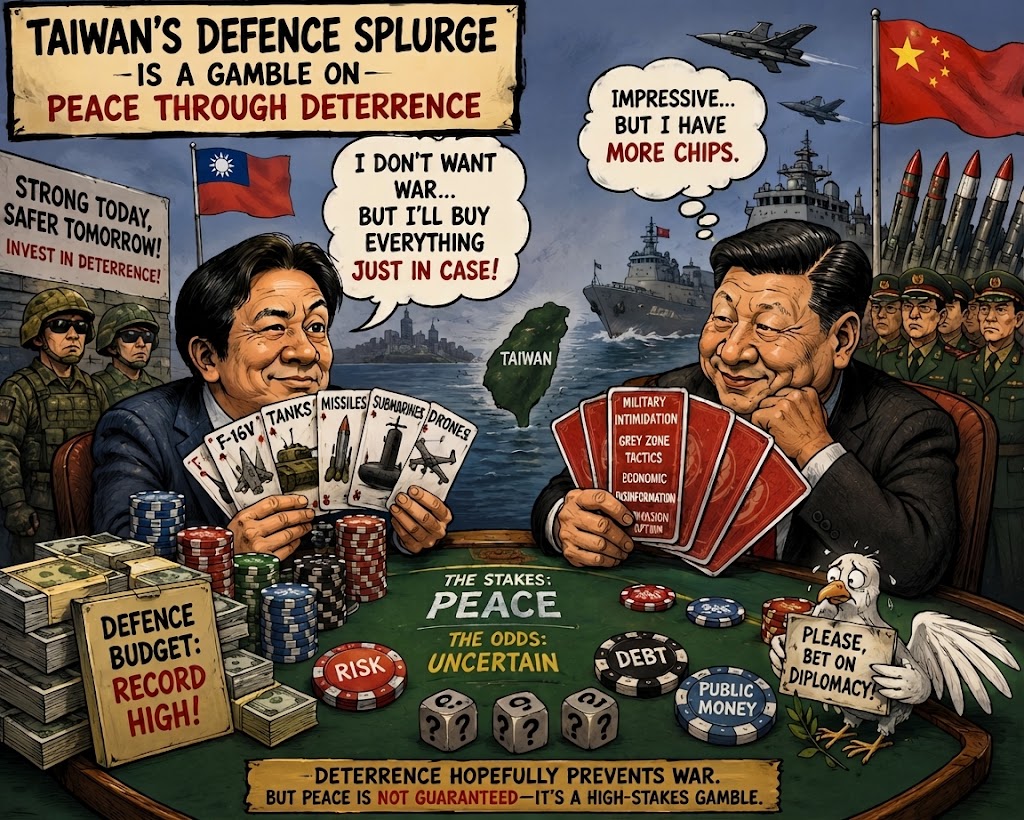
Taiwan is about to spend more on its military than at any point in its history. President Lai Ching-te has confirmed that Taipei’s 2027 defence budget will top NT$1.1225 trillion, around $35 billion, the first time it has crossed the trillion-dollar mark, pushing spending past 3% of GDP. It’s a 16% jump on this year, and one step on a longer march: Taipei has committed to reaching 5% of GDP by 2030, a level matching NATO’s most hawkish members.
“investing in national defence is investing in peace”
On paper, this looks like prudence. China flies warplanes and sails ships around Taiwan almost daily, and Beijing has never renounced force as a means of bringing the island under its control. Lai’s framing, “investing in national defence is investing in peace”, echoes a well-worn logic: make invasion costly enough, and you deter it. But the scale, speed, and politics of this increase deserve more scrutiny than that slogan allows.
Start with where the pressure is coming from. Much of this budget isn’t purely a Taiwanese calculation about its own threat environment — it’s also a response to Washington. The Trump administration has pushed Taipei to spend as much as 10% of GDP on defence, well beyond what the US itself or any treaty ally spends. Taiwan’s 5%-by-2030 target reads as a compromise between what Washington wants and what Taipei’s fractured legislature will tolerate. That matters: it means the pace of rearmament is being set as much by an alliance relationship as by an independent assessment of actual military need. When defence policy becomes a function of pleasing a patron, spending risks being optimised for signalling rather than deterrence.
Taiwan’s opposition-controlled legislature has not rubber-stamped Lai’s ambitions
Then there’s the money itself. $35 billion is a serious sum for an economy of Taiwan’s size, arriving alongside a separate $40 billion arms package running to 2033, most of it earmarked for American hardware , including an ambitious “Taiwan Dome” air-defence shield. This is one of the fastest peacetime defence build-ups in the democratic world. Supporters will say that’s the point: deterrence works only if credible, and half-measures invite the aggression they’re meant to prevent. Sceptics will note that fast-moving arms budgets are notoriously vulnerable to waste and procurement delays, problems that plague far richer defence establishments than Taiwan’s.
The domestic politics are just as revealing. Taiwan’s opposition-controlled legislature has not rubber-stamped Lai’s ambitions. It took eight months — a record delay, to pass this year’s general budget, and the Kuomintang-led opposition already gutted a third of a $25 billion special defence package, stripping out funding for domestic drone production. This isn’t obstruction for its own sake; it reflects a genuine, unresolved argument within Taiwanese society about how much confrontation with Beijing to court, and how much of its prosperity to redirect from housing, wages, and social spending into missiles and radar systems. A democracy arguing loudly over its defense budget is, in one sense, healthy, it means civilian control is real. But it also means the rearmament could stall exactly when consistency matters most.
American security umbrella can no longer be assumed to hold at its old terms.
The wider implication is regional, not just insular. Taiwan is not spending in isolation. Japan, South Korea, and much of Europe are simultaneously raising military budgets, partly in response to the same signal: that the American security umbrella can no longer be assumed to hold at its old terms. Taiwan’s build-up will be read in Beijing as confirmation of encirclement, in Washington as proof its pressure campaign is working, and across the Indo-Pacific as one more data point in a regional arms spiral that nobody has fully priced into their planning.
An underprepared Taiwan is a more dangerous Taiwan, for itself and the region.
None of this means Taiwan is wrong to rearm. An underprepared Taiwan is a more dangerous Taiwan, for itself and the region. But “investment in peace” is a shortcut that skips the harder questions: whether this spending is calibrated to Taiwan’s real defence needs or to Washington’s demands, whether the money will be spent well or squandered, and whether a democracy this divided over the bill can sustain the decade-long commitment deterrence requires. Big budgets buy hardware. They don’t automatically buy the political consensus, or the strategic patience, that makes deterrence credible in the first place.