
MP Khwezi Ka Ceza is Gqeberha-based independent political commentator, community leader and a social activist.
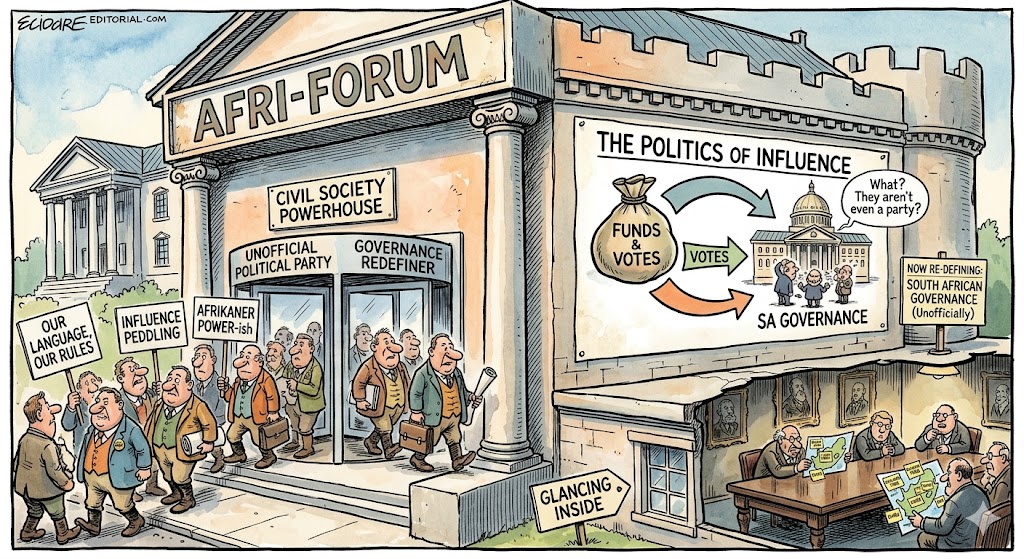
In contemporary South African politics, few organizations command as much polarizing influence as AfriForum. Officially registered as a Non-Government Organization (NGO), this civil rights group has effectively blurred the lines between civil society, corporate enterprise and a parallel state. To understand South Africa’s changing landscape, one must look past its legal status and critically analyze how AfriForum wields power outside the ballot box. Unlike traditional political parties that compete for legislative control, AfriForum operates on a philosophy of “state-proof” self reliance (ons sal self). This strategy recognizes the systemic decline of local municipalities and positions the organization as an alternative service provider. By repairing roads, securing neighborhoods through multiple independent watch networks and managing water infrastructure, AfriForum does not just protest state failure – it steps into the vacuum. This tactical shift from traditional civil rights lobbying to civic governance wkns deep loyalty from its approximate 300 000 strong paying membership. It provides tangible results that state institutions often fail to deliver.
AfriForum does not just protest state failure – it steps into the vacuum
AfriForum’s true strength lies within the broader Solidarity Movement. This ecosystem acts as a complete, self-sustaining parallel society for its constituency – with finance and labor anchored by the Solidarity trade union. Akademia (a private higher education institution) and Sol-Tech (a vocational college) support their education system, while cultural and media propaganda are driven AfriForumTV and the AfriForum Theatre. This network shields the organization from electoral volatility. While political parties must constantly adjust platforms to win shifting voter demographics, AfriForum relies on a stable subscription-funded business model. This funding guarantees long-term sustainability and allows the group to execute multi-year legal strategies without any political compromise.
Through its dedicated Private Prosecution Unit, led by Advocate Gerrie Nel, AfriForum uses the judiciary as its primary political battleground. Given the fact that minority groups hold limited voting power in South Africa’s proportional representation system, legislative routes are often dead ends, AfriForum remedies this imbalance by utilizing the courts to strike down laws, thereby effectively shaping national policy from the judicial bench. AfriForum’s political impact splits along deep ideological lines. Proponents argue that AfriForum represents a necessary evolution in democratic checks and balances. They are of the view that in a dominant-party or unstable coalition system, strong extra-parliamentary bodies prevent the abuse of state power and safeguard constitutional minority rights. On the other hand, critics argue that AfriForum’s focus on minority interests promotes a form of “balkanization” or voluntary segregation.
Proponents argue that AfriForum represents a necessary evolution in democratic checks and balances.
By pulling private resources out of public systems and into exclusive enclaves, the group risks widening historic racial divides and weakening the collective social fabric needed for national nation-building. As South Africa moves deeper into an era of fragmented coalition politics, the traditional weight of the state continues to decentralize. AfriForum’s model demonstrates that holding political office is no longer a sole requirement for exercising political power. By combining corporate efficiency, legal expertise and community mobilization, the organization has successfully built a parallel centre of gravity. It remains one of the most sophisticated, well-funded and influential players in South African public life today.
Through its US lobbying nexus, AfriForum has managed to transnationalize the South African ethnic politics, bypassing standard diplomatic channels to engage directly with the Trump administration in the United States. They have successfully elevated Afrikaner minority politics from a domestic grievance into a matter of US foreign policy leverage. This critical analysis evaluates AfriForum’s actions through the lens of examining the subsequent geopolitical implications. AfriForum’s Washington offensive yielded measurable, highly disruptive geopolitical consequences that demonstrates the power of well-positioned identity politics.
They have successfully elevated Afrikaner minority politics from a domestic grievance into a matter of US foreign policy leverage.
By successfully embedding an ethno-nationalist narrative into Washington’s foreign policy calculus, AfriForum helped catalyze the US boycott of South Africa’s G20 engagements. This severely undermined the South African government’s standing in multilateral forums. A wave of diplomatic fallout in US-South Africa relations have shaped AfriForum as an “unofficially political party” capitalizing on access to conservative American lawmakers and the Trump administration. Their strategies have deepened domestic political polarization.