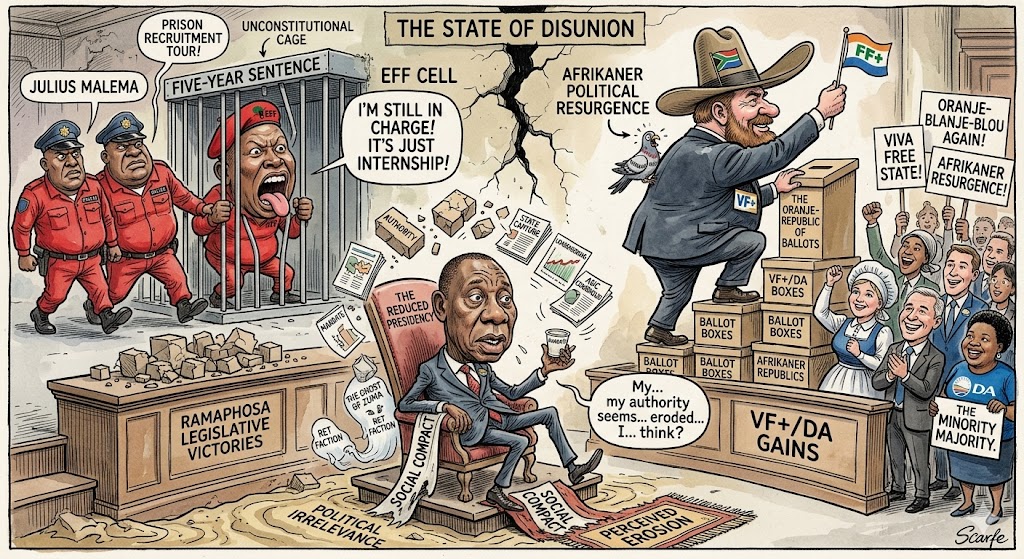

The sentencing of political figures in high-profile democracies invariably generates contestation over legal proportionality, institutional independence, and perceived political signalling. The recent attention directed at Julius Malema and the imposition of a five-year sentence (as reported in public discourse) has intensified these dynamics, not only within South Africa’s domestic political arena but also across broader debates on sovereignty, judicial autonomy, and elite influence.
At the core of the matter is Malema’s long-standing entanglement with the criminal justice system, including prior convictions linked to unlawful firearm discharge and public-order offences arising from political gatherings. These cases have historically been interpreted through divergent lenses: on one hand, as legitimate enforcement of criminal statutes; on the other, as selectively amplified prosecutions of a polarising opposition leader. This duality is central to understanding why sentencing outcomes involving Malema are often framed less as isolated judicial determinations and more as politically charged events embedded within South Africa’s contested democratic transition.
judicial decisions involving prominent political figures are interpreted through lenses of geopolitical influence, ethnic contestation, or party-political engineering
From a legal-technical standpoint, sentencing decisions in such matters are expected to reflect established principles of proportionality, deterrence, and consistency with precedent. However, the perception of severity—particularly where custodial outcomes are emphasised—frequently triggers broader political interpretation. In this instance, critics argue that the outcome signals a punitive escalation that exceeds comparable sentencing norms for similar offences, thereby raising questions about equal treatment before the law. Supporters of the judiciary, conversely, maintain that the rule of law necessitates consistent application regardless of political status, especially where public safety considerations are implicated.
A parallel narrative circulating in political commentary suggests external geopolitical influence over domestic decision-making, including allegations that international actors may have indirectly shaped domestic political pressures. These claims, including references to interactions between South African leadership and foreign administrations, remain unsubstantiated in verified legal or diplomatic records. Nevertheless, their persistence reflects a broader anxiety within segments of the political landscape regarding perceived erosion of policy autonomy in the context of global power asymmetries. It is analytically important, however, to distinguish between evidentiary claims and interpretive political rhetoric; no verifiable record confirms direct foreign instruction regarding prosecutorial or sentencing decisions in this matter.
Cyril Ramaphosa is often framed by commentators as navigating complex trade-offs between domestic political stability
Within this contested interpretive space, the presidency under Cyril Ramaphosa is often framed by commentators as navigating complex trade-offs between domestic political stability, investor confidence, and strategic international relations. In this framing, judicial outcomes involving prominent political actors are sometimes mischaracterised as instruments of diplomatic appeasement. A more institutionally grounded reading would instead locate such outcomes within the separation of powers doctrine, where the judiciary operates independently of executive negotiation. Nonetheless, perceptions of influence—whether accurate or not—can materially shape public trust in institutions.
Similarly, broader debates concerning diplomatic appointments, including ambassadorial postings to major global partners, are frequently drawn into narratives of elite bargaining and ideological alignment. While diplomatic staffing decisions are inherently political and strategic, there is no substantiated evidence that such appointments are causally linked to judicial proceedings or sentencing outcomes. Conflating administrative foreign policy decisions with criminal adjudication risks obscuring the functional independence of state institutions.
Civil society organisations, including advocacy groups representing Afrikaner constituencies such as AfriForum, occupy an influential position within South Africa’s pluralistic legal environment. Their litigation strategies and public campaigns are often framed by supporters as rights-based accountability mechanisms, while critics interpret them as selectively oriented interventions within broader cultural and political contestation. In analytical terms, these organisations function as pressure actors within a competitive civil society ecosystem rather than as determinative agents of state coercion. Assertions that such groups “silence” political movements require careful qualification, as South Africa’s constitutional framework provides extensive protections for political expression and mobilisation.
The broader political environment further complicates interpretation. The African National Congress has experienced declining electoral dominance, while opposition formations such as the Democratic Alliance and the Economic Freedom Fighters continue to reposition themselves within an increasingly fragmented party system. In such a context, high-profile legal proceedings are frequently absorbed into broader narratives of political realignment. However, attributing judicial outcomes directly to partisan advantage risks oversimplifying a multi-institutional system governed by procedural law and evidentiary standards.
Afrikaner constituencies such as AfriForum, occupy an influential position within South Africa’s pluralistic legal environment.
A critical analytical concern emerging from these dynamics is the widening gap between institutional processes and public perception. When judicial decisions involving prominent political figures are interpreted through lenses of geopolitical influence, ethnic contestation, or party-political engineering, institutional legitimacy can become contested regardless of legal correctness. This perception gap is particularly consequential in societies undergoing ongoing transformation, where historical inequities continue to shape interpretive frameworks of authority and justice.
In conclusion, the sentencing of Julius Malema, irrespective of its precise legal configuration, functions as a focal point for competing narratives about justice, sovereignty, and political power in South Africa. While some interpretations emphasise external influence and coordinated elite bargaining, these claims remain largely unsubstantiated in evidentiary terms. A more analytically robust reading situates the matter within domestic tensions between judicial independence, political contestation, and evolving democratic legitimacy. The long-term institutional risk lies not necessarily in the sentence itself, but in the erosion of shared confidence in the neutrality of adjudicative processes.

The writer, Dr. Tiema Haji is an academic, researcher, author, journalist, communication specialist and an accomplished poet.