

Prof FG Tsibani is Water Governance and Programme Evaluation Expert at the University of Johannesburg. He is writing in his personal capacity.
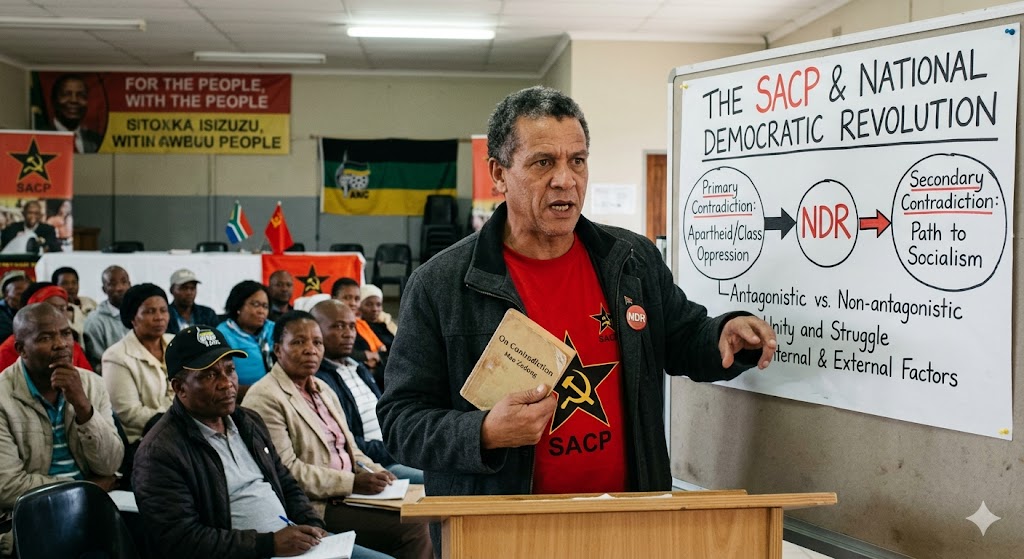
The quotation from Mao Zedong’s 1957 address “On Correct Handling of Contradictions Among the People” provides a methodological lens through which to assess the current political moment in South Africa, particularly the conduct and strategic orientation of the South African Communist Party under General Secretary Solly Mapaila. Mao’s central contribution is the insistence that contradictions are universal and permanent, but their character is not fixed. He distinguishes between antagonistic contradictions, which exist between ourselves and the enemy and can only be resolved through struggle that removes the opposing force, and non-antagonistic contradictions, which exist within the ranks of the people and whose fundamental interests align. The latter are to be resolved through discussion, criticism, self-criticism, and education rather than through coercion or organisational rupture.
contradictions are universal and permanent, but their character is not fixed.
Applied to the South African context post-May 2024, the question becomes whether the current tensions within the Tripartite Alliance, and within the broader left, constitute antagonistic contradictions or non-antagonistic ones. The SACP’s decision to convene a “conference of the left” following the electoral setback of the African National Congress, and its public posture of punishing alliance partners for not appointing the Secretary General to a ministerial position, suggests a conflation of categories. The matter of cabinet deployment is a question of negotiation, persuasion, and soft power within an alliance whose constituent forces share a historical commitment to the National Democratic Revolution and the two-stage theory.
To elevate a deployment dispute into a justification for a parallel political process risks treating a non-antagonistic contradiction as antagonistic. The empirical consequence of such a move is the fragmentation of working-class unity at a time when workers are already divided across more than three federations, with NUMSA under Irvin Jim and AMCU under Joseph Mathunjwa operating outside the Congress of South African Trade Unions. This division leaves the working class more vulnerable to exploitation and weakens the capacity of the movement to advance a coherent programme.
The empirical consequence of such a move is the fragmentation of working-class unity
Mao’s dialectical nuance regarding contradictions between exploited and exploiting classes in a socialist society is also instructive. He argues that such contradictions contain both a non-antagonistic and an antagonistic aspect. The non-antagonistic aspect derives from the fact that, under working-class leadership, the long-term interests of former exploiting classes are subordinate to socialist construction. The antagonistic aspect persists through the remnants of capitalist ideology, habits, and resistance. In South Africa in 2026, this dual character is visible in the tension between the constitutional commitment to a mixed economy and the strategic objective of transforming property relations through the NDR. The task is to apply firmness in principle while maintaining differentiation in practice. A conference that lacks a concrete socialist revolution roadmap, and that uses the term “left” as a colour or posture rather than as an ideological principle derived from the founding values and ethos of the Communist Party of South Africa, departs from this method. It substitutes programmatic clarity with symbolism, and strategic debate with organisational positioning.
A conferences that uses the term “left” as a colour or posture rather than as an ideological principle
The methodological significance of Mao’s statement that contradictions differ in content between the period of revolution and the period of building socialism lies in its demand for concrete analysis of concrete conditions. Following the May 2024 elections, the principal contradiction confronting the movement is no longer the capture of state power, but the reconstruction of state capacity, the advancement of land and industrial policy, and the protection of workers’ interests within a coalition government. The ANC alliance retained the capacity to deploy SACP cadres in strategic clusters of finance, mining and mineral resources, higher education, science and innovation, until 2029.
A strategic approach grounded in collectivism would have focused on strengthening policy influence within those sites of power, using tools such as SWOT analysis and Theory of Constraints to identify leverage points for transformation. Instead, the turn to a separate conference and to electoral contestation by the SACP itself represents a tactical shift that Mao’s framework would categorise as a mishandling of contradiction. Treating non-antagonistic contradictions as antagonistic alienates allies and weakens unity. Treating antagonistic contradictions, such as the neoliberal agenda embedded in certain “fashionable black political parties” that seek to replace the NDR with market fundamentalism, as non-antagonistic would constitute ideological capitulation.
A left project that does not place Sustainable Development Goals 4, 6, 7, 11 and 17 at the centre of its programme, cannot claim to represent the interests of the working people.
The critique articulated by Mr Zamikhaya Maseti in 2025, that the SACP ought to lead debate on the global economics of BRICS rather than pursue aesthetic “caravan campaigns”, points to the same methodological requirement. In 2026, the motive forces of South African politics are defined by material conditions: 46.1 percent youth unemployment, the crisis of water and sanitation, energy insecurity, the impacts of climate change, and the threat of epidemic disease such as Ebola. These are the contradictions that determine the content of politics. A left project that does not place Sustainable Development Goals 4, 6, 7, 11 and 17 at the centre of its programme, and that does not articulate a BRICS-Africa partnership model for development, cannot claim to represent the interests of the working people. SDG 4, education for transformation, is the foundational motive force of any post-apartheid and post-colonial project because it determines whether the 46.1 percent of South African youth who are currently unemployable are equipped with the technical, scientific and critical capacities to participate in industrialisation and the knowledge economy rather than remain a reserve army of poverty. Without universal access to quality, decolonised education linked directly to the skills demands of manufacturing, energy, water and digital infrastructure, education becomes an exercise in credentialism rather than liberation.
SACP ought to lead debate on the global economics of BRICS rather than pursue aesthetic “caravan campaigns”,
SDG 6, access to safe drinking water and adequate sanitation services, addresses the most immediate material contradiction confronting working-class communities, where water insecurity and failing municipal infrastructure reproduce ill-health and undermine labour productivity. SDG 7, clean energy and electricity, is inseparable from the question of national sovereignty, because an energy system still dominated by a single failing utility and by private extraction cannot sustain reindustrialisation or protect households from energy poverty. SDG 11, sustainable cities and communities, demands that urban development be planned around human needs rather than speculative property markets, requiring smart, resilient towns that integrate housing, transport, green spaces and disaster preparedness against climate shocks and epidemics such as Ebola. Finally, SDG 17, partnerships for the goals, compels a left formation to move beyond national insularity and to concretise South Africa’s strategic alignment with BRICS and Africa through technology transfer, joint industrial projects, and financing models that reduce dependence on the global North. A programme that neglects this integrated architecture abandons the material conditions of the working people and substitutes radical rhetoric for a programme capable of transforming them.
Mao’s framework demands that the SACP to identify the principal contradiction of the current stage and apply the correct method of resolution. The so-called conference of the left, if it functions as a vehicle for regime change and for burying the ANC rather than for advancing a socialist programme, becomes a competition for office rather than a revolutionary project. In 2026, the test of political maturity is therefore the capacity to distinguish between differences that can be resolved through comradely debate within the alliance, and contradictions that require principled struggle against forces seeking to liquidate the national democratic project.
Conclusion and Recommendations
The South African Communist Party under General Secretary Solly Mapaila cannot be politically separated from the current fashionable black political parties that advance a regime-change agenda in South Africa, because both tendencies, despite different rhetorical postures, converge in their practical effect of fragmenting the National Democratic Revolution and substituting it with neoliberal alternatives imported from the global North. In this context, the African National Congress must resist the temptation to expel SACP members deployed in the economic cluster, education, science and technology, as such expulsions would disrupt essential services and undermine state capacity at a time when reconstruction remains incomplete. Instead, the ANC, as the known leader of society, must manage these contradictions through principled engagement, collective discipline and ideological clarity, prioritising the best interests of both parties and, above all, of the working class.
This approach is required by the global contradictions of 2026, where the emergence of BRICS as an alternative centre of economic and political power has created new strategic possibilities, and where South Africa’s ministers of International Relations and Cooperation have already articulated policies that resist emerging ultra-right and ultra-Nazism tendencies internationally. Managing contradiction rather than deepening rupture therefore becomes the only method consistent with the movement’s historical responsibility to protect workers, defend national sovereignty, and advance a coherent socialist-oriented transformation within the conditions of the present stage.
Prof FG Tsibani is Water Governance and Programme Evaluation Expert at the University of Johannesburg. He is writing in his personal capacity