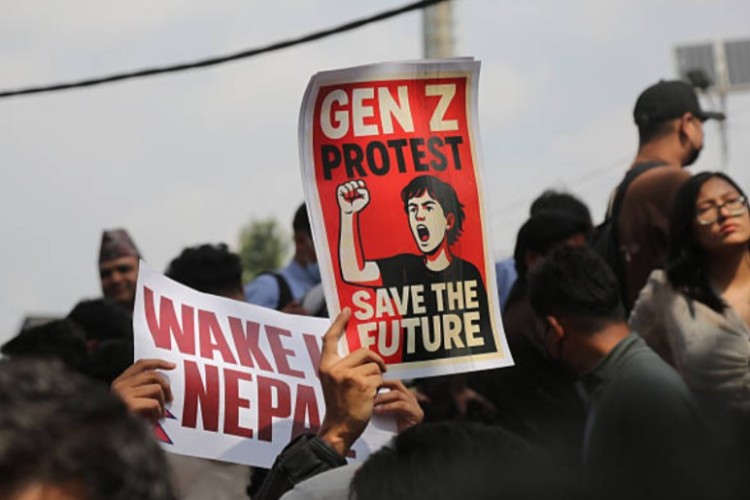
In Kathmandu on the evening of September 8, 2025, tens of thousands of young people, mostly teenagers and early-20s, streamed toward New Baneshwor and Singha Durbar, the seats of Nepal’s Parliament and central ministries. They carried signs, they chanted slogans about corruption, joblessness, and the right to speak online. By the next day, the Prime Minister, K. P. Sharma Oli, had resigned, the government had lifted a sweeping social media ban, and the symbols of power, parliament buildings, luxury hotels, political residences—were under siege.
This, many say, was Gen Z finally breaking through.
The Spark, the Fuel, the Rage
What triggered the protest was, quite literally, a digital switch-off. On September 4, the government ordered 26 social media platforms, Facebook, Instagram, WhatsApp, X, YouTube among them—to register with Nepal’s Communications Ministry or face shutdown. For many young people who rely on these platforms for education, income (especially in gig economies), news, admiration, and social connection, the ban felt like censorship and humiliation piled onto long-standing grievances.
But beneath the ban lay deeper fuel: skyrocketing youth unemployment (≈20-21%), an economy dependent on remittances (over 30% of GDP), elite nepotism and wealth inequality, and a sense that political leadership has long ignored Gen Z’s aspirations. The #NepoKids revelations—calls that exposed how children of political elites flaunted privilege—fanned outrage.
political leadership has long ignored Gen Z’s aspirations…
How Young Nepalis Organized and Overcame
What’s remarkable is how this movement organised horizontally, with no single charismatic Gen Z leader dominating the stage. Students, unemployed graduates, gig-workers, and informal sector youth converged in the streets and online. Social media not only spread mobilization but became the stage for exposing injustice. Even after the government blocked platforms, protest coordination continued via proxy networks and word-of-mouth. When demonstrations turned violent after police used force, momentum shifted decisively against the government. Within days, key demands were met: the social media ban was lifted, and Oli announced his resignation.
Will Gen Z’s “Victory” Be Robbed by the Old Guard?
Nepal’s Gen Z faces a familiar risk: having won the stage, will their gains be neutralized by entrenched elites? There are precedents: in Sudan after the 2019 uprising, or Kenya’s youth protests, where political actors quietly co-opted or diluted youth demands. In Nepal, Gen Z is already engaged in talks over interim leadership, with names like former Chief Justice Sushila Karki and Mayor Balendra Shah floated. But the danger is clear: if those in power treat Gen Z demands as symbolic rather than transformational, or if constitutional amendments and elections are delayed or manipulated, the protest’s promise could be hollow.
Why Gen Z is Emerging as a Force
What makes Gen Z distinct in Nepal (and elsewhere) is their digital fluency, their impatience with inherited inequality, and their existential exposure to both global culture and local stagnation. For many, social media was not luxury but lifeline. Education without jobs, civic promises without transparency, these contradictions became acute. Also, Gen Z has fewer axes to grind with party loyalties; many were born after old party rivalries hardened, making it harder for politicians to buy their loyalty with rhetoric alone.
Gen Zs making it harder for politicians to buy their loyalty with rhetoric alone.
What Next: For Gen Z, for Politicians, for Nepal
For Gen Z, the way forward must involve vigilance. They must demand not just leaders who speak their language, but policies that reflect their needs: new frameworks for employment, stronger anti-corruption mechanisms, constitutional reforms, maybe even a referendum on civic rights and oversight. Healing will need credible investigative panels, justice for those killed, and transparency in the transition period.
Politicians, on the other hand, must do more than shuffle portfolios. They need to engage Gen Z meaningfully, not as social media spectacle but in decision-making. That means opening up institutions, ensuring real accountability, sharing power, and resisting co-option of youth energy for partisan ends.
Nepal’s Gen Z has demonstrated it can topple a government. But the test now is whether their “victory” becomes more than a headline: whether it reshapes power, not just perfomance. If not, Nepal risks following in Kenya’s and Sudan’s footsteps, where youthful revolutions end up as footnotes in the powerful’s biography.
Ultimately, Gen Z’s rise isn’t about being young, it’s about being refused patience. And when a generation refuses to wait, change becomes inevitable.