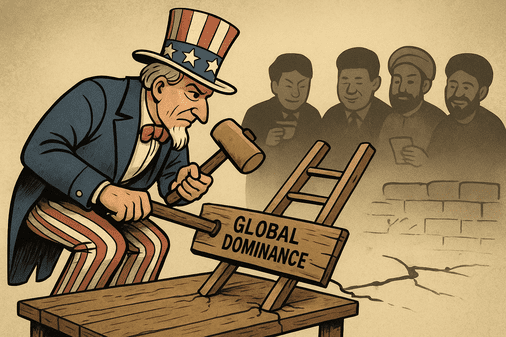
For decades, the United States has strutted across the global stage as the world’s self-anointed policeman. Armed with unmatched military power, economic leverage, and political influence, Washington has perfected the art of coercion. Nations that resist its dictates are swiftly punished with sanctions, coups, or isolation, while those that comply are expected to inherit America’s enemies, mirror its policies, and sign onto trade deals tilted heavily in Washington’s favour.
Yet here lies the paradox: the tighter Washington squeezes, the more it risks driving rivals, and even hesitant allies—into each other’s arms. What once seemed like an effective strategy of domination may now be the very glue that binds America’s adversaries together.
The Playbook of Pressure
Dollar dominance, NATO muscle, and sanctions on demand remain the central tools of American diplomacy. With military bases scattered across every continent, NATO acting as an extension of Washington’s will, and the U.S. dollar providing unrivalled economic leverage, the United States projects power with unmatched reach. Sanctions, “aid with strings attached,” and the perpetual threat of military action have become its default instruments.
For smaller nations, often dependent on loans and wary of retaliation, submission may appear to be the only option. But loyalty born of fear carries a steep cost. Such nations inherit Washington’s enemies, get dragged into proxy conflicts, and risk losing legitimacy at home.
Turning on India, China, Russia, and Iran
Even major powers have not been spared the sting of Washington’s heavy-handed tactics. India, once celebrated as a democratic counterweight to China, now faces pressure over its trade policies, defense purchases, and neutrality regarding Russia. Rather than feeling like a trusted partner, New Delhi increasingly perceives itself as a pawn.
China, meanwhile, has been pushed into what amounts to an economic cold war. Tariffs, technology bans, and military encirclement through Indo-Pacific alliances all signal a strategy of containment. But instead of weakening Beijing, these measures have only accelerated its push toward self-reliance and expanded influence abroad.
Russia has endured perhaps the most extensive sanctions regime in modern history. Far from collapsing, Moscow has pivoted eastward, strengthening ties with Beijing and presenting itself as a champion of resistance against American dominance.
Iran, vilified for decades, continues to defy Washington’s sanctions while extending its influence across the Middle East. Its growing partnerships with Russia and China highlight a recurring pattern: American pressure often breeds pragmatism and resilience, not capitulation.
The Glue That Could Bind Them
The irony is stark. Washington does not need to foster affection among its rivals; it only needs to make them dislike America more than they distrust one another. In targeting India, China, Russia, and Iran simultaneously, the United States may be writing the script for their convergence.
Signs of this shift are already visible. The expansion of BRICS, the growing role of the Shanghai Cooperation Organisation, and financial experiments designed to bypass the dollar all point to a changing world order. Energy partnerships linking Russia, Iran, and China further strengthen this realignment. Should India lean more decisively into these frameworks, the geopolitical balance could tilt in ways Washington is unprepared to counter.
A loose axis among these powers, without even requiring deep ideological unity, would control vast markets, abundant natural resources, and formidable military strength. Together, they could challenge the supremacy of the dollar, reshape trade systems, and erode the foundations of American hegemony.
America’s Dangerous Blind Spot
Empires often falter not simply because of external opposition but because arrogance blinds them to reality. Washington continues to pride itself on “leading the free world,” but increasingly, its strong-arm tactics appear less like strength and more like the desperation of a fading empire.
Short-term concessions may still be wrung from allies and rivals, but these victories come at the expense of long-term trust. The more America isolates its adversaries, the more it risks isolating itself. By demanding loyalty and punishing dissent, it breeds resentment instead of respect.
From Hegemon to Just Another Power
The United States still commands enormous influence, but the era of unquestioned supremacy may be drawing to a close faster than Washington anticipates. By alienating India, antagonizing China, sanctioning Russia, and vilifying Iran, America is inadvertently nurturing alliances that could redefine the global balance of power.
The bitter irony is that America’s greatest rival may not be any of these countries individually. Its greatest rival may be its own arrogance.

