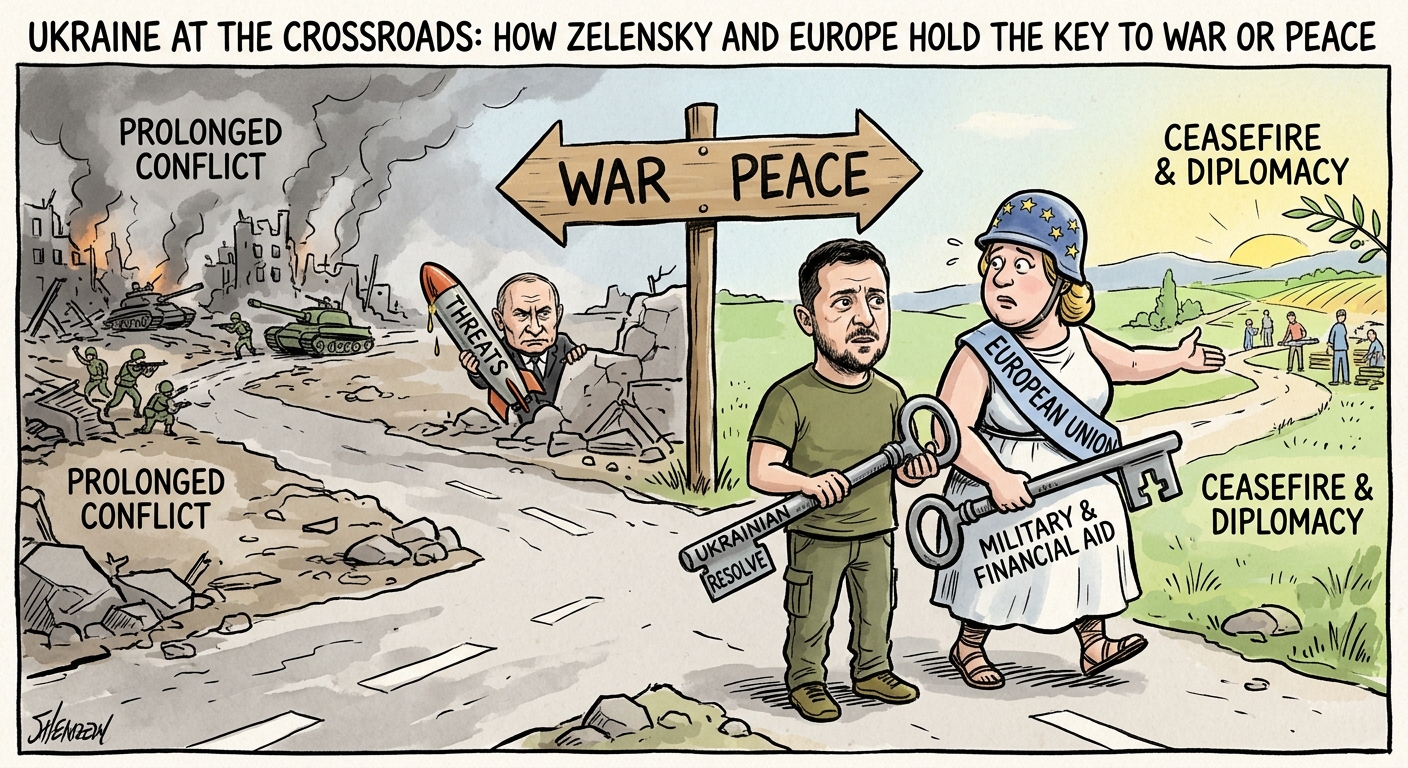

The continuation or eventual resolution of the conflict in Ukraine may ultimately depend on two principal actors: Ukrainian President Volodymyr Zelensky and the leading European powers, particularly Germany, Britain and France.
Russia has repeatedly signalled its willingness to bring the war to an end after years of devastating conflict. United States President Donald Trump is also advocating for a negotiated settlement, arguing that the war cannot continue indefinitely. This leaves the ball in Zelensky’s court, it’s up to him to play it or to torse it off the outline.
European nations have provided Ukraine with substantial military aid, financial assistance and political support
Over the past four years, European nations have provided Ukraine with substantial military aid, financial assistance and political support. Their involvement has transformed the conflict into a broader geopolitical struggle between Russia and the Western alliance. As military assistance has increased, so too have concerns about the possibility of a direct confrontation between Russia and NATO member states, a scenario many fear could escalate into an even larger international conflict.
so too have concerns about the possibility of a direct confrontation between Russia and NATO member states
Although Germany, France and Britain remain at the forefront of European support for Ukraine, they are not alone. Numerous European countries, including Poland, the Baltic states and the Scandinavian nations, have adopted increasingly assertive positions regarding Russia. Some political figures within these countries have openly discussed the need to strengthen military capabilities and deter what they perceive as Russian aggression.
The growing military preparedness across Europe has raised serious questions about the long-term consequences of the current trajectory. Governments throughout the continent have encouraged their citizens to prepare for a more uncertain security environment. What remains less clear, however, is whether any military strategy aimed at confronting Russia could succeed without exposing Europe to devastating risks. Russia remains one of the world’s foremost nuclear powers, and any direct war involving such a state would carry consequences far beyond the battlefield.
Russia remains one of the world’s foremost nuclear powers
At the same time, many European governments are facing domestic political challenges, including economic pressures, social tensions and declining public confidence with ongoing violent protests in countries like France. Some analysts argue that international crises can strengthen political leaders by rallying national support around a common external threat. Similar arguments have been made regarding conflicts elsewhere in the world, where governments have sought to consolidate political support during periods of instability and uncertainty.
A direct conflict between Russia and European countries would inevitably raise the spectre of nuclear war. The potential use of weapons of mass destruction remains one of the gravest dangers facing humanity. The catastrophic consequences of nuclear warfare were witnessed in Hiroshima and Nagasaki in 1945, where entire cities were devastated and generations suffered from the lasting effects of radiation. While modern circumstances differ significantly from those of the Second World War, the destructive power of nuclear weapons remains an undeniable reality.
The potential use of weapons of mass destruction remains one of the gravest dangers facing humanity
History also demonstrates that large-scale wars rarely remain confined to the nations where they begin. Major conflicts often draw in allies and partners, transforming regional confrontations into international struggles. The First and Second World Wars illustrated how alliance systems can rapidly expand a conflict beyond its original participants. Once such a process begins, controlling escalation becomes increasingly difficult.
Should a direct military clash occur between Russia and European powers, there is widespread speculation that Moscow’s strategic partners, including China, Iran and North Korea, could become more deeply involved. Whether through diplomatic support, economic cooperation or military assistance, these countries have already been associated with varying degrees of support for Russia during the conflict in Ukraine. Such developments would further complicate the geopolitical landscape and increase the risks associated with a prolonged war.
Direct military clash between Russia and European powers, could involve Moscow’s strategic partners, including China, Iran and North Korea
Supporters of a negotiated settlement often point to the early months of the conflict in 2022 when Russia and Ukraine engaged in discussions aimed at ending hostilities. They argue that opportunities for peace existed at that stage but were ultimately not realised. Since then, the war has continued with enormous human, economic and social costs for all sides involved. Despite years of fighting and sustained Western support for Kyiv, the conflict remains unresolved and a decisive outcome has yet to emerge, a hoped-for resolution often becomes an on-and-off.
Nevertheless, there are reasons for optimism. Recent diplomatic initiatives and renewed discussions about possible negotiations suggest that alternatives to continued warfare still exist. Efforts by both Russia and the United States to explore pathways towards a settlement have introduced a different dynamic into the debate. While some European governments may view such initiatives with caution, others see diplomacy as the only realistic means of preventing further escalation.
President Trump has repeatedly stated his opposition to a prolonged war and has argued that achieving peace should be a priority for all parties involved. From this perspective, the United States, as the leading power within the Western alliance, has a crucial role to play in encouraging dialogue and compromise rather than continued confrontation.
Ultimately, there is only one durable solution to the conflict: a negotiated peace settlement. Regardless of differing political positions, military realities and diplomatic calculations, an end to the war will require meaningful negotiations between Kyiv and Moscow. Ukraine remains heavily dependent on external support, while Russia continues to face the economic and military burdens associated with a prolonged conflict. Neither side can escape the costs of war indefinitely.
there is only one durable solution to the conflict: a negotiated peace settlement
For those advocating peace, the path forward is clear. They believe that President Zelensky and President Vladimir Putin must return to the negotiating table and seek a settlement that addresses the core concerns of all parties. While compromise may be politically difficult, it remains preferable to the alternative of an endless war whose consequences could extend far beyond the borders of Ukraine. In an era of heightened global tensions, diplomacy, however imperfect, offers the best chance of preventing a wider and potentially catastrophic conflict.

- Thobile Jiwulane