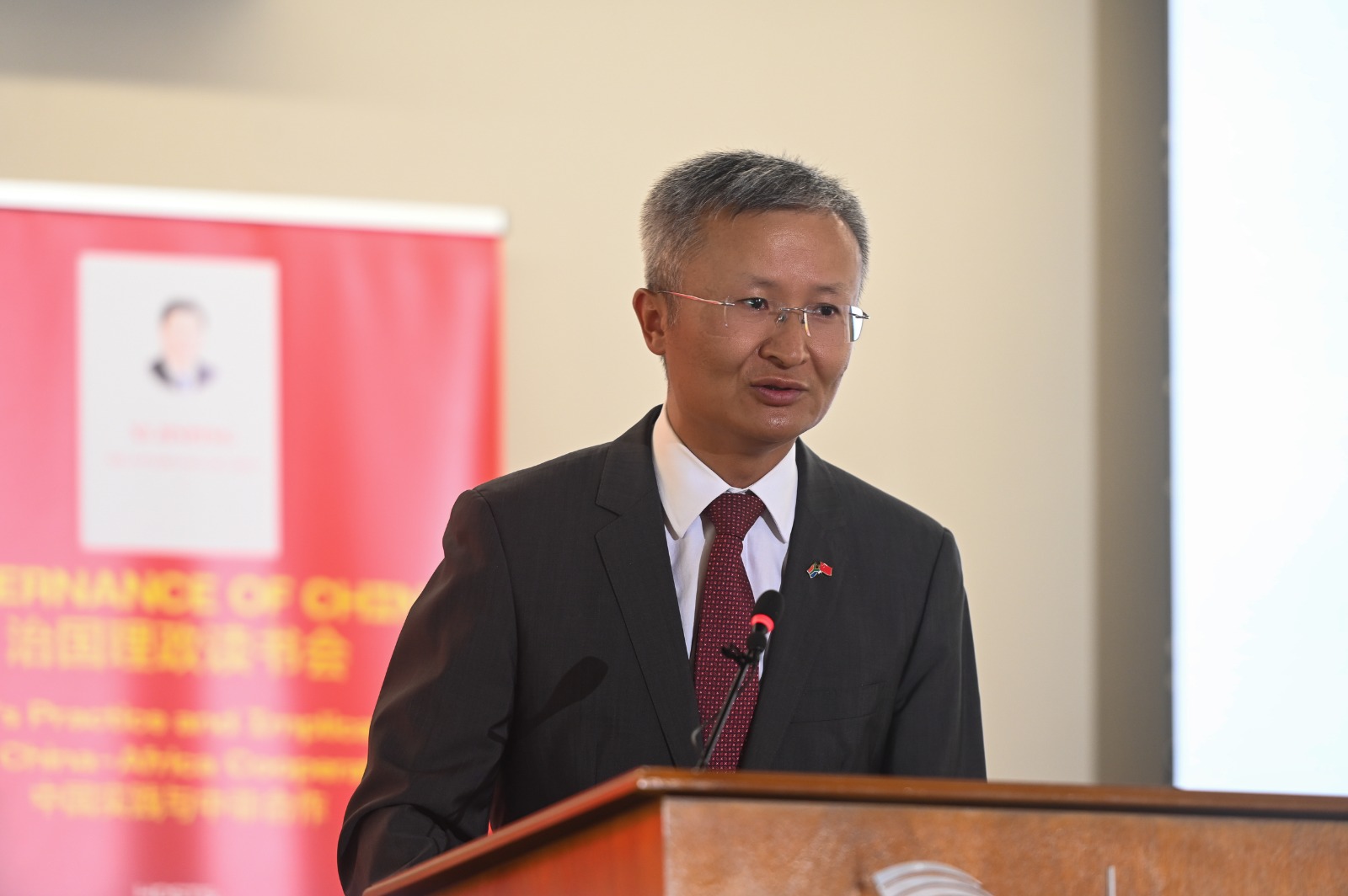
Minister Counsellor at the Chinese Embassy in South Africa,
Zhao Jixian, addressing the seminar
Picture by Albert Ni
People-centred governance became a refrain during a seminar in Pretoria, where guests, including politicians, diplomats, scholars, and researchers, exchanged ideas and debated the lessons Africa must learn from China’s people-centred model of governance.
Africa must learn from China’s people-centred model of governance.
Under the theme “China’s Practice and Implications for China-Africa Cooperation,” the event drew more than 240 participants to the Albert Luthuli Auditorium at the National Research Foundation of South Africa. The seminar, jointly hosted by the Embassy of the People’s Republic of China in South Africa, the CICG Centre for Europe and Africa, and the University of Venda, took place in Pretoria on Friday 9 October.
Many students and young researchers attended, eager to understand the lessons for the continent as encapsulated in Chinese President Xi Jinping’s themed book series, “Governance of China”, whose concepts many scholars and students in South Africa had been scrutinising in their research.
The gathering’s significance was highlighted by Zhao Jixian, Minister Counsellor at the People’s Republic of China Embassy in South Africa, who described it as a “meaningful moment”. Zhao noted that the event occurred just over a week ago, following China’s 77th anniversary celebrations. It also coincided with 2026, the China-Africa Year of People-to-People Exchanges, and marked 70 years of China-Africa diplomatic relations.
President Xi Jinping has called on China and Africa to deepen mutual learning and share governance experience
“President Xi Jinping has called on China and Africa to deepen mutual learning and share governance experience. That is also why we are here today,” Zhao said. He said China stands with South Africa, is willing to share its governance experience, and deepen the existing relationship for the benefit of the people of both countries.
The senior diplomat emphasised the significance of cooperation between the two countries. “Building on our all-round strategic cooperative partnership in the new era, China stands ready to work with South Africa to deepen exchanges of governance experience, strengthen dialogue between our think tanks and universities, and align our development strategies, so that our cooperation brings real benefits to our peoples.”
Explaining the people-centred concept in China’s governance, Zhao said governance must put the people at the centre. He said the true standard is not how impressive a policy looks on paper, but whether ordinary people feel the difference in their daily lives. “That is why we practise whole-process people’s democracy, in which the people take part not only on election day, but in consultation, decision-making and oversight afterwards as well.
the true standard is not how impressive a policy looks on paper, but whether ordinary people feel the difference in their daily lives.
Citing an old Chinese saying, Zhao said: “Neither mountains nor seas can keep apart those who share a common purpose.” Let us keep learning from each other, working with each other, and building a shared future together.”
The event heard addresses from other speakers. In his address, Cedric Frolick, South African lawmaker and National Assembly House Chairperson: Committees, Oversight and Participation, dwelt on the people-centred governance question as an important lesson for South Africa and Africa as a whole.
Frolick explored how the China-South Africa partnership must translate into shared prosperity for the peoples of both countries. He also noted that China, under President Xi Jinping’s leadership, has assumed an increasingly important role in international affairs.
President Xi Jinping’s leadership, has assumed an increasingly important role in international affairs.
“We are friends of China and, as such, we have a common objective: to improve the livelihoods of the people of both our countries. Our two countries have built a close relationship through multilateral platforms, including the BRICS mechanism, the United Nations, the G20 and the Forum on China-Africa Cooperation,” he said. “We work on issues affecting both our nations and the wider international community, especially the reform of global governance.”
The politician was impressed by China’s use of technology, such as street cameras, to combat crime and suggested South Africa could emulate the approach. This was one of the key lessons he learnt during his visit to China.
Mabuse Mpe, a member of the South African Communist Party (SACP) Central Committee and head of the Office of the SACP General Secretary, also spoke at the meeting, calling for the China-South Africa co-operation to expand beyond political, diplomatic and trade relations.
“China-South Africa cooperation must be a relationship of equals, grounded in mutual respect, mutual benefit and solidarity among countries of the Global South. It must move beyond the export of raw materials towards beneficiation, local manufacturing, skills transfer, technological cooperation and decent job creation,” Mpe said.
Fulufhelo Netswera, acting vice chancellor and principal of the University of Venda, stressed the importance of China-South Africa cooperation in high technology, noting the exchanges that have already taken place between universities and institutions in both countries. He noted that bilateral cooperation in scientific and technological innovation could benefit people in both countries.
China places greater emphasis on appointing capable, knowledgeable people to govern
Kevin Wall, a fellow of the South African Academy of Engineering, compared urban governance practices in China and South Africa. He argued that the cultural differences between the two countries created opportunities for them to learn from each other in this field.
Prof Arthur Mutambara, director of the Institute for the Future of Knowledge at the University of Johannesburg, raised interesting points about hard lessons Africa must take from China, such as its heavy punishment of corruption.
At the same time, Africa should learn that China places greater emphasis on appointing capable, knowledgeable people to govern, unlike some African countries that hired unqualified people to run the government. He highlighted the technical qualifications generations of Chinese leaders possessed, which enabled them to implement proper governance.
“If you look at China’s leadership, you will find that nearly all Chinese leaders have expertise in chemical, civil or electrical engineering and other technical fields. China is allowing some of its best minds to run the country. African countries should learn from China in this regard,” he said, adding that investment in education is a foundation for national development that Africans must also emulate.
The gathering concluded with a panel discussion featuring Lungile Magagula, president of the South Africa Youth Association of Global Affairs; John Bailey, CEO of Sunday World; and Sizo Nkala, a political scientist and postdoctoral fellow at the Centre for Africa-China Studies at the University of Johannesburg. They explored the importance of China-Africa cooperation in youth engagement, media and think-tank exchanges

