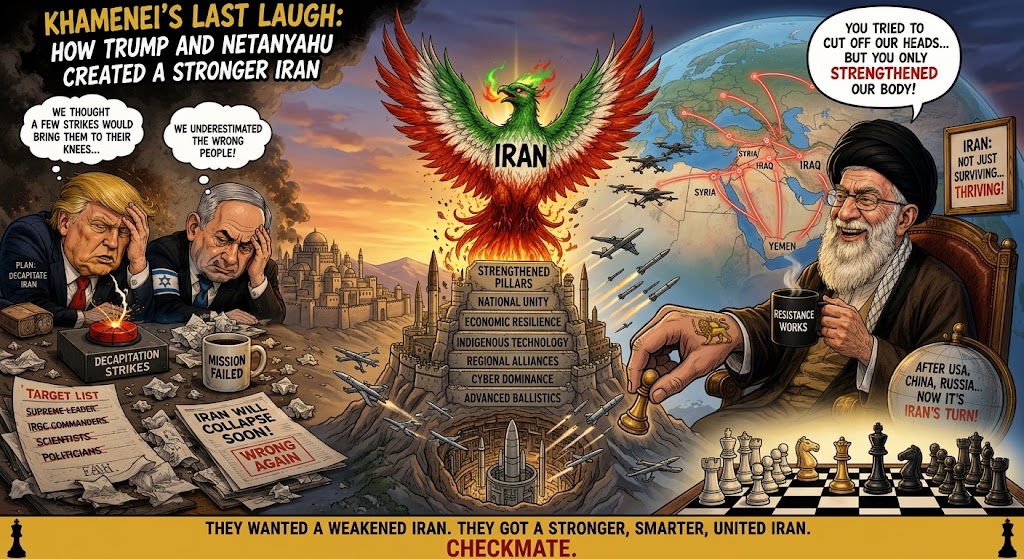

For decades, Washington and Tel Aviv have subscribed to a simple strategic assumption: remove enough leaders, destroy enough military infrastructure, and the Islamic Republic of Iran will eventually collapse under its own weight. The logic appears straightforward. Eliminate senior commanders, cripple decision-making, and force Tehran into submission.
The latest confrontation once again tested that theory.
Instead of producing strategic paralysis, Iran responded with coordinated military operations that surprised many analysts. Whether one supports or opposes Tehran’s government, one conclusion is increasingly difficult to dismiss: Iran possesses one of the most resilient leadership and governance structures in the modern world.
America and Israel may have won tactical victories. Iran arguably won the strategic argument.
Decapitation Is Not Defeat
Modern warfare has increasingly embraced what military strategists call leadership decapitation. The assumption is that removing senior political or military leaders disrupts command structures, damages morale, and shortens conflicts. istory tells a more complicated story.
The deaths of Saddam Hussein’s commanders did not instantly pacify Iraq. The elimination of Taliban leaders failed to end their insurgency. Hezbollah survived repeated assassinations of senior officials. Hamas has repeatedly regenerated its leadership despite extensive Israeli operations.
Iran belongs to this category of highly institutionalised states and organisations.
Its military doctrine has never depended on a single charismatic commander. Instead, authority is distributed through overlapping political, religious, intelligence and military institutions designed precisely for continuity during crises. This is not accidental. It is the product of more than four decades of preparing for existential threats.
The Islamic Republic Was Built to Survive
Western commentary frequently portrays Iran as a system centred entirely around the Supreme Leader.
That interpretation misses how the Islamic Republic actually functions.
Power is spread across multiple institutions, including the Office of the Supreme Leader, the Islamic Revolutionary Guard Corps (IRGC), the regular armed forces, parliament, intelligence agencies, provincial administrations, and an extensive bureaucracy that continues operating regardless of battlefield developments.
Every senior commander has deputies. Every major command has successors. Every strategic institution has contingency plans. This redundancy resembles the command structures found in major military powers. The objective is obvious. No single strike should be capable of collapsing the state.
America Underestimated Institutional Resilience
American military superiority has rarely been questioned. Its ability to translate battlefield dominance into lasting political outcomes has.
- Afghanistan.
- Iraq.
- Libya.
Each demonstrated that destroying military assets does not automatically produce political victory. Iran has studied every one of these conflicts. Rather than building a military designed solely to defeat the United States conventionally, Tehran developed a strategy focused on endurance. Its doctrine assumes that enemies possess overwhelming technological superiority.
The response has been asymmetric warfare, decentralised command, missile forces, drones, cyber capabilities and regional partnerships. This makes Iran exceptionally difficult to coerce through leadership targeting alone.
Nationalism Became Tehran’s Greatest Weapon
External military pressure often produces an unintended consequence. It strengthens national unity. Iranians hold diverse political opinions regarding their government. Yet history demonstrates that foreign attacks frequently transform domestic disagreements into collective resistance. National identity begins to outweigh political division.
This dynamic has repeatedly frustrated foreign powers throughout history. The assumption that internal dissatisfaction automatically translates into state collapse has consistently proven unreliable. Iran appears to understand this better than many of its adversaries.
The IRGC Is Bigger Than Any Individual Commander
One persistent misunderstanding concerns the Revolutionary Guard. Outside observers often personalise the organisation around prominent figures. In reality, the IRGC functions as a vast institution incorporating aerospace forces, naval units, ground forces, intelligence services, cyber operations, logistics networks and industrial capabilities.
Its leadership succession mechanisms are well established.
- Commanders can be replaced.
- Operational doctrine continues.
- Military production continues.
- Strategic planning continues.
The organisation was deliberately designed to survive precisely the kinds of attacks directed against it.
The New Balance of Power
Few serious analysts would argue that Iran equals the United States in economic size, global military reach or technological sophistication. Nor does it rival China’s manufacturing capacity or Russia’s nuclear arsenal. Yet measuring power solely through GDP or defence budgets overlooks a changing strategic reality. Iran has developed one of the world’s largest ballistic missile programmes, sophisticated drone capabilities and extensive experience in asymmetric warfare. It has demonstrated an ability to impose costs on far stronger adversaries without matching them weapon for weapon.
That alone has altered regional calculations.
Iran increasingly occupies a position as the Middle East’s most formidable indigenous military power. Whether one views that development positively or negatively is beside the point. Its strategic significance is undeniable.
Washington and Tel Aviv Face an Uncomfortable Reality
Military planners often distinguish between tactical success and strategic success. They are not the same. Destroying infrastructure is tactical. Winning political objectives is strategic. If the objective was to weaken Iran’s resolve, disrupt its institutions permanently or force capitulation, the evidence remains inconclusive.
Instead, Tehran continues functioning.
- Its government remains intact.
- Its military continues operating.
- Its regional influence persists.
- Its leadership structure continues adapting.
The Islamic Republic has demonstrated that resilience itself can become a strategic weapon.
Khamenei’s Legacy May Be Institutional, Not Personal
Political leaders inevitably leave the stage. Institutions endure. Ayatollah Ali Khamenei’s long-term legacy may ultimately rest less on his personal leadership than on the political architecture developed during his tenure. The Islamic Republic has invested heavily in continuity, succession planning and institutional redundancy to ensure the state can function through periods of crisis. his does not make Iran invincible. It does make it considerably harder to defeat than many Western policymakers anticipated.
The enduring lesson is straightforward. States built around strong institutions are rarely broken by removing individuals alone. The latest confrontation reinforced an enduring principle of strategic studies: governments fall when institutions collapse, not simply because leaders are targeted.
Washington and Tel Aviv possess overwhelming military capabilities. Iran has demonstrated something different but equally consequential: the capacity to absorb shocks, replace leaders and continue operating under extreme pressure.
That may prove to be the Islamic Republic’s greatest strategic advantage, and one its adversaries can no longer afford to underestimate.

The writer, Dr. Tiema Haji is an academic, researcher, author, journalist, communication specialist and an accomplished poet.