
The writer, Dr. Tiema Haji is an academic, researcher, author, journalist, communication specialist and an accomplished poet.
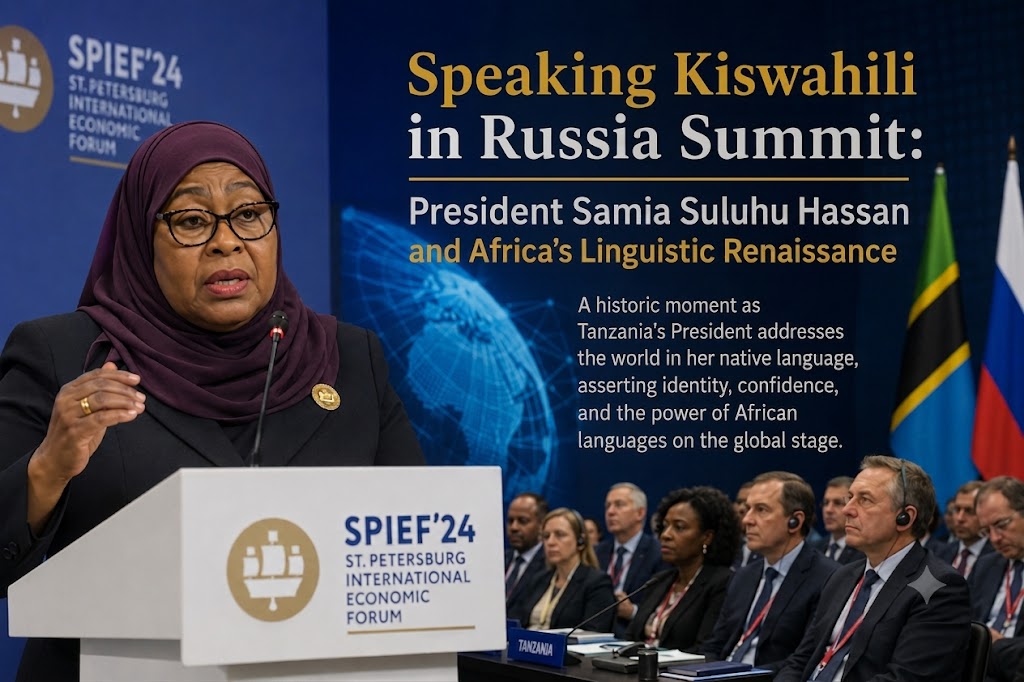
When Tanzanian President Samia Suluhu Hassan addressed an international audience in Kiswahili during her engagements in Russia, she did more than communicate a message; she made a statement about Africa’s place in the world. At a time when global diplomacy has historically been dominated by European languages, her decision to confidently use an African language on an international platform represented an important moment in the struggle for cultural recognition and intellectual equality.
For decades, African leaders have participated in international forums where English, French, and Portuguese have remained the dominant languages of diplomacy, business, and academia. While these languages provide practical avenues for global communication, their dominance has also reflected Africa’s complicated colonial history. Colonial administrations did not only control African territories; they also elevated European languages and systems of knowledge while often marginalising indigenous languages and traditions. President Suluhu Hassan’s use of Kiswahili challenges the long-standing assumption that African languages belong only to local spaces and are unsuitable for serious international engagement.
Colonial administrations did not only control African territories; they also elevated European languages and systems of knowledge
This moment strongly reflects the ideas of the late Kenyan scholar and writer Ngũgĩ wa Thiong’o, whose work focused extensively on language, culture, and liberation. Ngũgĩ argued that language is not simply a tool of communication but a carrier of history, identity, values, and collective memory. In his influential work on the decolonisation of African thought, he maintained that colonialism created a psychological dependency by encouraging Africans to view European languages as superior while treating their own languages as inferior.
For Ngũgĩ, reclaiming African languages was central to reclaiming African confidence. He believed that genuine independence required more than political sovereignty; it required Africans to regain control over their own cultural and intellectual expression. President Suluhu Hassan’s decision to speak Kiswahili in Russia represents the practical application of this philosophy. It demonstrates that an African language can carry diplomatic messages, conduct international dialogue, and represent a nation’s interests on the world stage.
Tanzania President demonstrated that an African language can carry diplomatic messages, conduct international dialogue,
The significance of this decision extends beyond Tanzania. Kiswahili is one of Africa’s most widely spoken languages and serves as an official language of the African Union. Its growing international recognition demonstrates that African languages can participate in global knowledge systems rather than remain confined to domestic communication. The engagement between Tanzania’s National Kiswahili Council (BAKITA) and the Moscow State Institute of International Relations to promote Kiswahili education and exchange further illustrates that African languages are gaining space in global academic and diplomatic institutions.
President Suluhu Hassan’s action also raises an important question for other African leaders, professionals, and institutions: why should African languages remain absent from international spaces where African ideas and interests are represented? If African languages are used in homes, communities, literature, and cultural expression, there is no reason they cannot also be used in boardrooms, universities, diplomatic negotiations, and international conferences.
Language is closely connected to knowledge production. When African academics, researchers, and professionals rely exclusively on foreign languages to produce knowledge, there is a risk that certain indigenous concepts, histories, and experiences become difficult to express fully. Promoting African languages does not mean rejecting international languages; rather, it means creating a more balanced world where African languages receive the respect and recognition they deserve.
there is a fallacy that certain indigenous concepts, histories, and experiences become difficult to express
The importance of President Suluhu Hassan’s decision lies in its symbolism and practical impact. She has shown that African leaders can engage internationally while remaining connected to their linguistic heritage. Her example may encourage future generations of African diplomats, entrepreneurs, scientists, and scholars to view indigenous languages as instruments of confidence rather than barriers to global participation.
Ngũgĩ wa Thiong’o spent much of his intellectual life arguing that Africa’s liberation must include the liberation of African minds from colonial patterns of thinking. President Suluhu Hassan’s Kiswahili address in Russia represents a continuation of that struggle. It reminds the world that African languages are not relics of the past; they are living languages capable of carrying ideas, negotiating partnerships, and shaping the future.
Ngũgĩ wa Thiong’o argued that Africa’s liberation must include the liberation of African minds
The future of African identity in the global arena will depend partly on whether Africans continue to value and use their own languages. By speaking Kiswahili where many expected a colonial language, President Samia Suluhu Hassan has opened a significant pathway. She has demonstrated that Africa can speak to the world in its own voice.