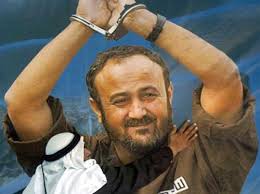
In the concrete stillness of an Israeli prison cell, a man named Marwan Barghouti has lived behind bars for over two decades. At 65 years old, Barghouti has become far more than a prisoner. He has evolved into a living legend and symbol of Palestinian resistance and resilience, a leader whose influence refuses to fade, despite his physical absence from the public stage. Often called the “Palestinian Mandela,” Barghouti is seen by many as the only figure capable of uniting the fragmented Palestinian movement and rekindling hope in the possibility of a sovereign Palestinian state.
He has evolved into a living legend and symbol of Palestinian resistance
Born in 1959 in the village of Kobar near Ramallah, Barghouti’s political awakening came early. By the age of 15, he had joined Fatah, the dominant Palestinian political movement founded by Yasser Arafat. His activism led to his first arrest by Israeli forces at just 18. After earning a degree in history and political science from Birzeit University, Barghouti rose to prominence as a key figure in the First and Second Intifadas, leading grassroots resistance while advocating both armed and diplomatic strategies. He was elected to the Palestinian Legislative Council in 1996, underscoring his popular appeal and legitimacy.
His 2002 arrest during the Second Intifada marked a turning point. Tried in an Israeli civilian court, a violation of international law, he was handed five life sentences for alleged involvement in deadly attacks. Barghouti denied the charges, insisting he opposed targeting civilians. Amnesty International and other human rights observers questioned the fairness of the trial, noting its political underpinnings. Since then, he has been held in solitary confinement for long stretches, denied family visits, and targeted with punitive measures meant to break his spirit. Yet from prison, he continues to write, organize, and inspire.
Tried in an Israeli civilian court, a violation of international law, he was handed five life sentences
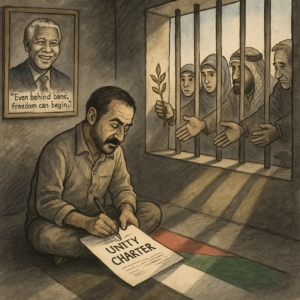
Barghouti’s enduring appeal stems from his rare ability to speak across divides. He commands respect not only from Fatah loyalists but also from Hamas sympathizers, leftist intellectuals, and even disillusioned youth. In 2006, while imprisoned, he led a cross-factional initiative known as the “Prisoners’ Document,” calling for national unity and a two-state solution. His vision transcends political infighting, an affliction that has crippled Palestinian leadership for years. For many Palestinians, he represents a future leader not tainted by the corruption, inertia, or factionalism of the current political elite.
But Barghouti’s path is not without obstacles. The internal rift between Fatah and Hamas remains deep, and any leader attempting to bridge that divide risks alienating one side or the other. Moreover, his imprisonment, while symbolic, limits his direct engagement with diplomacy and governance. Some within Fatah’s leadership fear his popularity and have worked to sideline him, even as ordinary Palestinians continue to chant his name in refugee camps and university halls.
Israel’s refusal to release Barghouti speaks volumes. Unlike other high-profile prisoners who have been freed in past exchanges, Barghouti is seen as politically dangerous—a man capable of mobilizing mass support and altering the balance of leadership in the region. His liberation could legitimize the Palestinian cause in ways Israel fears, especially if he were to emerge as a presidential candidate.
To keep him imprisoned is to try and silence a narrative that cannot be caged.
Barghouti’s story is not merely one of imprisonment; it is a testament to the enduring power of political identity and collective memory. Like Nelson Mandela before him, Barghouti has turned confinement into a platform for moral clarity and national dignity. He is not without controversy, but his voice carries the weight of sacrifice and service—traits sorely lacking in the current leadership landscape.
The question is not only whether Barghouti will walk free, but whether Palestinians and the international community will rally behind his call for justice, unity, and peace. In a region starved of credible leadership and vision, Marwan Barghouti remains the one figure capable of lighting a path forward—if we are willing to listen.

