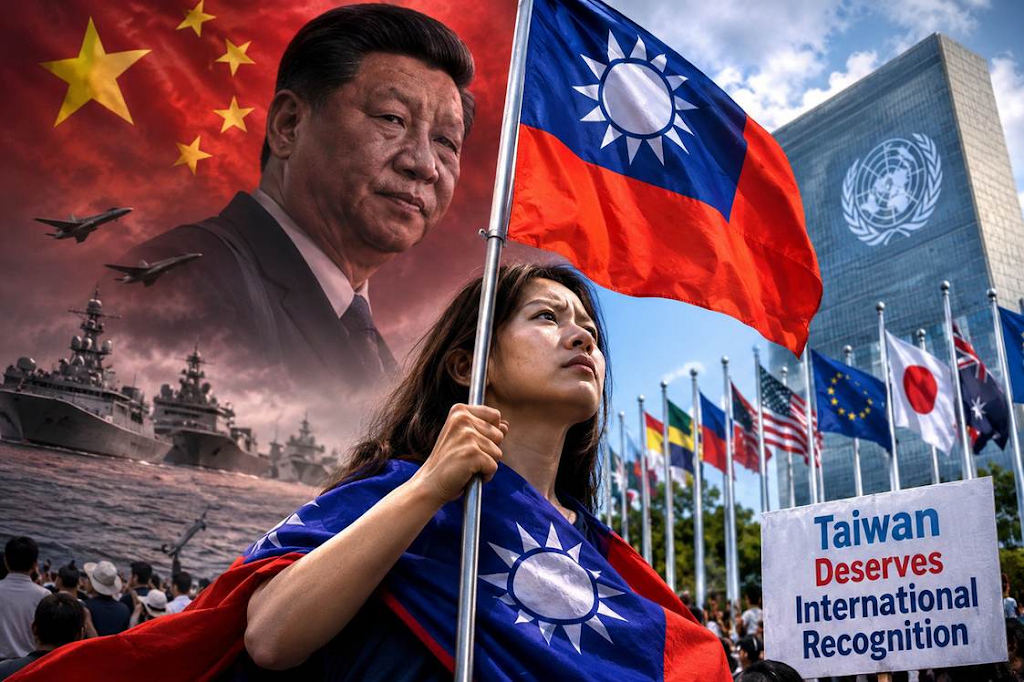

The struggle across the Taiwan Strait is often examined through the language of military preparedness, territorial sovereignty and the possibility of armed conflict. Yet, another contest is unfolding, one that receives considerably less attention: the battle for diplomatic recognition, international access and control over the narratives through which the world understands Taiwan’s political identity.
In this contest, Beijing enjoys a substantial structural advantage. Its extensive diplomatic network, economic influence and political relationships across Africa, Europe, the Middle East, Asia and the wider Global South provide it with platforms that Taipei cannot access on comparable terms. This imbalance has consequences extending far beyond the number of embassies each side maintains. It shapes which political positions are heard, which governments feel comfortable engaging Taiwan and, ultimately, how Taiwan’s international legitimacy is perceived.
Beijing enjoys an extensive diplomatic network, economic influence and political relationships that Taipei cannot access on comparable terms.
China has established formal diplomatic relations with almost every African country, while Taiwan retains official diplomatic recognition from only one: Eswatini. The situation is similarly restrictive elsewhere. As of 2026, Taiwan has just 12 formal diplomatic allies worldwide, with the Holy See its only diplomatic partner in Europe. By contrast, Beijing maintains an extensive network of embassies, diplomatic missions and bilateral partnerships through which it advances its foreign policy positions.
This does not mean Taiwan is absent from international engagement. Its Ministry of Foreign Affairs reported 113 overseas missions in 71 countries and regions as of March 2025, including 12 embassies and numerous representative and economic offices. However, these offices do not enjoy the same diplomatic status as embassies accredited by countries that formally recognise Taiwan. The distinction is fundamental: having a representative office does not necessarily mean having the political standing to participate in official diplomatic processes.
China has established formal diplomatic relations with almost every African country, while Taiwan retains official diplomatic recognition from only one: Eswatini.
The consequences of this imbalance are particularly visible in Africa. Over the years, Beijing has strengthened its relationships with African governments through infrastructure financing, trade, development partnerships, investment and high-level diplomatic engagement. These relationships also provide China with opportunities to promote its position on Taiwan, particularly its One-China principle, which maintains that Taiwan is an inalienable part of Chinese territory and that the People’s Republic of China is the sole legitimate government representing China.
For African governments, the decision to establish or maintain relations with Beijing rather than Taipei is therefore not necessarily a question of historical ignorance about Taiwan. It is frequently a calculation involving economic interests, development priorities and the political consequences of diplomatic choices. Countries dependent on external financing, infrastructure investment and access to international markets may be reluctant to adopt positions that could jeopardise their relationships with a major economic power.
The experience of Lithuania illustrates the potential consequences. In 2021, the country permitted Taiwan to establish a representative office in Vilnius using the name Taiwan rather than Taipei. Beijing responded with diplomatic and economic pressure, including trade restrictions. The episode demonstrated that even a European Union member could face substantial economic consequences for decisions Beijing considers contrary to its interests.
In April 2026, Taiwan’s President Lai Ching-te postponed a planned visit to Eswatini after Seychelles, Mauritius and Madagascar withdrew overflight permissions for his aircraft
More recently, Africa has witnessed another revealing episode. In April 2026, Taiwan’s President Lai Ching-te postponed a planned visit to Eswatini after Seychelles, Mauritius and Madagascar withdrew overflight permissions for his aircraft. Taipei attributed the decisions to Chinese pressure and economic coercion, allegations Beijing rejected. The incident demonstrated how diplomatic influence can extend beyond formal recognition and affect even the practical movement of Taiwan’s political leadership.
The latest developments in the Pacific are equally significant. On 17 November 2026, Papua New Guinea’s Prime Minister James Marape told Chinese President Xi Jinping that closing Taiwan’s representative office in his country had not been easy, although his government was committed to the One-China principle. Taiwan had announced the office’s closure earlier in November, attributing the decision to Chinese pressure. This illustrates how Beijing’s diplomatic influence can translate into the gradual contraction of Taiwan’s international presence.
On 17 November 2026, Papua New Guinea’s Prime Minister James Marape told Chinese President Xi Jinping that closing Taiwan’s representative office in his country had not been easy,
The broader concern is the relationship between diplomatic reach and narrative power. When Chinese diplomats engage governments, universities, media institutions, political parties and regional organisations, Beijing has multiple opportunities to communicate its interpretation of cross-strait relations. Its position can become embedded in official statements, bilateral agreements and regional diplomatic declarations. Taiwan, operating under considerably greater restrictions, has fewer equivalent opportunities to contest those representations.
Over time, this creates an uneven international information environment. The repeated presentation of Taiwan as an internal Chinese matter can become familiar to international audiences, while Taiwan’s democratic institutions, distinct political identity and self-governing reality receive comparatively less diplomatic attention. Familiarity with one state’s position, however, does not automatically establish its legal or moral correctness.
The distinction between Beijing’s One-China principle and other governments’ One-China policies also deserves attention. Countries make different diplomatic formulations, and United Nations General Assembly Resolution 2758 of 1971 recognised the representatives of the People’s Republic of China as China’s representatives at the United Nations. The resolution did not explicitly determine Taiwan’s sovereignty or independently resolve its political status.
Taiwan’s predicament therefore raises an important question about the international system: can smaller political entities exercise meaningful international agency when their diplomatic opportunities are constrained by the economic and political power of a much larger state?
Taipei cannot compete with Beijing simply by attempting to replicate China’s diplomatic infrastructure. It must strengthen substantive relationships through trade, technology, education, development cooperation, cultural diplomacy and engagement with democratic institutions. It must also communicate more effectively with African societies, where public understanding of Taiwan is often mediated through the diplomatic positions of national governments.
Taipei must communicate more effectively with African societies, where public understanding of Taiwan is often mediated through the diplomatic positions of national governments.
Ultimately, Taiwan’s international isolation should not be mistaken for an absence of political identity, democratic legitimacy or international relevance. Its predicament reflects an unequal distribution of diplomatic power in which economic influence can determine who receives access to international platforms and whose political narrative becomes more widely heard.
The danger is that, in the struggle for Taiwan’s future, the international community may become increasingly familiar with Beijing’s position while hearing progressively less from the people whose political future is being contested.

The writer, Dr. Tiema Haji is an academic, researcher, author, journalist, communication specialist and an accomplished poet.