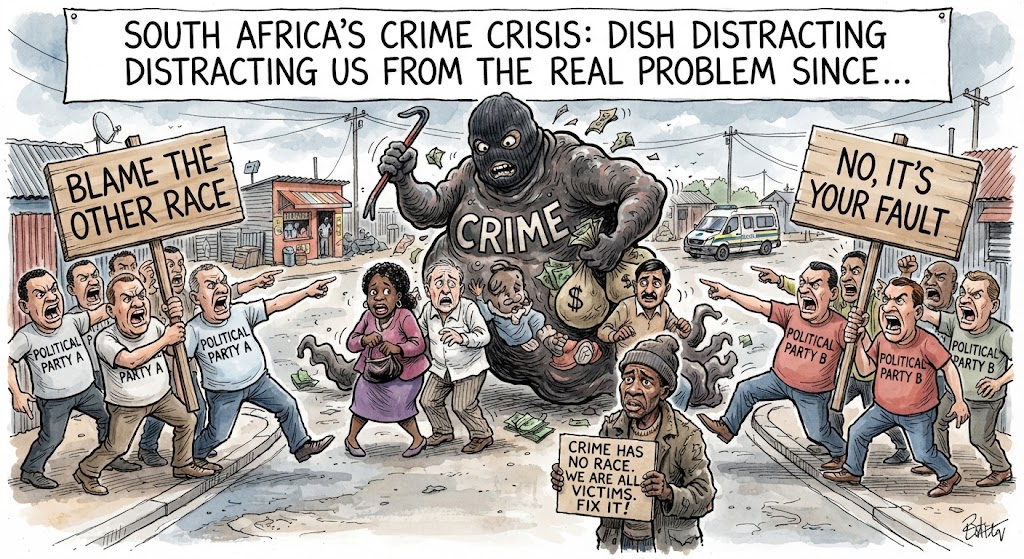

Something troubling is happening in how South Africa is increasingly discussed in parts of the United States. A country of more than 60 million people, with one of the most complex histories of race, reconciliation and democratic change in the modern world, is increasingly being presented through a much narrower story: that white Afrikaners are the targets of systematic racial persecution. The claim has moved beyond the margins of political debate. It has entered the diplomatic relationship between South Africa and the United States and is influencing how some Americans understand our country.
South Africa should not respond by pretending that all is well.
South Africa should not respond by pretending that all is well. Crime is one of the most serious challenges facing our society. South Africans are murdered, robbed and assaulted in communities across the country. Women continue to experience unacceptable levels of violence. Farmers and farmworkers worry about their safety, as do families in townships, suburbs, informal settlements and rural villages. These are not abstract statistics. Behind every incident is a person, a family and a community whose life has been changed.
The evidence does not support that conclusion.
The question is therefore not whether South Africa has a crime problem. We do. The more important question is whether the violence confronting the country amounts to a state-directed campaign against white Afrikaners. The evidence does not support that conclusion. Acknowledging the reality of crime and rejecting claims of genocide are not contradictory positions. We can take farm attacks seriously without describing them as evidence of racial extermination. We can listen to Afrikaners who are genuinely afraid without accepting every political conclusion drawn from that fear. We can demand better policing in farming communities while demanding the same urgency for women facing gender-based violence and families living with violent crime elsewhere in the country.
can demand better policing in farming communities while demanding the same urgency for women facing gender-based violence
South Africa’s Ambassador to the United States, Roelf Meyer, brought an important personal dimension to this debate in a recent BBC interview. Meyer is himself an Afrikaner and was one of the central negotiators in South Africa’s transition from apartheid. He rejected the suggestion that there is a mass attack on Afrikaners while acknowledging South Africa’s difficulty in preventing and combating crime. He also made an important point about his role in Washington: he is not there to represent Afrikaners alone, but South Africa as a whole.
Nobody should dismiss the experiences of people who have been attacked on farms
That is precisely the balance this conversation requires. Nobody should dismiss the experiences of people who have been attacked on farms or lost family members to violence. Farm attacks are real, sometimes brutal, and deserve effective policing and prosecution. Rural communities also present particular policing challenges because of distance, isolation and response times.
What does not follow from those realities is the conclusion that white farmers are being systematically eliminated because of their race.
Perhaps the more useful starting point is to recognise that South Africa does not need to choose which victims deserve our compassion. A farmer murdered on a farm, a farmworker killed in the same rural economy, a woman murdered by an intimate partner and a young person killed in a township are not competing claims on our humanity. Each represents a life lost and a family left to live with the consequences. Our response to crime should therefore never depend on the victim’s race, occupation or geography.
This is why South Africa must address crime holistically.
This is why South Africa must address crime holistically. Rural safety presents particular challenges and requires appropriate interventions. Gender-based violence and femicide demand responses that recognise its particular causes and circumstances. Gang violence, organised crime, extortion, illegal firearms and violence in communities present different challenges again. Different forms of criminality require different responses, but they fall under the same national responsibility to protect people.
There is also an opportunity here for the United States and South Africa. Instead of allowing crime to become another source of diplomatic confrontation, the two countries could make public safety an area of practical cooperation. Meyer has spoken about the possibility of American assistance with resources that could strengthen policing and improve response capabilities. Such cooperation would be far more constructive than arguing across the Atlantic about which racial group owns South Africa’s suffering.
South Africa also has a responsibility to explain itself better
South Africa also has a responsibility to explain itself better. When institutions are slow to provide credible information, speculation fills the space. When people with genuine concerns feel dismissed, they will naturally seek audiences elsewhere. When difficult issues are left unexplained, others will inevitably provide their own explanations.
The answer cannot be propaganda or an attempt to persuade the world that South Africa has no problems. Nobody who lives here would find that credible. The better response is openness. We should put credible facts on the table, acknowledge where government is falling short, listen to communities that feel unheard and correct misinformation without insulting people who may have believed it. The same care should inform the American conversation about South Africa. Afrikaner experiences deserve to be heard, but they cannot be treated as the only South African experiences that matter.
We should put credible facts on the table,
There is something profoundly South African about being able to hold these truths together. One can be proudly Afrikaner and fully South African. One can acknowledge the continuing consequences of apartheid without believing that white South Africans have no future here. One can be deeply concerned about farm attacks while recognising that violent crime devastates families of every race. Crime must be confronted because every South African deserves to live without fear. Farmers and farmworkers deserve protection. Women and children deserve protection. Families in townships, villages, suburbs and cities deserve protection.
There should be no racial hierarchy in the value we attach to those lives. South Africa’s crime crisis is serious enough without turning it into a racial contest over whose suffering matters most.
****
Saul Molobi is a former South Africa’s Consul-General in Milan. He is the founding Chairman and Chief Executive Officer of Brandhill Africa.

Saul Molobi is a former South Africa's Consul-General in Milan. He is the founding Chairman and Chief Executive Officer of Brandhill Africa.