

MP Khwezi Ka Ceza is Gqeberha-based independent political commentator, community leader and a social activist.
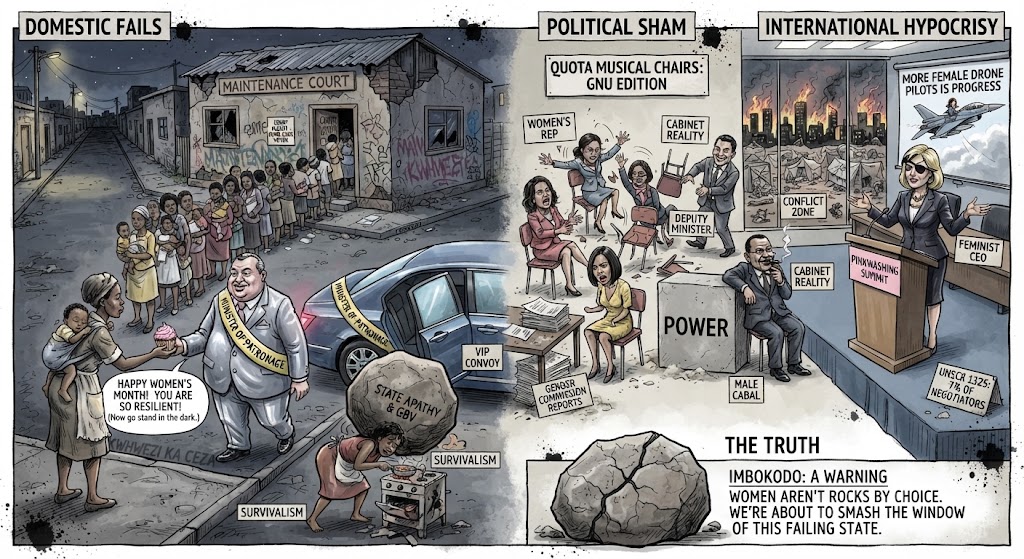
Every August, South Africa performs the same tired, patronizing ritual. The red carpets roll out, politicians dust off their tailored suits, and the national microphone gets choked with breathless tributes to Wathint’ Abafazi, Wathint’ Imbokodo (you strike a woman, you strike a rock). It is a predictable annual script. Empty speeches, staged photo-ops, and state-sponsored cupcakes are handed out to women who would much rather have functioning streetlights and working maintenance courts.
Let’s stop calling it a national celebration. August in South Africa isn’t a tribute; it’s a tax.
The state’s obsession with “female resilience” is nothing more than a convenient, psychological scam. Women are endlessly praised for their ability to endure because the government has utterly failed to provide the basic safety, economic infrastructure, and law enforcement that would render such extreme endurance unnecessary. Women aren’t resilient by choice. They are forced into resilience because the alternative provided by a failing state is literal extinction.
Quota Musical Chairs and the Shrinking Table
Look at the political landscape following the 2024 general elections and the messy formation of the Government of National Unity (GNU). The rhetoric promised gender transformation. The data tells a story of systemic regression. Women’s representation in the National Assembly didn’t surge. It backslid, dropping from 46% down to 43%. South Africa tumbled down global parliamentary gender rankings from 12th to 22nd place in a single political cycle.
When political parties sat down to divide cabinet portfolios and negotiate power-sharing deals, gender parity commitments were the first items tossed off the table. Women currently hold just 40% of executive ministerial posts, reversing years of incremental gains. Independent statutory oversight bodies, including the Commission for Gender Equality , continue to publish damning reports detailing systemic failures; from alarming withdrawal rates of sexual offense cases in Mpumalanga to the broken infrastructure of Thuthuzela Care Centres in the Eastern Cape. The reports gather dust. The status quo remains untouched.
What we are witnessing is a game of “quota musical chairs.” Political parties strategically position female leaders to soften the public image of decaying, corrupt institutions, but rarely hand over the keys to hard power. Finance, Energy, and Police remain comfortably locked within male-dominated cabals. Women leaders are deployed as political human shields who are expected to absorb public rage over collapsing municipal services while wielding zero real budgetary authority to fix them.
More Female Drone Pilots Isn’t Feminist Progress
If our domestic situation feels like a slow-motion wreck, the international stage is a masterclass in liberal hypocrisy. Step into any corporate boardroom from Johannesburg to London, and you’ll be drowning in buzzwords like “feminist foreign policy,” “boardroom inclusion,” and “women in leadership.” It’s pinkwashing at its most expensive.
Over two decades after the UN Security Council adopted Resolution 1325 (UNSCR 1325), promising to protect women and girl children in conflict and guarantee their participation in peacebuilding; the actual data on global warfare reads like a damning indictment. According to the UN Women Peace and Security Data tracking UNSCR 1325 indicators, the proportion of women killed in armed conflicts globally doubled year-on-year. Verified cases of conflict-related sexual violence against women and girls surged past 4,600 recorded incidents, marking an 87% leap over recent reporting periods. Out of all formal peace processes worldwide, women make up an abysmal average of just 7% of negotiators and 14% of mediators, while 676 million women and girls live directly within conflict zones. To compound the hypocrisy, out of billions spent in conflict-affected settings, funding dedicated to local women’s rights organizations in war zones remains stalled at a paltry baseline.
While Western liberal feminism celebrates the “historic milestone” of a female CEO taking over a defence contractor or a global banking cartel, the material reality for women and girls in Gaza, Sudan, and the Democratic Republic of Congo is accelerating into catastrophe. Maternal healthcare systems are systematically obliterated and conflict-related sexual violence is weaponized with absolute impunity. The global international order eagerly crowns “women in power” to give polished summit keynote speeches, but remains totally indifferent when those same power structures oversee the destruction of maternity wards. Shattering the “glass ceiling” means very little when the structural floor is being blown out from under the women who actually keep human society alive.
Subsidizing State Failure with Female Burnout
Back home, the quietest theft occurs within the “Care Economy.” South Africa’s economic machinery relies heavily on a massive, uncompensated army of women who manage households, raise children, care for the elderly, and nurse the sick. All, while navigating unlit township roads and terrifying daily security risks.
The national crime statistics remain a daily index of horror, with over 60 people murdered every day and Gender-Based Violence (GBV) operating at epidemic levels. What is the state’s answer? Delayed policy rollouts, underfunded shelters, and platitudes. Instead of structural economic support, women are told to start under-capitalized informal micro-enterprises. Survivalism is rebranded as “entrepreneurship,” neatly shifting the responsibility of economic security off the state and onto the exhausted shoulders of the marginalized.
Keep Your Cupcakes, Fix the Courts
So what should August actually mean? It means rejecting the performative circus. Society does not need another Ministerial Women’s Month breakfast. It does not need another panel discussion that ends with a commemorative photo and zero binding policy deadlines.
We need to break the myth of the “rock.” Expecting women to endure poverty, systemic violence, and state negligence without dying is not an achievement. It’s an injustice.
If the state wants to honour women, it should start by funding specialized police units and fixing maintenance court queues with the same speed and budget it allocates to VIP blue-light convoy motorcades. If international institutions want to preach gender equality under Resolution 1325, they must confront the reality that a female executive overseeing an arms firm isn’t progress. It’s an atrocity in a pencil skirt.
This month, let’s drop the polite celebration. Let’s stop expecting women to be the silent rocks that absorb the blow while the tide tries to drown them. Calling women Imbokodo shouldn’t be a patronizing compliment handed out by men in suits. It should be taken as a warning that the rock is about to smash the window.
MP Khwezi ka Ceza is a Gqeberha–based independent political commentator and social critic