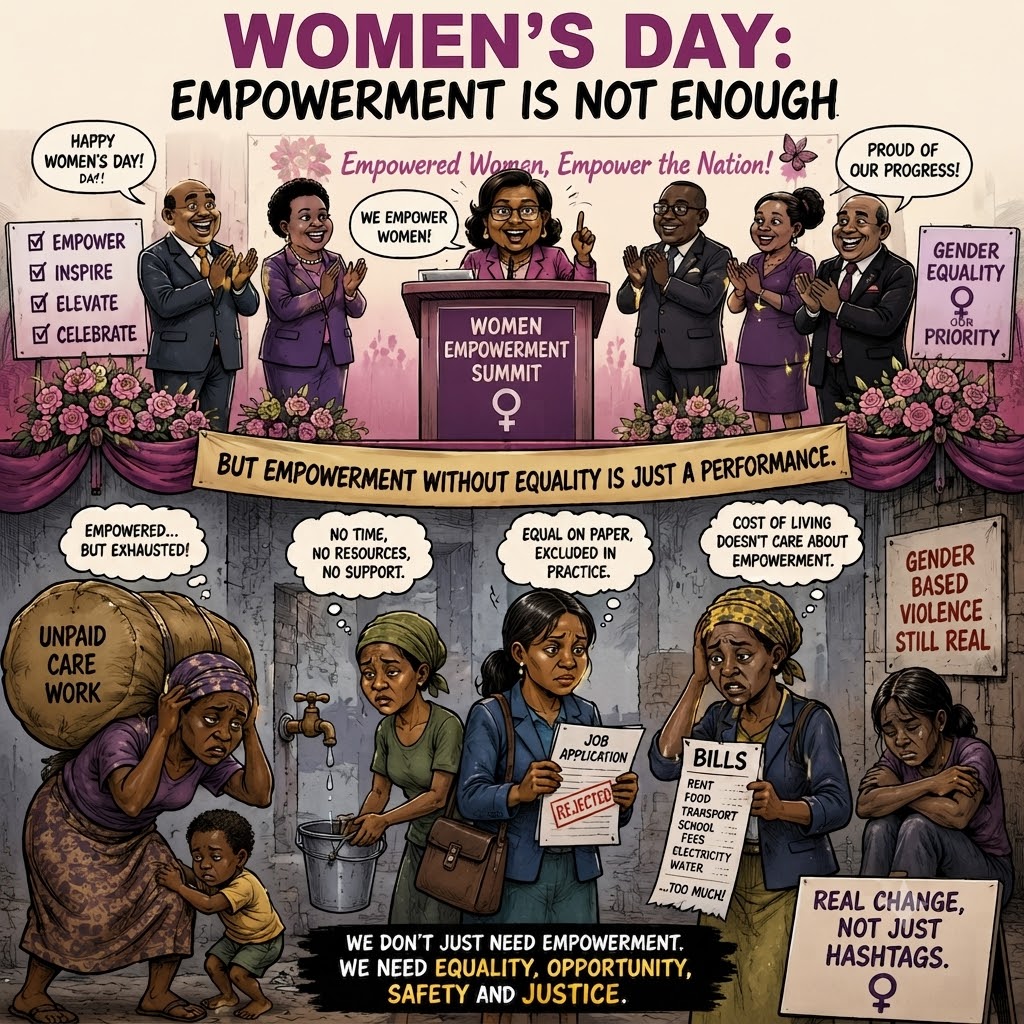
On Women’s Day, seventy years after the march to the Union Buildings, the language of empowerment is not the whole of what those women were reaching for. What they wanted was flourishing.
On the ninth of August 1956, more than twenty thousand women walked to the Union Buildings and, having laid their petitions at a locked door, stood in silence for half an hour. We remember the marching and the singing. Wathint’ Abafazi, Wathint’ Imbokodo, you strike a woman, you strike a rock. But I have always been moved most by the silence, a fullness held in common. Thousands of women choosing, together, to say nothing and to mean everything by it. They had come to protest the pass laws. But a protest against a document that dictates where a body may go is never only about the document. It is about the life that document forecloses: the going and the staying, the working and the loving, the whole unlived arc of a person who is told what she may become.
Statistics South Africa puts the unemployment rate for women at close to thirty-six percent,
Seventy years on, and more than thirty years into our constitutional order, we return to that day each August with a vocabulary the marchers might not recognise. This year the state gathers us under the theme Empowered Women Empower the Nation, and directs Women’s Month towards economic inclusion: access to finance, to markets, to procurement, and to the means of a livelihood. I do not dismiss this. I have sat in the rooms where these commitments are negotiated; I know that a woman without income is a woman whose choices have been made for her, and that inclusion in the economy is, for millions, the difference between dependence and a life she can call her own. Empowerment is real, and it is necessary.
And the need is not abstract. Statistics South Africa puts the unemployment rate for women at close to thirty-six percent, several points higher than for men, and the gap widens rather than narrows at the lower end of the wage scale. Women carry the greater share of the country’s unpaid care, absorb the sharpest cuts when a household budget fails, and live under a threat of gender-based violence that can make even the home unsafe. Three decades into our constitutional democracy, the legacy of 1956 is, in the most literal sense, unfinished.
Empowerment asks whether a woman may enter the existing structure in the form of the market,
But it is not the whole of what those women were marching for, and I think we dishonour them when we let it stand in for the whole. Empowerment asks whether a woman may enter the existing structure in the form of the market, the boardroom, and the ballot. Flourishing asks a harder and more generous question: whether the structure she enters is one in which a human being can actually become. These are not the same. One can be included in an economy that still consumes you; one can be counted in a parliament and uncounted at home; one can be ‘empowered’, and still not free to flourish. Empowerment opens the door; flourishing asks what kind of house we have built behind it.
Flourishing, in the tradition I work within, is not a private possession. It is not a matter of one woman’s achievement, held up as proof that the system works. It is relational. The southern African grammar for this is ubuntu: I am because we are, a self that comes into being only through others. And its cousin is a word I return to often, ngisazophumelela (I am still becoming, I will yet succeed). It is the insistence of a person who has not arrived, spoken in the present continuous, because becoming is the only tense a living person truly inhabits. To flourish is to be given the room to become who one has not yet been permitted to be.
Read against that horizon, the wounds we name each August come into sharper focus. Gender-based violence is not, in this frame, only a crime statistic; it is the tearing of a relational web. The striking of a woman who holds a fabric of kin and care, tears that fabric so that she and all of us are made smaller by the tear. The women of 1956 already knew this. Wathint’ Imbokodo is not a boast about one woman’s hardness. It is a claim about the web: strike her, and you strike everyone she is bound to. The care that women carry unwaged and unseen, the labour that holds households and clinics and communities together while going unmeasured in every ledger of the economy is a web, and a flourishing worthy of the name would not merely include women in the economy but would finally see the economy that women have been holding up all along.
To flourish is to be given the room to become who one has not yet been permitted to be.
I want to press on the theme itself. Empowered Women Empower the Nation is true, and it is also a sentence that makes a woman’s flourishing conditional, something that must earn its keep by serving the nation. The women who stood in silence that day were not being useful. They were being human, in full, in public, and demanding that the country make room for them. A woman’s becoming does not require a national return on investment to justify itself. And yet her flourishing is the nation’s, not because it is instrumental but because we are woven together, and no thread flourishes while the cloth is torn.
This is why Women’s Day, for me, is never quite a celebration and never quite a mourning. It is a day of the not-yet. Seventy years on, we have the vote, the Constitution, the language of rights, and the seats at the table. But we do not yet have the thing those women were reaching towards with their thirty minutes of eloquent silence: a country in which every woman is free, in the fullest sense, to become.
So let us ask more of this day than remembrance. A constitutional democracy is judged, in the end, not only by the rights it guarantees but by whether it lets people live lives of dignity, belonging and possibility. By that measure the work belongs to all of us: to a government that must treat women’s flourishing as an index of the nation’s health; to a business sector that must ask not merely how many women it has hired but whether the lives it shapes are ones in which a person can become; and to each of us who draws on the web that women hold together.
Let Women’s Day become the measure of whether we are building that country, rather than the occasion on which we congratulate ourselves for how far we have come. Ngisazophumelela is not a lament but a vow, I am still becoming, and a vow, unlike a celebration, asks to be kept.

