

MP Khwezi Ka Ceza is Gqeberha-based independent political commentator, community leader and a social activist.
The South African political landscape of 2026 is defined by a desperate, oscillating energy. From the corridors of power in Pretoria to the dust-blown streets of Mdantsane, Umlazi and Soweto, the rhetoric has shifted from the grand promises of the post-1994 transition to a visceral, survivalist politics. At the heart of this shift is the rise of movements like those chanting “Abahambe.” These are movements that have identified the foreign national as the primary obstacle to prosperity.
Are we actually fighting for liberation, or are we merely fighting for the crumbs
But as the chant echoes across township spaza shops and vending stalls, a critical question emerges: Are we actually fighting for liberation, or are we merely fighting for the crumbs of a system that was designed to keep us exactly where we are?
The Optics of Scarcity
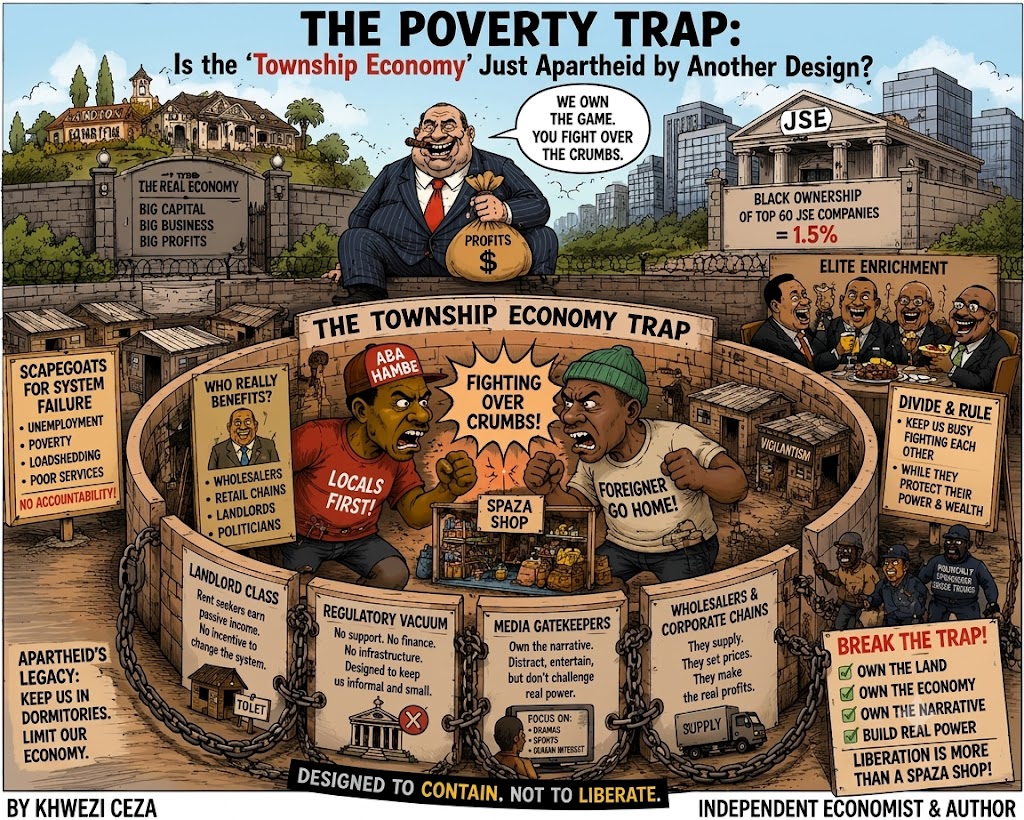
The Abahambe movement and its counterparts operate on a simple, emotive premise. A chimera that the displacement of foreign migrants from the informal sector will create space for locals to thrive. It is a politics of the “visible enemy.” By targeting the Somali spaza shopkeeper or the cross-border vendor, these movements provide a cathartic release for a population exhausted by a national unemployment rate that now sits at a staggering 32.7%, and an even more punishing 60.9% for those aged 15–24.
However, this strategy is not an act of revolution; it is an act of containment.
By focusing the entirety of our struggle on the “township economy,” we are not challenging the architectural legacy of the 1913 Land Act or the Group Areas Act. We are internalizing it. Apartheid was, at its core, a spatial project designed to limit Black economic activity to “labour dormitories” and informal markets. As government-linked research confirms, the apartheid planning system resulted in townships “acting as dormitories for the labour requirements of the mining industry and later manufacturing and services.” When we frame the solution to Black poverty as the reclaiming of the spaza shop, we are accepting the premise that the township is the only place we belong. We are ‘policing our own borders,’ ensuring we remain in the shacks while the real capital remains untouched in the gated enclaves of Sandton, uMhlanga, and Constantia.
When we frame the solution to Black poverty as the reclaiming of the spaza shop, we are accepting the premise that the township is the only place we belong
The Illusion of Control: Who Runs the “Township Economy”?
The term “Township Economy” is often treated as a monolith, but it is actually a captured ecosystem.
Despite the optics of the “local spaza vs. foreign shopkeeper” conflict, the true “owners” of the township economy are the massive wholesalers and retail chains who have the monopoly. Whether a spaza shop is owned by a South African or a foreign national, the inventory is almost exclusively sourced from large-scale, non-Black-owned formal wholesalers. As one analysis puts it: “Every economic space in these areas is dominated by merchandise from outside black or township control”. These corporations make their margins regardless of who is behind the counter.
The Landlord Class
Many South Africans who previously operated spaza shops have shifted their role. They have become landlords, renting out their premises to foreign entrepreneurs. In this setup, the landlord extracts passive income while the tenant carries the business risk and the daily labour. This creates a class of local residents who are financially incentivized to maintain the current structure rather than revolutionize it.
Research on township economies confirms this pattern of “minimal government support,
The Regulatory Vacuum
The state’s failure to provide infrastructure such as banking support, cold-chain logistics, and simplified compliance ensures the sector remains “informal.” Research on township economies confirms this pattern of “minimal government support, inadequate infrastructure and skills, and limited access to finance”. This makes it impossible for small-scale entrepreneurs to scale up, keeping them trapped in a cycle of subsistence that benefits the larger formal economy by acting as a cheap distribution point for their goods.
The Media Gatekeepers
You asked who owns Isolezwe. It is published by Independent News and Media SA, which is 55% owned by Sekunjalo Investments. When you read Isolezwe, you are consuming a publication tailored for what its own editor described as the “modernising Zulu” consumer. That is someone “who may go back home to the rural areas… but is as equally comfortable taking his family out for dinner.”
While it provides a vital platform for local language news, its editorial direction is beholden to the shareholder interests of its parent company. It acts as a mirror for the community’s aspirations, but it is a mirror polished by an entity far removed from the streets of the township. By focusing on human-interest stories, local sports and community dramas, these papers often steer the public away from the deep-dive investigative journalism that would threaten the major economic interests of the holding companies or their corporate partners.
Black Economic Empowerment (BEE), while theoretically noble, has largely devolved into “elite enrichment.”
The Myth of the “Empowered” Elite
Black Economic Empowerment (BEE), while theoretically noble, has largely devolved into “elite enrichment.” Since the 1990s, by some estimates, a small cohort of politically connected individuals secured the lion’s share of BEE mining and energy deals. This is not the “leveling of the playing field” that Steve Biko envisioned. Biko’s philosophy was about psychological and economic independence, the reclaiming of the self from a colonial system. Instead, we have seen a system where a few “eat” on behalf of the many, using the language of empowerment to justify a status quo that keeps the majority in perpetual precarity.
Who Benefits from Vigilantism?
The Abahambe movement serves as “political shock troops.” The primary beneficiaries are rarely the marchers.
This is where political entrepreneurship raises its ugly head. Opportunistic politicians use this to deflect accountability for failed economic policy, energy crises, and the erosion of public services. It is a “divide and rule” strategy. When the people are busy policing their own neighbourhoods, they are not marching to the Union Buildings or the JSE. The corporate status quo is guaranteed immunity. Vigilantism protects the elite.
By keeping the working class focused on the “spaza shop level,” the movement legitimizes the idea that the problem is the competition for crumbs, rather than the size of the bread.
The vigilante narrative provides a convenient excuse for state failure.
The Scapegoat
The vigilante narrative provides a convenient excuse for state failure. If the government cannot provide jobs or healthcare, it points to the “foreigner.” It is a deflection that allows the political elite to maintain their positions of power while the impoverished residents of the township fight a war of attrition over the right to sell goods in a space designed to be a dormitory, not an economic hub.
If we want to honor the legacy of those who fought against apartheid, we must stop fighting over the scraps and start interrogating the citadels of capital.
The Corporate Concentration
Why is the public discourse not focused on the percentage of the JSE owned by non-Black capital versus the actual, tangible ownership by the Black working class? New research commissioned by the Black Management Forum shows black ownership accounts for just 1.5% of the market capitalisation of the top 60 JSE companies. That is R255-billion, or 6.9% of South African assets. Worse, 77% of all black ownership on the JSE is concentrated in just two sectors; mining and financial services, while the rest of the economy remains virtually untouched. This is not transformation, it is containment by another name.
The Geography of Wealth
We have seen our leaders migrate from the townships to the leafy suburbs. When they leave, they take the political focus with them. The fight for a “share of Sandton” is about breaking the spatial and economic confinement that has defined our existence for over a century.
True liberation will not be found in the clearing of a market stall. It will be found when we stop being the gatekeepers of our own poverty and start demanding the keys to the kingdom. Until then, we are not fighting for a future; we are just fighting to remain in the past.
MP Khwezi ka Ceza is a Gqeberha-based independent political economist and author