
MP Khwezi Ka Ceza is Gqeberha-based independent political commentator, community leader and a social activist.
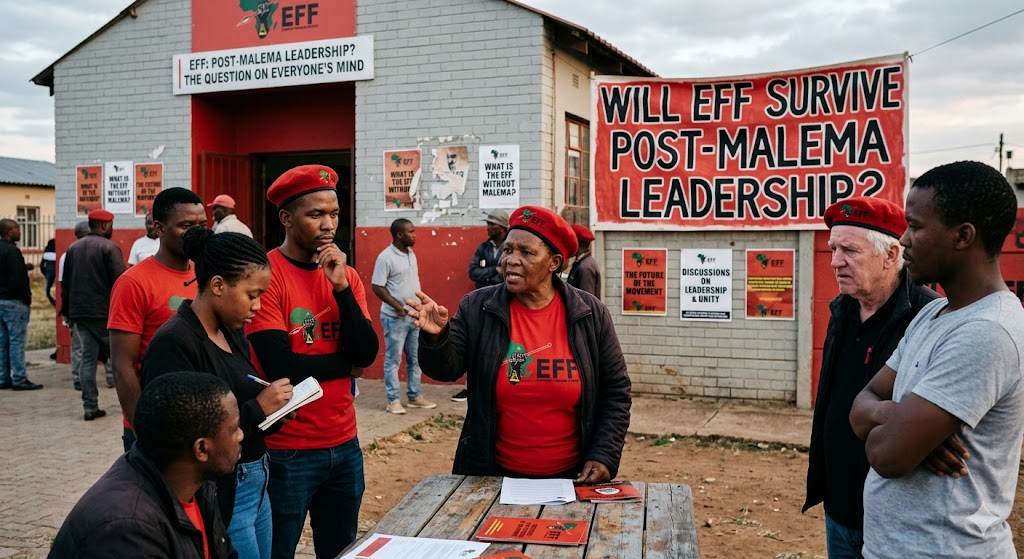
Judging from continuous developments throughout the evolving existence of the EFF, political theories, media speculations and misconstrued obituaries have been surfacing across the political spectrum. While the recent the discussion has been sparked by the recent criminal charges and the subsequent conviction of its President, this is rooted in the misrepresentations, misrepresentations and oversimplification. Hence, the political propaganda driven through the media bias that the party would face an existential crisis in the absence of its current founding president.
The political propaganda driven through the media bias that the party would face an existential crisis
However, empirical analysis and evidence-based assessment of the EFF should be relied upon data, exit polls and party manifestos. Of course, a decline from 10,80 %in 2019 to 9,52 in 2024 was an undesirable outcome and a regressive trend by its established standards. And that should be viewed as a consequence of internal infiltration that was resultant of the establishment of the Umkhonto Wesizwe Party, as evidenced by what transpired in the aftermath.
Therefore, even the nominal exit of some prominent members could barely be used as a measure of significant decline or internal power dynamics. On the contrary, it unmasked certain elements harboring within the organizations who were harboring selfish interests elsewhere, but rather exploiting their political access to facilitate their clientistic agendas through the organization. Power networks have also suggested that such developments will result in leadership vacuum. To identify the logical fallacies of the argument, the dissidents often referred to have never made any sort of impact elsewhere since leaving the organization. And of course, their departure may have caused a deficit in strategic leadership capital, but never precipitated an ideological erosion, increasing the party’s susceptibility to policy drift, nor did it reduce its overarching programmatic coherence.
their departure may have caused a deficit in strategic leadership capital, but never precipitated an ideological erosion,
Typically, one cannot be blind to the fact that, as a matter of principle, the EFF has cultivated and entrenched a culture of empowering its leadership at all levels through compulsory education and a whole lot of resourceful vibrant young leadership. Its manifesto and policy framework speak to not only to wretched of the country, but the entire continent. In the same vein, the EFF’s organizational survival is not strictly contingent upon the personalized leadership of Malema, nor does his absence signals the terminal collapse for the party.
In the South African contemporary political climate, the EFF is always ahead of the rest when it comes to planning. Disentangling Malema from formal parliamentary constraints would likely enhance rather than mitigate the EFF’s role as an extra-parliamentary opposition force. Such a move would solidify its position as a counter-hegemonic thorn to the current governing coalition and the broader status quo. Furthermore, the electoral dominance of independence-era parties is currently facing an existential challenge. A significant demographic shift has introduced a cohort of “born-free” voters who prioritize technocratic competence and economic outcomes over the symbolic capital of the liberation era. The institutional ossification this traditional monopoly on power is being disrupted by a generational realignment, where voters would likely exchange path-depended loyalty for rational-choice evaluations of economic governance. This marks the end of the charismatic, liberation era legitimacy that has resulted in a shift towards a predatory state, utilizing state-sponsored patronage to sustain control against the populace. Several factors accelerating this paradigm shift found traction from younger generation having no personal memory of the liberation struggle. They are focused on immediate needs- jobs, housing and education – rather than nostalgic legitimacy. Combined with economic stagnation, high unemployment and the failure to reform extractive colonial economies, trust in the political establishment has evaporated.
From South Africa’s EFF blueprint to splintered movements across the continent,
From South Africa’s EFF blueprint to splintered movements across the continent, Africa’s economic freedom parties are in a state of flux. The initial phase of rapid growth has slowed, giving way to a more complex era of institutional testing and localized context-specific agenda aimed at youth unemployment and anti-corruption. Led by Captain Ibrahim Traore, the newly formed Confederation of the Sahel States (AES) – comprising Burkina Faso, Mali and Niger – marks a clear shift away from ECOWAS and Western influence, offering a new sovereignty-focused security alliance in the region.
The EFF is built heavily upon the charismatic authority of Julius Malema, similar to many political movements where a dominant personality defines the party’s identity. This structure means the party’s cohesion is directly tied to his political survival. His ability to rally supporters and dominate the media landscape allows the EFF to punch above its weight, but it also creates a vulnerability – the lack of a clear, equivalent alternative leader.
The EFF remains strategically composed, arguably ahead of its organizational timeline.
To understand dynamics of the case, one should read into the recent Iran vs the US/Israel conflict. The loyalty of the EFF collective to their leadership is currently unmatched in South Africa. Whatever trials and tribulations Malema is put through, whether he survives or not, he would still remain a hero or martyr. By framing the upcoming elections as “victory or death,”Malema is raising the stakes to ensure maximum mobilization. This rhetoric ensures that members and potential voters view these elections not just as a policy choice, but as a fight for survival. It is aimed at consolidating the EFF’s base while potentially alienating moderate swing voters. The EFF remains strategically composed, arguably ahead of its organizational timeline. Far from a crisis point, Julius Malema’s leadership is insulated for the interim by protracted appellate processes. Furthermore, a potential incarceration of Malema would likely act as a catalyst for increased institutional cohesion and intensified the EFF’s political capital rather than causing a leadership vacuum.
MP Khwezi Ka Ceza is Gqeberha-based independent political commentator