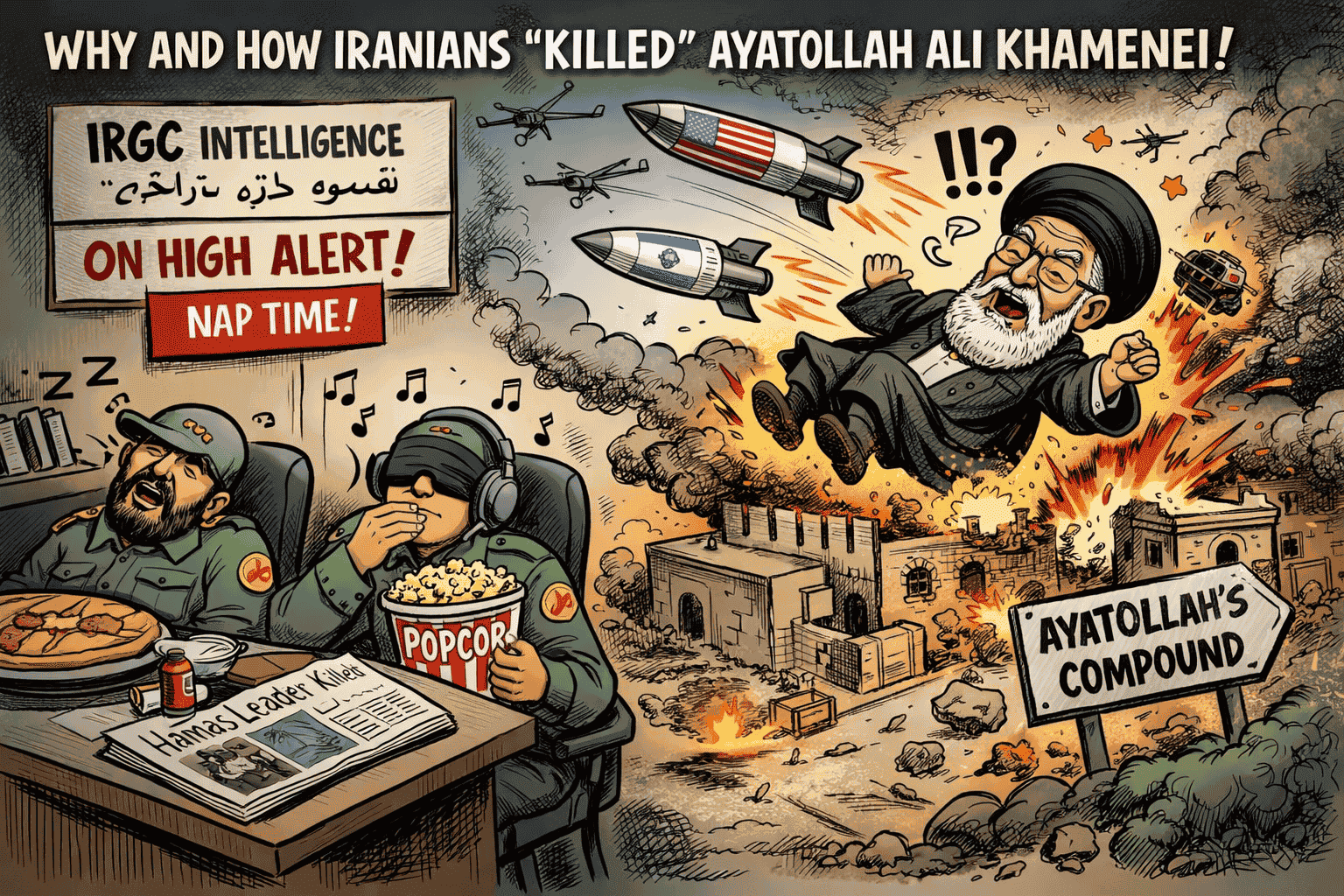
The sudden and dramatic collapse of Iran’s leadership in early 2026, culminating in the reported assassination of the Supreme leader, Ayatollah Ali Khamenei, constitutes one of the most profound intelligence and security failures in recent Middle Eastern history. On 28 February 2026, a coordinated joint military operation by the United States and Israel reportedly killed Khamenei, Iran’s supreme leader since 1989, along with scores of senior political and military officials, in a series of precise aerial strikes across Tehran and other strategic sites.
To understand why and how this occurred, it is critical to examine a pattern of Iranian security lapses that stretches back at least to June 2025, during a twelve-day conflict triggered by an Israeli aerial assault on Iran’s nuclear, military, and intelligence infrastructure. The contrast between Iran’s internal diplomatic posturing, its negotiation stance with the United States, and its catastrophic inability to protect its own leadership reveals deep structural flaws in the Iranian intelligence apparatus.
June 2025: The First Decapitation Strike
On 13 June 2025, Israel launched a large-scale air campaign against Iranian targets as part of “Operation Rising Lion.” This strike was not limited to infrastructure; it was a systematic decapitation of Iran’s military command and nuclear scientific community.)
Among the reported casualties:
- Hossein Salami – Commander-in-Chief of the Islamic Revolutionary Guard Corps (IRGC).)
- Mohammad Bagheri – Chief of Staff of Iran’s Armed Forces.
- Gholamali Rashid – Head of IRGC’s Khatam al Anbia Headquarters.
- Brig. Gen. Gholamreza Mehrabi – Deputy Head of Intelligence for the Armed Forces General Staff.
- Mohammad Mehdi Tehranchi – Nuclear physicist and academic.
- Additional nuclear scientists including Abdolhamid Manouchehr, Ahmad Reza Zolfaghari, Amirhossein Feghi, and Motalibizadeh were also killed.
Analysts at the time recognised the magnitude of this loss: nearly two dozen senior commanders and scientific leaders eliminated in a single coordinated air campaign. The sophistication of the strikes reflected deep foreign intelligence penetration and an ability to locate Iranian leadership even within presumed secure facilities.
A Pattern of Predictability and Structural Exposure
What is striking in retrospect is not just the lethality of these strikes but the context in which they occurred. Throughout 2025, Iran had been simultaneously engaged in diplomatic negotiations with the United States over its nuclear program, even as Israeli Prime Minister Benjamin Netanyahu threatened escalating military action. Iranian leadership appeared externally confident, maintaining high-level meetings and projecting a posture of strategic resilience.
Despite sustained threats and escalating conflict, Iran’s intelligence services repeatedly failed to effectively protect senior personnel and shield critical command nodes. This failure can be attributed to several interconnected weaknesses:
Centralised High-Level Gathering Points
Reports indicate that on multiple occasions, senior commanders were killed while convening meetings in predictable locations, including underground command centers within Tehran. Intelligence services failed to anticipate that such gatherings themselves would be prime targets for adversary strike planners, undermining the basic operational security principle of dispersion.
Overemphasis on Regime Security Over Military Security
Iran’s security focus has historically prioritised regime preservation against internal dissent and subversion. The IRGC and intelligence organs were deeply embedded in domestic surveillance and political policing, arguably at the expense of external threat anticipation. This internal focus may have dulled the apparatus’s capacity to counter sophisticated foreign intelligence and aerial targeting capabilities.
Intelligence Blind Spots and Counterintelligence Failures
The systematic precision of the strikes, which hit not only obvious military targets but also scientific figures and key operational planners, suggests Iranian counterintelligence either underestimated foreign access to encrypted communications, failed to identify infiltration vectors, or lacked awareness of adversary target prioritisation. The repeated loss of intelligence commanders like Mehrabi underscores these vulnerabilities.)
The 2026 Operation and the Death of Khamenei
The reported 28 February 2026 operation, described by U.S. and Israeli sources as involving highly coordinated targeting across multiple locations, resulted in the death of Ayatollah Ali Khamenei, the supreme leader who symbolised Iran’s ideological and political unity for nearly four decades.
Reports indicate up to 40 senior officials were killed in the strikes, including:
- Khamenei himself, whose removal represents a watershed moment in Iran’s political hierarchy.
- Abdul Rahim Mousavi, Iran’s Chief of Staff, among others.
The sheer scale and precision of this operation underscore that foreign intelligence agencies were able to monitor, locate, and strike Iran’s most protected leadership targets, even as they operated ostensibly within fortified compounds.
Comparative Perspectives: Intelligence Failures and State Vulnerability
When contrasted with other notable intelligence failures, whether in fragile or more consolidated states, Iran’s experience highlights unique systemic blind spots rather than mere incompetence. Comparisons to African states where coups and leadership assassinations have occurred often focus on structural instability, weak institutional coherence, and fragmented security apparatuses.
However, Iran’s case is different: it is a state with substantial military resources, deep regional intelligence networks, and one of the most sophisticated security services in the Middle East. The fact that this apparatus twice failed to anticipate and mitigate existential threats, and in 2026 allowed the supreme leader’s death, points to an extraordinary intelligence collapse. This collapse appears to originate not from lack of capability, but from flawed strategic assessments, overcentralisation, and misaligned priorities.
Geopolitical Consequences and Future Risks
The killing of Khamenei and scores of senior commanders has immediate and long-term implications:
- Power Vacuum: With no clear succession mechanism, Iran faces political fragmentation and internal power struggles.
- Regional Instability: The removal of a central figure in Iran’s geopolitical posture risks further escalation with Israel, the United States, and proxy actors across the Middle East.
- Intelligence Reform Imperative: Iran must reassess not only tactical security protocols but also strategic intelligence doctrine if it is to regain credibility as a regional actor.
The events of June 2025 and February 2026 illustrate a catastrophic pattern of intelligence and security failures in Tehran that allowed foreign adversaries to strike at the heart of Iran’s command structure. The death of Ayatollah Ali Khamenei, once unthinkable , now stands as a stark reminder that even powerful states are vulnerable when their security institutions fail to adapt to asymmetric threats and advanced foreign intelligence capabilities. The Iranian intelligence community must now confront its own structural weaknesses if it hopes to preserve national sovereignty and prevent further erosion of state power.