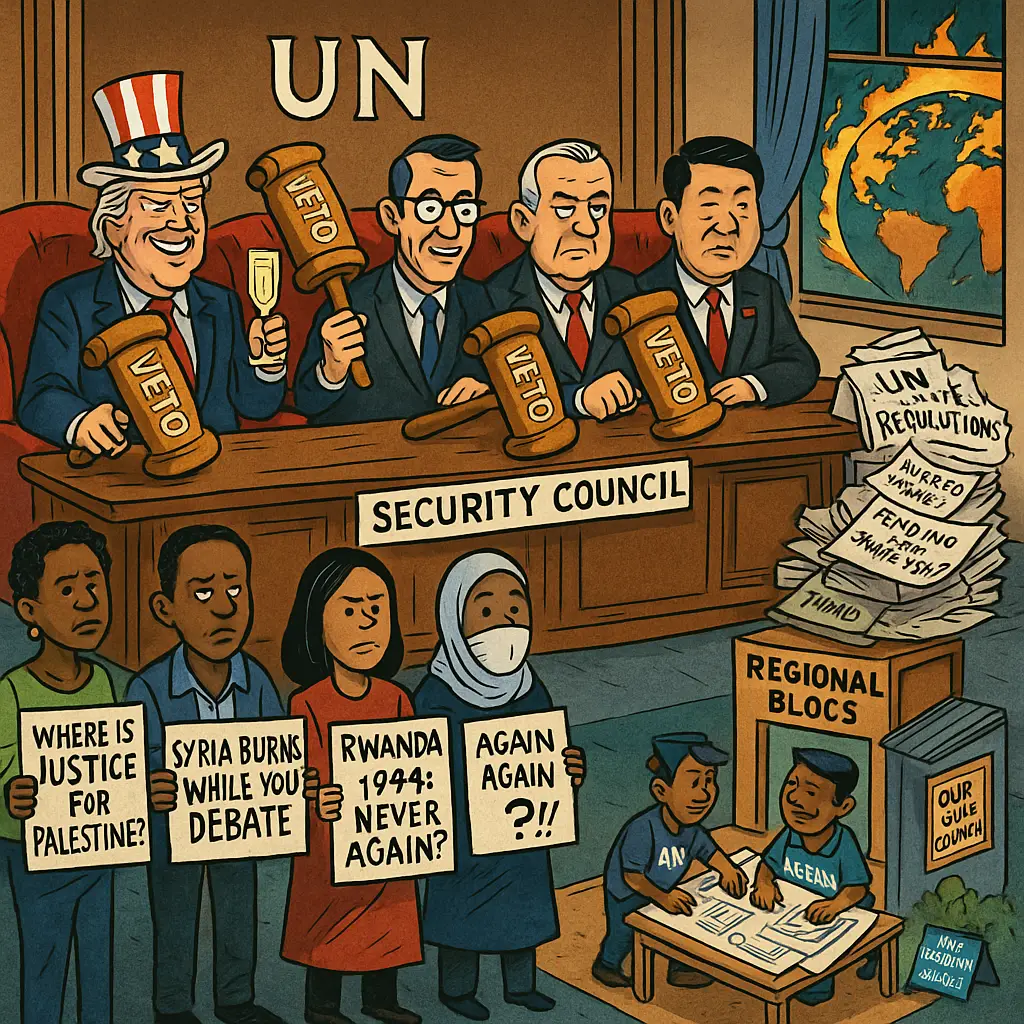

Once envisioned as the moral compass of global governance, the United Nations has devolved into a geopolitical puppet show, one where real conflict resolution is traded for symbolic resolutions, and global equity is crushed under the veto power of five permanent members.
Today, the UN functions more like an exclusive gentleman’s club for elite nations than a serious arbiter of international peace and justice.
It is time to question not just its effectiveness, but its very relevance.
The UN Security Council’s five permanent members, USA, UK, France, Russia, and China, hold unchecked veto power, routinely obstructing global consensus when it doesn’t suit their interests. This elite grip undermines the democratic ideals the UN was meant to uphold. For instance, UNSC Resolution 242, adopted in 1967 calling for Israeli withdrawal from occupied Palestinian territories, has been ignored for over five decades. Multiple resolutions condemning Israel’s settlement activities, such as Resolution 2334 (2016), have either been vetoed or left toothless, while the illegal blockade of Gaza continues with little more than hand-wringing from UN officials.
Take Syria: between 2011 and 2020, Russia and China vetoed more than a dozen Security Council resolutions aimed at humanitarian relief or ceasefires, Resolutions 2014, 2016, and 2017 among them. As a result, while millions died or fled, the UN remained frozen by internal division. Similarly, when the U.S. invaded Iraq in 2003, it did so without UN approval, openly defying international opinion and rendering the institution’s authority meaningless. No sanctions followed. No accountability. Just silence.
Even worse, the UN failed to prevent one of the greatest human tragedies of the 20th century: the Rwandan genocide in 1994. Despite clear warnings and peacekeepers on the ground, the Security Council hesitated. Over 800,000 lives were lost while the world watched.
The same script played out in Yemen and Western Sahara, where years of UN reports and resolutions have led to little meaningful change.
Why does this happen? Because the UN has become hostage to the will of superpowers, especially the United States. From blocking Palestine’s full membership to recognizing Jerusalem as Israel’s capital, despite global opposition and a strong General Assembly vote (A/RES/ES-10/19), the U.S. routinely flouts international norms while the UN offers nothing more than symbolic reprimand. For countries in Africa, Latin America, and the Middle East, the UN has become a distant bureaucracy that intervenes too late, if at all.
The solution? A radical rethink of global governance, a decentralization of peacekeeping and diplomacy. Instead of relying on a single global body susceptible to paralysis, we should strengthen regional alliances capable of acting swiftly and autonomously. For example:
- The African Union’s Peace and Security Council can evolve into a continental conflict-resolution force tailored to local contexts.
- The Arab League and ASEAN can play stronger roles in regional security without needing Washington or Moscow’s green light.
- South America’s MERCOSUR and UNASUR could mediate disputes and negotiate trade and climate agreements independent of Northern interference.
These regional bodies are more culturally and politically attuned to their environments. They don’t require global consensus to act, and are less vulnerable to superpower manipulation. A networked system of empowered regional organizations could more effectively uphold peace, mediate conflicts, and protect human rights than a single UN entity caught in perpetual deadlock.
The UN may have noble intentions and a legacy of global idealism, but it is increasingly a relic of post-World War II power structures. The world has changed. Power is shifting. Multipolarity is here. The time has come to either reform the United Nations beyond recognition, or replace it with a decentralized system of regional guardianship that actually delivers peace.
If we truly value justice, dignity, and peace, we must ask: Do we need the UN, or do we need something better?