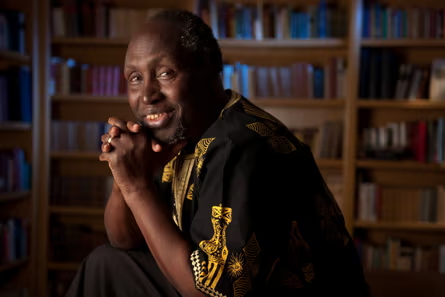
The death of Professor Ngũgĩ wa Thiong’o marked the end of a towering literary and intellectual presence who for decades inspired Africa and the diaspora to confront the lingering legacies of colonialism. He was the moral and philosophical compass of postcolonial Africa. a man who rejected the English language as a medium of African expression, embraced Gikuyu as a political act, and called on Africans to decolonise not only institutions but the mind itself.
Yet, in a move that has left many deeply conflicted, Ngũgĩ, the avowed cultural nationalist, chose cremation over burial, an act many perceive as a betrayal of the very values he championed.
In his celebrated book Decolonising the Mind, Ngũgĩ fiercely defended African languages and traditions as essential vehicles of memory, dignity, and cultural sovereignty. He saw African burial rituals not merely as spiritual customs but as memory anchors that reinforce community, continuity, and belonging. In many African societies, graves serve as more than final resting places; they are physical manifestations of lineage, grief, and reverence. They provide descendants with a space to commune with ancestors, to remember, and to be remembered. Ngũgĩ knew this—his entire intellectual project was steeped in the cultural logic of African remembrance.
And yet, in the final chapter of his life, Ngũgĩ opted for cremation—an act alien to most African cosmologies. Unlike Western norms where cremation may symbolize efficiency or detachment, in African tradition it is often interpreted as erasure. Cremation does not leave behind a tangible legacy; it removes the body from the land, severs the physical connection with lineage, and disrupts the spiritual geography of ancestry.
For someone who wrote extensively about the symbolism of land, roots, and continuity, this decision is not just puzzling, it is profoundly dissonant.
To those who revered him as the custodian of African cultural thought, Ngũgĩ’s choice appears to unravel the narrative he so fiercely constructed. What does it mean for a man who insisted that “language carries culture” to abandon the final cultural rite, burial? How do we reconcile his intellectual insistence on cultural preservation with a personal decision that flies in the face of ancestral customs? For critics and admirers alike, Ngũgĩ’s cremation raises uncomfortable questions about authenticity, consistency, and the burden of intellectual legacy.
This tension is made even more stark by his own advocacy for the preservation of African memory. He often insisted that memory is embedded not just in stories but in rituals, practices, and places. He argued that colonialism robbed Africans not only of their languages but of their ways of remembering, of communing with the past. By rejecti, g burial near his parents and siblings—a powerful cultural symbol of returning to one’s origin, Ngũgĩ may have inadvertently reinforced the colonial logic of rupture and detachment that he fought so hard against.
Of course, personal autonomy must be respected, and no intellectual, no matter how iconic, can be reduced to the sum of his political or cultural positions. Yet, when public figures become symbols of cultural resistance, as Ngũgĩ undoubtedly did, their personal choices acquire political weight. His cremation is not just a private act; it is a public message. And that message is, at best, contradictory.
Some may argue that Ngũgĩ’s choice reflects a personal evolution, perhaps even a rejection of dogmatic traditionalism. But if so, it is a turn he never articulated in public, leaving the decision to appear not as philosophical evolution but as silent capitulation. The absence of context or explanation has only deepened the sense of betrayal felt by those who saw him as the last uncompromising voice for African indigenous identity.
Ngũgĩ wa Thiong’o will undoubtedly remain a giant in African letters, a literary revolutionary whose words shaped generations. But in choosing cremation over burial, he has complicated his legacy. He has exposed the fissures between theory and praxis, between personal freedom and cultural obligation, between the mind and the body. In a world still grappling with the project of decolonisation, Ngũgĩ’s final act offers a sobering reminder: even our heroes are human, and even the most radical minds are not immune to contradiction.
Whether his ashes will be remembered as vividly as a headstone in Gikuyu soil is uncertain. But one thing is clear, Ngũgĩ’s death has reignited a conversation about what it truly means to honour African tradition in both word and deed. And perhaps, in that uncomfortable conversation, his influence lives on.

