

Sacha Knox is a researcher, wellbeing economist, and critical development practitioner with 15 years of experience working across climate finance, health economics, diversity equity and inclusion, and feminist approaches to socio-economic justice and social protection in South Africa and beyond.
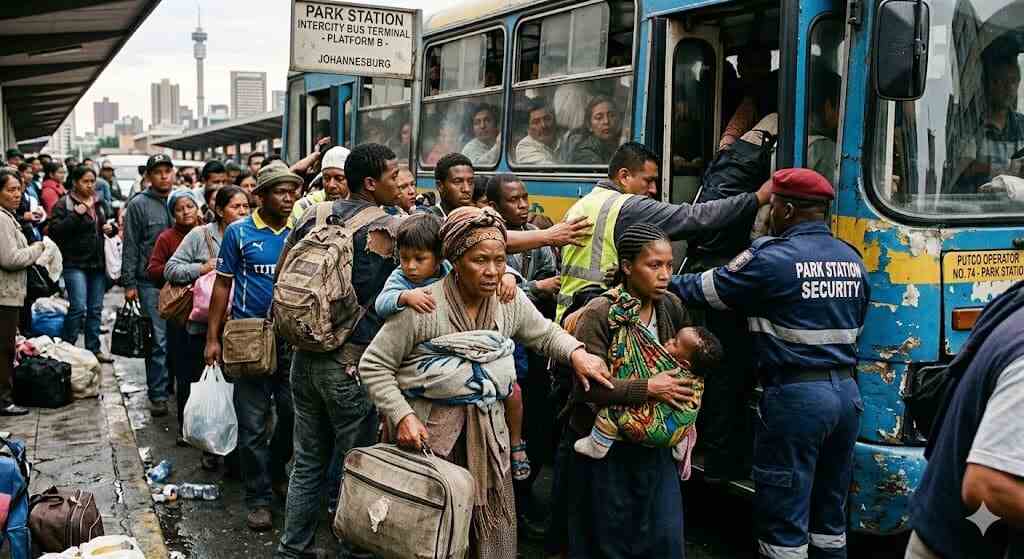
In recent months, at Johannesburg stations, hundreds of Zimbabweans have queued to board buses for what officials call “voluntary repatriation.” Families with luggage. Children who have known no other home. Voluntary is doing a lot of work in that sentence that the reality does not support.
The Zimbabwean Exemption Permit (ZEP) has been fought over in the courts since Cabinet announced its termination in November 2021. The Pretoria High Court ruled on 28 June 2023 that then-Home Affairs Minister Aaron Motsoaledi’s decision was procedurally unfair, unlawful, and invalid. He sought leave to appeal at every level – the High Court, then the Supreme Court of Appeal, then the Constitutional Court – and was refused each time. On 18 June 2024, the Constitutional Court dismissed his application and confirmed that the termination was unlawful. The ZEP was subsequently extended to 28 May 2027 by ministerial directive, to allow for the court-ordered consultation process to take place.
The government has been unambiguous: this extension is the last one. There will be no further grace periods, no renewed directives, no pathway to regularisation for the overwhelming majority of the approximately 178,000 holders.
The queues at Johannesburg’s bus stations are the opening chapter of that ending, not its conclusion.
The permit’s terminal date has not stopped the harm from accumulating. ZEP holders report being turned away by banks, refused school registration, and dropped by employers who won’t absorb another cycle of uncertainty. The government did not need to cancel the permit today to produce this effect – announcing its final date was enough. Insecurity is the mechanism: low-grade, relentless, doing the government’s work for it.
The “Special Skills” Misdirection
In May 2025, Sports, Arts and Culture Minister Gayton McKenzie told entities under his department that no foreign national should be employed in a position a South African can fill. The argument is an old one dressed in new urgency: migrants are taking jobs that belong to South Africans. The numbers tell a different story.
South Africa’s unemployment rate averaged 32.4% in 2025 – second highest in the world, behind Eswatini at 34.2%, according to World Bank figures. This crisis was not built by migrant labour. Decades of deindustrialisation, spatial inequality hardwired by apartheid, and chronic failures of economic policy built this labour market. Removing 178,000 ZEP holders will not create 178,000 jobs for South Africans. It wi
ll destroy livelihoods and hollow out the informal economic networks that many South African workers depend on too.
In 2023/24, government debt service costs of R356 billion exceeded the entire health budget of R276 billion, according to Statistics South Africa. Approximately 64% of Black South Africans live below the national upper-bound poverty line of R1,634 per person per month. Roughly one in four children under five is stunted. None of that has anything to do with Zimbabwean migrants. Blaming them serves the politicians making the argument. Working-class communities absorbing that argument pay the price in broken solidarity.
Across South Africa, people are fighting each other for scraps at the bottom of a labour market that was broken long before any of them arrived.
The Vigilante Infrastructure
Between 2022 and 2024, Xenowatch – the African Centre for Migration and Society’s incident monitoring platform at Wits – recorded 255 verified xenophobic discrimination incidents, resulting in 57 deaths, 6,134 people displaced, and 810 shops looted. The peak was 2022, with 110 incidents – the highest single year on record. Of the 255 incidents, one resulted in a conviction.
Operation Dudula led its first march through Soweto on 16 June 2021. The group spread rapidly, running patrols and demanding identity documents from African migrants – none of which its members have any legal authority to do. From July 2025, members stationed themselves at clinic entrances across Gauteng and KwaZulu-Natal, turning away patients who could not produce a South African identity document. In April 2026, the African Commission on Human and Peoples’ Rights issued a formal statement deploring the pattern and calling on the South African government to take concrete action against vigilante groups and the conditions enabling xenophobic violence.
Many ZEP holders have lived in South Africa for 15 to 20 years.
Human Rights Watch documented how, ahead of the May 2024 elections, candidates across parties – McKenzie and ActionSA’s Herman Mashaba among them – scapegoated foreign nationals while the perpetrators of years of xenophobic violence went unaccountable. When political leaders collapse migration and economic anxiety into a single threatening category, South Africans and Zimbabweans end up at each other’s throats at clinic queues and construction sites. Fixing unemployment requires sustained policy work. Blaming migrants requires a loud voice.
What the Law Requires
South Africa’s Constitution guarantees everyone – not citizens alone – the right to dignity, freedom of movement, and protection from arbitrary deprivation of property. Courts have held that Section 9’s prohibition on unfair discrimination extends to nationality and citizenship as analogous grounds. The Promotion of Administrative Justice Act requires notice, the right to make representations, and written reasons for decisions. The Immigration Act requires that deportations be carried out with due process.
Many ZEP holders have lived in South Africa for 15 to 20 years. Under international law, prolonged residence creates legitimate expectations of continued stay. The extension to May 2027 exists because the courts made the alternative untenable – the government did not arrive there willingly. It is also the last extension the government has said it will grant.
The processing of ZEP holders through Johannesburg stations fails these tests. There is no individualised assessment, no weight given to years of residence or family ties, no meaningful opportunity to challenge removal. The government’s position – that a court-compelled final extension satisfies its constitutional obligations – is not compliance. It is the floor the courts were able to hold.
The children turned away from school registration did not choose to be born into a permit regime. The Constitution is unambiguous about their rights. The government has made its position clear: May 2027 is the end. What happens between now and then is still being decided – in courts, in communities, and at every clinic gate where someone is told to go home.
Sacha Knox is a researcher, wellbeing economist, and critical development practitioner with 15 years of experience working across climate finance, health economics, diversity equity and inclusion, and feminist approaches to socio-economic justice and social protection in South Africa and beyond.