With Raila Odinga gone, Kenya’s Orange Democratic Movement (ODM) enters uncharted territory. The man who for decades defined opposition politics, drove constitutional reform, and built East Africa’s most recognisable political brand has left behind an unfinished story. His passing is not only the end of a political era but also a test of Kenya’s capacity to sustain democracy beyond personalities. What happens next will determine whether ODM remains a national force or fades into political nostalgia, a museum relic of Kenya’s reformist golden age.
a test of Kenya’s capacity to sustain democracy beyond personalities.
ODM’s strength has always lain in Raila’s personal authority and unmatched ability to manage competing interests. He brokered alliances, quelled internal dissent, and guaranteed patronage across counties. In his absence, party structures face their first true stress test. The 2025 ODM National Delegates Convention will be the make-or-break moment. If it elects a legitimate, widely accepted leader and reforms candidate selection and leadership term limits, ODM could transition from a personality cult into a modern, rules-based party. But failure to do so could accelerate defections, particularly in its traditional strongholds in Nyanza and the Coast, where loyalty to Raila was once automatic but may no longer be guaranteed.
ODM could transition from a personality cult into a modern, rules-based party. B
Emerging contenders are already manoeuvring. Oburu Oginga, Raila’s elder brother and current acting party leader, provides symbolic continuity and a link to the Odinga legacy. Edwin Sifuna, the articulate party secretary-general, embodies institutional reform and generational renewal, appealing to urban youth and professionals. Wycliffe Oparanya, former Kakamega Governor and respected party stalwart, offers experience, regional balance, and an image of administrative competence. Meanwhile, younger figures like Gladys Wanga and Babu Owino represent ambition, youth energy, and a potential ideological shift toward issue-based politics. Whoever takes the helm must perform the delicate task of uniting loyalists nostalgic for Raila’s leadership and reformists demanding modernization, no small feat for a movement built on charisma rather than codified rules.
younger figures like Gladys Wanga and Babu Owino represent ambition, youth energy, and a potential ideological shift toward issue-based politics.
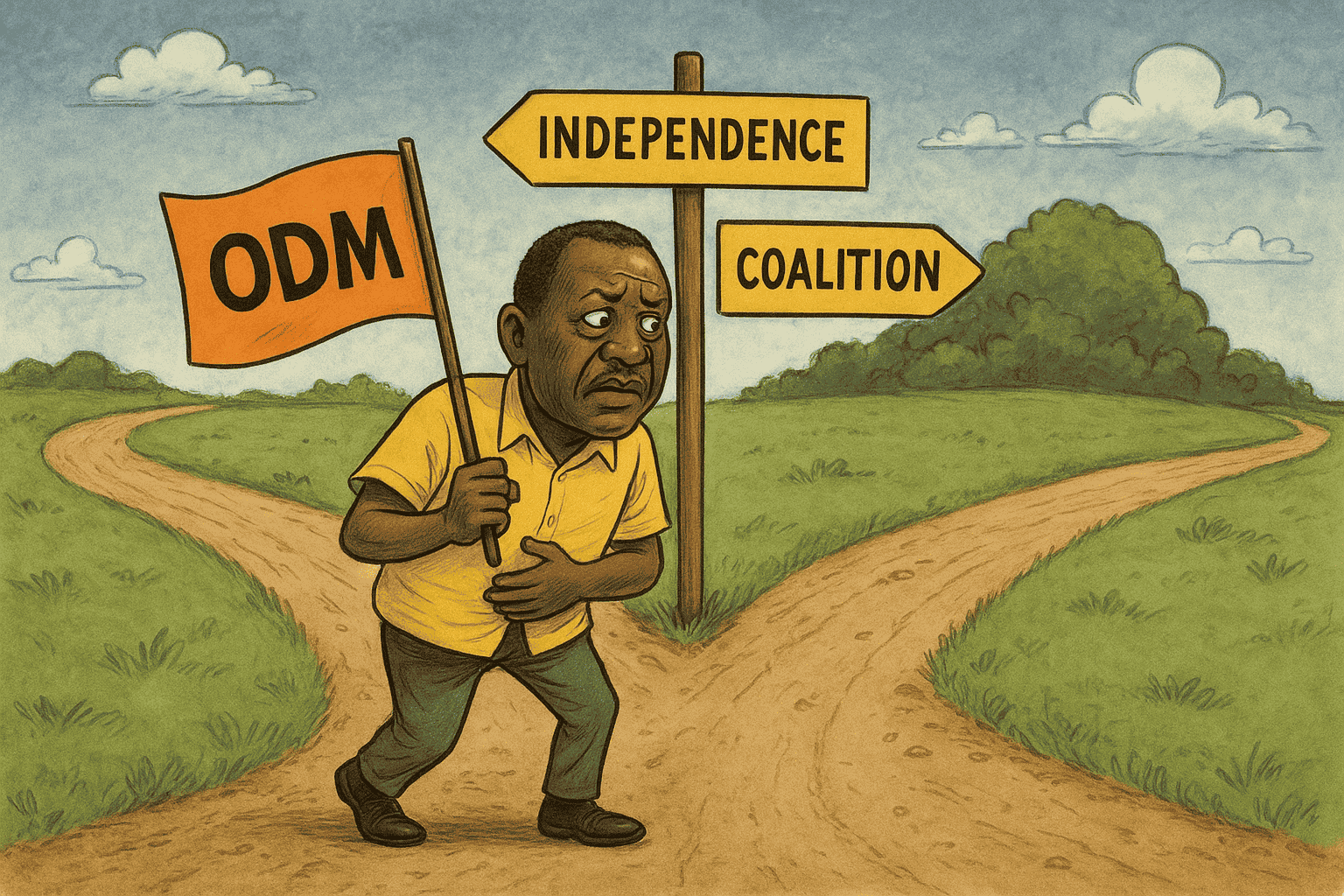
ODM’s future direction will influence the entire political landscape. Three possible paths stand out:
- Reform and Reinvention: If ODM seizes this moment to institutionalise, introduce democratic primaries, and diversify leadership to include youth and women, it can contest 2027 independently and keep Kenya’s opposition vibrant. A reformed ODM could become the model for party renewal in Africa, proving that political institutions can outlive their founders.
- Co-optation by Government: If ODM continues its cooperation with President Ruto’s administration, it risks being absorbed into the state machinery. While such an arrangement may offer short-term access to patronage and government resources, it would erode ODM’s watchdog role and undermine its reformist legacy.
- Fragmentation and Realignment: The worst-case scenario is disintegration, where regional leaders and MPs defect to other parties, creating multiple small factions. In this case, Kenya’s opposition space would splinter, potentially paving the way for a new national alliance led by ambitious governors or emerging youthful leaders outside ODM’s orbit.
If ODM continues its cooperation with President Ruto’s administration, it risks being absorbed
For rank-and-file ODM politicians, clarity is now survival. They must publicly define their political stance, remain independent or cooperate with government, since ambiguity weakens both credibility and constituency confidence. In a post-Raila landscape, grassroots service delivery and constituency visibility will matter far more than party slogans or past loyalties. Performance, not personality, will decide who endures.
For the national opposition, ODM’s decision represents both opportunity and crisis. Should ODM merge with the ruling coalition, a political vacuum will emerge, one that younger leaders or regional movements may exploit. Conversely, if ODM revitalises itself as a principled opposition, it could reassert its role as the conscience of Kenyan democracy.
For President Ruto’s coalition, managing ODM’s cooperation demands finesse. Absorbing ODM fully into government risks creating a complacent one-party culture, but allowing it partial autonomy could foster productive competition. Delivering tangible development in ODM-leaning regions such as Nyanza and Coast — roads, jobs, and local industries — will be critical to sustaining goodwill.
ODM’s internal cohesion could, however, unravel under the weight of ambition, regional rivalries, and the absence of a unifying patriarch. Generational divides between the “Raila-era veterans” and “digital-age reformists” are widening. Coastal leaders, long complaining of marginalisation within the party, may demand a greater share of leadership posts. Women’s representation, once symbolic, will also become a key test of credibility.
Ten key indicators will determine ODM’s fate: the leadership election outcome, level of defections before 2026, by-election performance in strongholds, adoption of internal reforms, emergence of a youth leader, decision on a 2027 presidential candidate, depth of cooperation with government, popularity among young voters, service delivery perception in ODM counties, and the coherence of its messaging.
The biggest risk lies in ODM becoming a mere appendage to power, alive but hollow, surviving on nostalgia rather than relevance. Raila Odinga’s passing closes a monumental chapter in Kenyan politics but opens a profound test of party maturity. The choice before ODM is existential: either rise as a truly institutionalised political movement or disintegrate into competing fiefdoms. Its survival will depend on how swiftly it shifts from being Raila’s political vehicle to becoming Kenya’s next-generation reform engine.