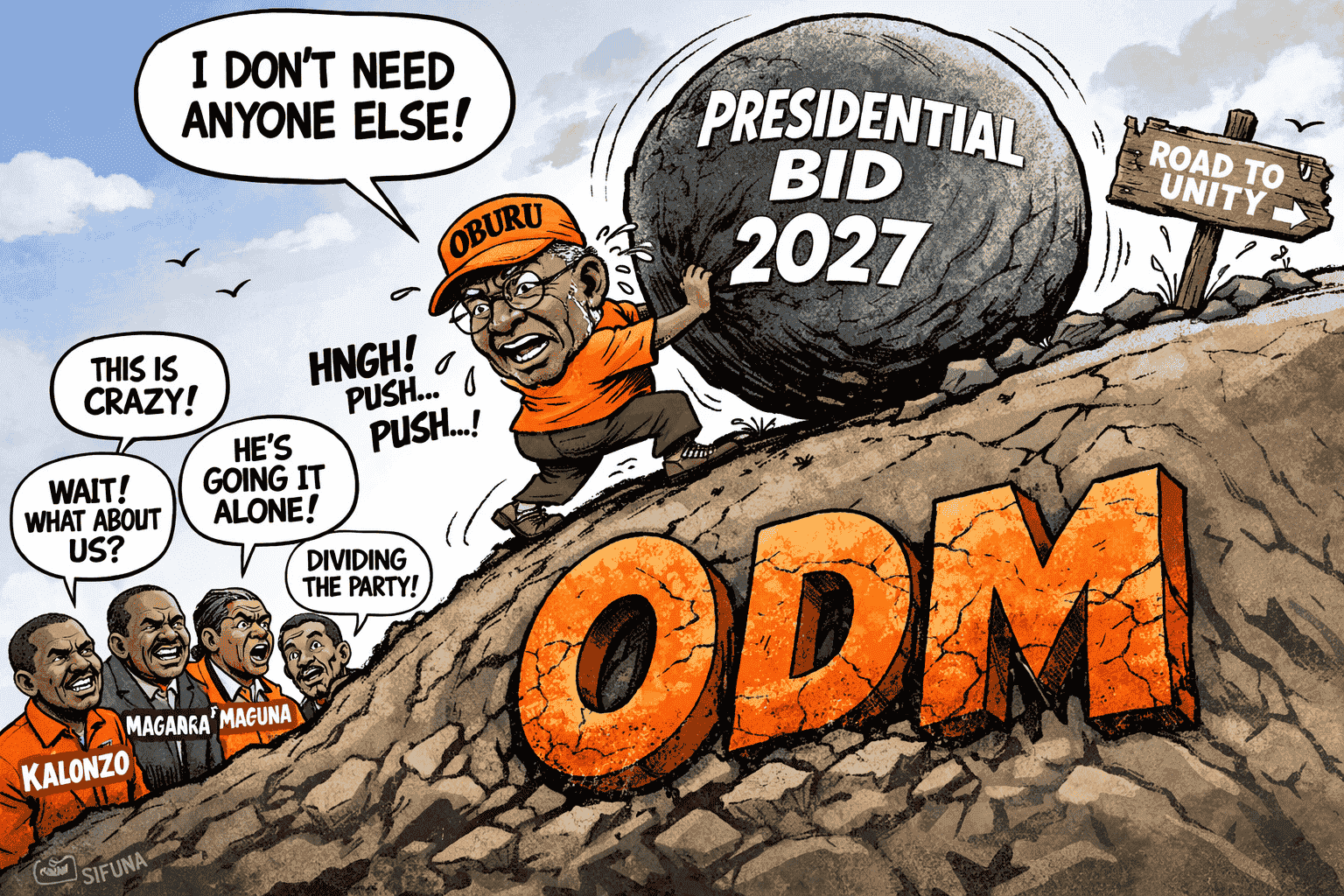
In a strategic pivot that has recalibrated the Orange Democratic Movement’s (ODM) internal dynamics, Siaya Senator Oburu Odinga has formally positioned himself as the party’s presumptive presidential flag‑bearer for the 2027 Kenyan general election, grounding his claim in the party’s constitutional provision that the sitting party leader becomes the flag‑bearer if ODM contests independently.
This development unfolds against the backdrop of one of the most consequential transitions in ODM’s modern history, the passing of Raila Odinga, the party’s charismatic founder and long‑time supremo, in October 2025. Following Raila’s death, the National Executive Committee (NEC) moved swiftly to appoint Oburu as Acting Party Leader, a decision later formalised by the party’s top organs.
Oburu’s ascendancy may diminish ODM’s national credibility
However, rather than uniting the party’s fractious factions around a consensual leadership model, Oburu’s assertion of authority, particularly his declaration that he will be ODM’s candidate if the party runs alone, has triggered internal debate and external scrutiny over whether this constitutes pragmatic stewardship or a consolidation of power that risks marginalising other aspirants and diluting the party’s broader appeal.
Continuity vs. Cohesion: The Internal Landscape
From a structural standpoint, Oburu’s rise represents a continuity mechanism: installing a seasoned, elder statesman with decades of political experience to steer ODM through a delicate transition. Key regional delegates and leaders backed his ascendancy shortly after working through formal channels to endorse his leadership.
Yet the optics are mixed. While Oburu has stressed unity and reaffirmed top lieutenants such as Secretary General Edwin Sifuna within the leadership fold, critics argue that his approach to the 2027 nomination, effectively shutting the door on internal competition — could suppress internal debate and alienate rising stars within the party.
effectively shutting the door on internal competition — could suppress internal debate
Internal critics, including party members and political commentators on public forums, have underscored a perception that ODM’s image risks being perceived as a family‑centric vehicle rather than a national coalition platform, especially given the strong emotional and symbolic attachment to the Odinga name. These voices highlight broader concerns that the party may struggle to assert a non‑ethno‑regional identity without a compelling unifier.
Leadership Profile: Experience vs. Electability
Oburu Odinga’s political résumé is beyond question in terms of experience , he has been a veteran parliamentarian and strategist, yet questions about charisma and mass appeal inevitably shadow his leadership profile. Raila Odinga’s decades‑long national presence carved a distinct brand that transcended regional politics; Oburu’s comparative lack of a high political profile raises questions about ODM’s capacity to galvanise a national coalition in a crowded 2027 field.
Oburu’s comparative lack of a high political profile raises questions about ODM’s capacity
In contrast, several notable names are earning traction in Kenya’s broader political ecosystem, leaders such as Fred Matiang’i, Kalonzo Musyoka, and others who bring different demographic, regional, or technocratic appeal to the national stage. These figures represent alternative leadership archetypes with their own constituencies and appeal vectors. Oburu’s early declaration, and the implication that rivals should seek platforms elsewhere, invites scrutiny over whether ODM may inadvertently narrow its strategic options just as the national contest is shaping up.
Strategic Positioning and Partnership Dynamics
Beyond internal party politics, Oburu’s leadership approach must be understood amid Kenya’s broader broad‑based government framework, an arrangement ODM has publicly reaffirmed through 2027. Under this configuration, ODM remains in partnership with President William Ruto’s government, navigating both collaboration and opposition vectors within the national governance architecture.
This pragmatic positioning could offer strategic cushioning, but it also blurs ODM’s ideological distinctiveness. If the party cannot clearly delineate its independent identity and leadership style, it may concede narrative space to rivals who are sharpening their own competition strategies for 2027.
This pragmatic positioning could offer strategic cushioning, but it also blurs ODM’s ideological distinctiveness
Appraisal: Opportunism, Miscalculation, or Strategic Necessity?
Assessing Oburu Odinga’s move through a strategic lens reveals a mix of opportunism and institutional necessity. On one hand, consolidating leadership claims early and anchoring them in constitutional provisions reflects a disciplined, rules‑based approach to organisational governance. It forestalls a protracted leadership vacuum that might otherwise fracture party coherence.
On the other hand, the lack of wider consultation and competitive pathways risks fuelling perceptions of exclusion and centralization, an optics challenge in a political environment where inclusion, youth engagement, and diversified representation are increasingly valued. The narrative that Oburu’s ascendancy may diminish ODM’s national credibility has traction among critics and underscores the potential costs of an inward‑looking leadership transition.
A Crossroads Moment
As ODM charts its course toward 2027, the party faces a defining strategic inflection point. Oburu Odinga’s leadership and early positioning as the presumptive flagship candidate may bring clarity and organisational stability, but it also carries the risk of alienating key constituencies within and beyond the party.
Whether this posture turns out to be a deft example of seasoned leadership or a miscalculation in stakeholder engagement will depend heavily on how the party balances institutional governance, internal democratization, and national outreach in the pivotal year ahead.
In the final analysis, ODM’s ability to translate structural continuity into broader political resonance will be the ultimate test of whether Oburu’s bid is perceived as visionary stewardship or self‑serving consolidation.