There was a time when the African National Congress (ANC) was not just a ruling party, but a liberation movement, a bearer of hope for millions of Black South Africans who emerged from the horrors of apartheid battered, landless, and economically excluded. But over 30 years into democracy, the ANC finds itself at a moral and political crossroads, bleeding support and seemingly more concerned with appeasing global capital than defending the dignity and socioeconomic empowerment of the very people it was elected to uplift.
When Black Economic Empowerment (BEE) was introduced, it was framed as a radical and necessary step to reverse centuries of systemic exclusion. Designed to redress the imbalances of apartheid by promoting Black ownership, participation, and advancement in the economy, BEE helped create a new Black middle class, opened doors to boardrooms, and expanded employment opportunities for previously disadvantaged communities. Alongside it, the ANC’s expansive social welfare system—particularly social grant, offered a critical safety net that helped lift millions of Black families out of absolute poverty.
Yet, for all its impact, BEE has always been vulnerable to manipulation by elites, often serving as a pipeline for politically connected individuals…
…to accumulate massive wealth while the masses continue to wait for land, real opportunity, and true economic liberation. And now, even that fragile veil of equity seems to be under threat.
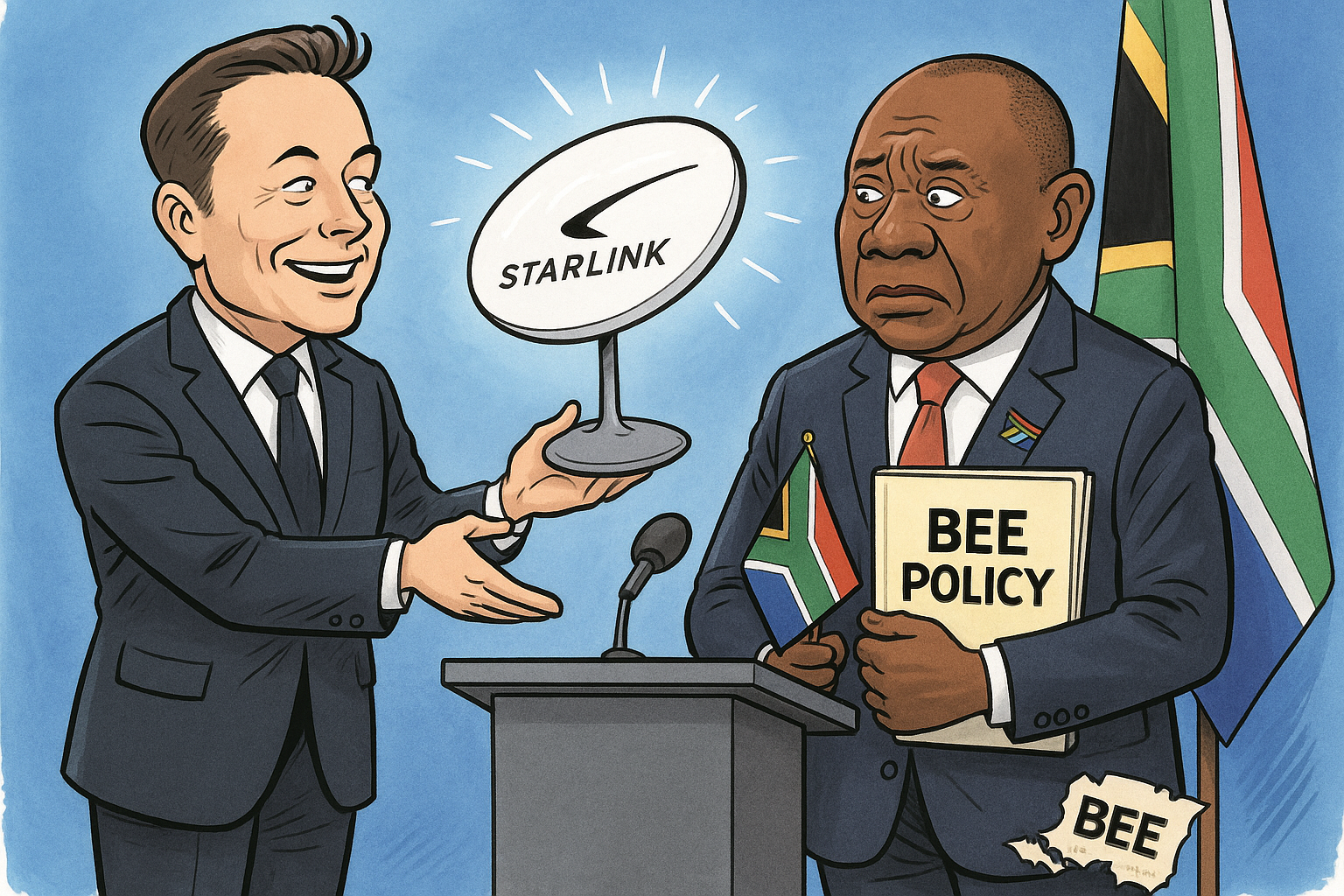
Case in point: Elon Musk’s Starlink, a satellite internet venture with the potential to revolutionize connectivity in rural South Africa, has reportedly been denied operating permission because Musk refused to comply with South Africa’s BEE regulations. On the surface, the Department of Communications was right to hold its ground, rules are rules. But fast forward just a few weeks after President Cyril Ramaphosa’s much-criticized meeting with former U.S. President Donald Trump at the White House, and whispers have begun that BEE laws may be quietly “revised” or “relaxed” to accommodate Starlink. Why now? Why so fast?
It is almost poetic in its irony. For decades, South African Black communities have pleaded for land reform, asking Parliament to amend Section 25 of the Constitution to allow for the expropriation of land without compensation. Despite enjoying a majority for years, the ANC dragged its feet, citing legal complexities, investor confidence, and constitutional hurdles.
But when a billionaire refuses to comply with local empowerment laws, the system suddenly finds a way to bend?
Is Starlink’s bandwidth more important than Black dignity?
And what about the economic implications? If Starlink enters the South African market with its massive infrastructure and global reach, what happens to local telecom giants like Vodacom, MTN, and Cell C? These companies, while far from perfect, employ thousands of South Africans. Will the surge of satellite internet services crush local players, leading to mass job losses? And will those who benefit from Starlink even be the poor and rural, or the suburban elite who can already afford data?
The timing is alarming. The ANC, now weaker than ever, finds itself forced into a Government of National Unity (GNU) with the Democratic Alliance (DA), a party that has historically resisted race-based redress policies like BEE and affirmative action. After the Trump-Ramaphosa meeting, where the South African delegation was reportedly sidelined and humiliated, it appears that global capital has found new leverage over the South African state.
Is this the final stage of capture, not by the Guptas, but by multinational interests in collusion with the DA and Western powers? If so, who will save the Black South African from slipping back into a new age of economic apartheid—one masked by democratic process but hollowed of justice?
Only two political voices seem unafraid to confront this emerging order: Julius Malema’s Economic Freedom Fighters (EFF) and the newly resurgent MK Party of former President Jacob Zuma. The EFF continues to push for radical economic transformation, while the MK Party draws from deep roots in ANC history to challenge its current trajectory. Whether through street mobilization, legal action, or ballot box revolt, one of these formations may yet catalyze the awakening of a politically anesthetized Black majority.
But change will require more than populist slogans. It needs organization, vision, and courage—the very values the ANC once embodied before it became a shadow of itself. If the ANC continues on its current path, dismantling its own empowerment laws to win favor with billionaires while ignoring the cries of the people, it will not just lose votes. It will lose its soul.
And when that happens, the question won’t just be whether the ANC can recover.
The question will be: Who still fights for the Black South African?