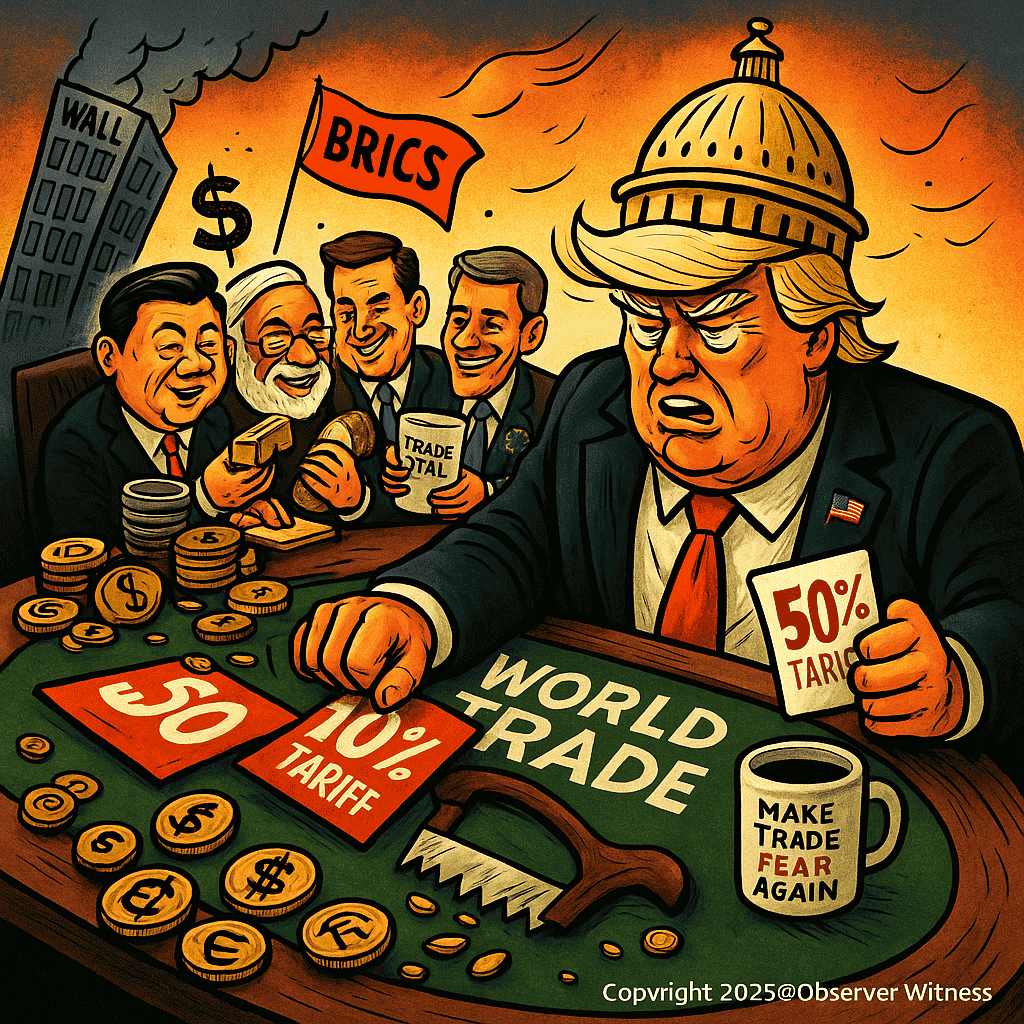

The United States once dictated the terms of global commerce and diplomacy with a potent combination of economic muscle, military reach, and political persuasion. For decades after World War II, it was the “indispensable nation”, able to compel, cajole, or co-opt other countries into its orbit. That era is ending. And Donald Trump’s second-term trade blitz is not halting the decline, it’s accelerating it.
Instead of forcing concessions, his measures have triggered a wave of retaliatory tariffs,
By imposing tariffs as steep as 50% on goods from India, Brazil, and China, alongside a baseline 10% tariff on nearly all imports, Trump has managed to alienate allies and push competitors into each other’s arms. Instead of forcing concessions, his measures have triggered a wave of retaliatory tariffs, trade diversions, and alternative alliances designed to reduce dependence on the United States.
Retaliation and Realignment
The backlash has been swift and coordinated. China responded with a 34% tariff on American goods and tightened restrictions on rare-earth mineral exports, critical components for U.S. electronics and defense industries. India and Brazil, both hit with Trump’s 50% tariff wall, have moved closer diplomatically and economically, deepening ties with Asian and African partners.
Meanwhile, the BRICS bloc, originally Brazil, Russia, India, China, and South Africa, has expanded to include Saudi Arabia, Egypt, and Iran, with more nations expressing interest. Framing Trump’s trade policies as neocolonial bullying, BRICS leaders are openly championing a multipolar economic order. Even the European Union, long the anchor of the transatlantic alliance, is pursuing deeper trade partnerships with BRICS nations, signaling that Washington’s grip on Western economic cohesion is loosening.
Economic Shockwaves at Home
The fallout is not confined to geopolitics. Financial markets have reacted sharply. U.S. tariff rates have soared from a decades-long average of around 3% to nearly 20%, a seismic shift in global trade norms. The S&P 500 and Dow Jones have endured volatility spikes, with investor confidence shaken by the prospect of a prolonged trade war.
Perhaps most alarming for Washington, the U.S. dollar’s dominance is showing cracks. Foreign central banks, from Jakarta to Johannesburg, are diversifying reserves into Chinese yuan, euros, and gold. The shift is gradual but significant: the dollar’s role as the world’s unchallenged reserve currency is no longer a given.
The Trump Doctrine: Coercion Over Cooperation
Trump’s foreign economic policy style, part intimidation, part transactional brinkmanship, and part mafia-boss bravado, may have served him in the boardrooms of New York real estate. On the global stage, it’s proving far less effective.
“The U.S. is now in a mutual-harm trade spiral, where coercion breeds alternatives and threats yield resistance.”
Rather than reinforcing U.S. dominance, this approach is inspiring countries to build parallel systems of trade, finance, and security—specifically designed to bypass Washington’s leverage.
BRICS: From Symbolism to Substance
The rise of BRICS from a loose economic forum to a strategic counterweight is perhaps the most consequential outcome of Trump’s policies.
- China’s Belt and Road Initiative is building infrastructure from East Africa to Eastern Europe.
- India is expanding its diplomatic and commercial footprint across Africa and Southeast Asia.
- Brazil is leveraging agricultural exports to win political influence.
- Russia continues to weaponize its energy exports in markets beyond NATO’s reach.
Together, these efforts are coalescing into a coherent framework that offers an alternative to the U.S.-led order.
Friends Losing Faith
The erosion of U.S. influence is most starkly reflected not in the defiance of rivals but in the hesitation of allies. In Berlin, Tokyo, and London, policymakers now openly debate whether America is still a stabilizing anchor or a volatile disruptor. Terms like “strategic autonomy” and “economic sovereignty”, once fringe, are now part of mainstream political discourse in Europe and Asia.
Behind closed doors, European officials talk about “strategic distancing” from Washington—language that would have been politically unthinkable a decade ago.
The End of the Unipolar Era
For decades, the U.S. thrived as the indispensable nation. Trump’s tariffs, protectionism, and transactional diplomacy are making it look dispensable. The post-Cold War unipolar moment has given way to an emerging multipolar reality in which America is just one of several competing power centers.
Unless Washington recalibrates, trading threats for genuine cooperation—it risks watching its global influence slip from center stage to the political wings.
———————————————————-
Aslam Khwezi, The Loose Cannon, is a political activist, social scientist and a commentator on social-political issues.