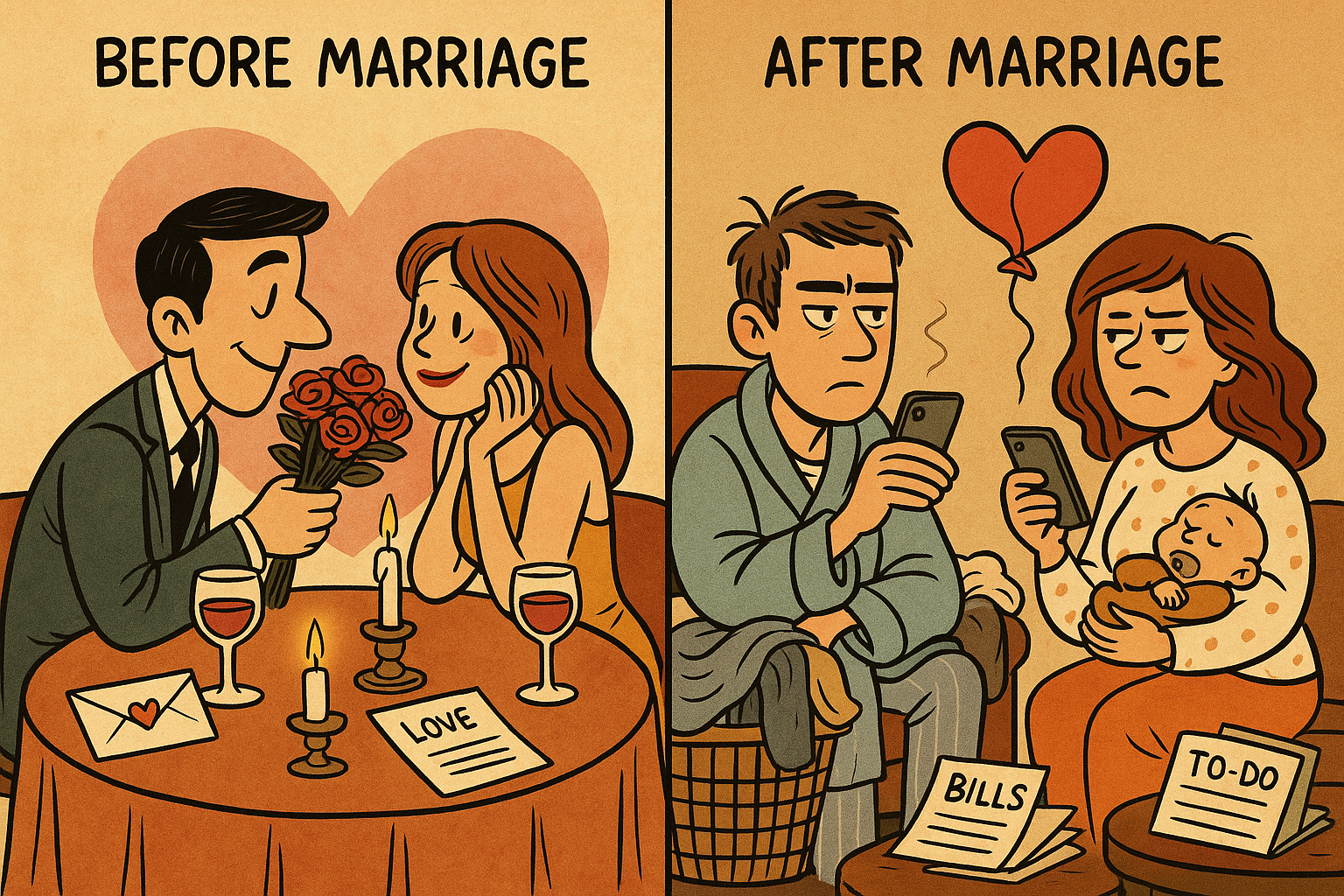

We’ve all heard it, “He changed after the wedding” or “She’s not the same person I married.” These aren’t just dramatic soap opera lines; they’re real sentiments whispered across café tables, vented in late-night phone calls, or thought in silent frustration when love feels like it’s drifting. But why does this happen?
Why do couples often seem to change toward each other after the confetti settles?
Let’s be honest: marriage changes the dynamic. Before the wedding, relationships are filled with spontaneity, mystery, and curated versions of ourselves. Date nights are planned, voices are gentler, and disagreements are either smoothed over or left unspoken. But marriage has a way of pulling back the curtain, revealing the routines, vulnerabilities, and sometimes, the disappointments that real life brings.
One of the biggest shifts is expectation. The moment vows are exchanged, even the most modern couples subconsciously slide into roles they’ve internalized from family, culture, or media. Suddenly, “my partner” becomes “my husband” or “my wife”, labels heavy with history. One expects more help; the other assumes they’re doing enough. One expects romance; the other is overwhelmed by responsibility. When expectations go unspoken, resentment fills the silence.
Another culprit is emotional laziness. During courtship, we invest effort, asking questions, complimenting, listening, showing up. After marriage, life gets noisy. Jobs, bills, kids, deadlines, health scares. The effort can quietly fall away. We assume our partner will always be there, forgetting that emotional intimacy doesn’t maintain itself. It must be nourished, or it fades.
Then there’s the issue of personal evolution. People grow, and not always in the same direction. Maybe she dives into a new career while he craves stability. Maybe he wants to start a family, and she’s rediscovering her independence. Marriage doesn’t freeze us in time. We marry who someone is, not who they’re becoming, and that can feel unsettling when the growth isn’t mutual or understood.
But perhaps most heartbreaking is how communication erodes. Not overnight, but in small, almost invisible moments. A joke dismissed. A concern brushed off. A dream deferred. Over time, we stop sharing. Or worse, we share and stop feeling heard. Intimacy is built on vulnerability.
When that bridge cracks, couples grow distant—living together but no longer emotionally in tune.
And yet, this isn’t a death sentence for love. It’s an invitation.
An invitation to relearn each other. To reintroduce yourselves not as the people you were when you met, but as who you are now. To communicate not just to fix problems, but to connect. To remember that love is not a static feeling, it’s a choice, a verb, a rhythm.
Couples who survive the “change” are not those who avoid it, but those who embrace it with curiosity and compassion. They learn to say, “You’ve changed, tell me more,” instead of “You’re not who I married.” They make room for reinvention and accept that love matures, just like we do.
Marriage, in its best form, isn’t about holding on to who someone was. It’s about walking beside who they’re becoming, and letting them walk beside you, too.