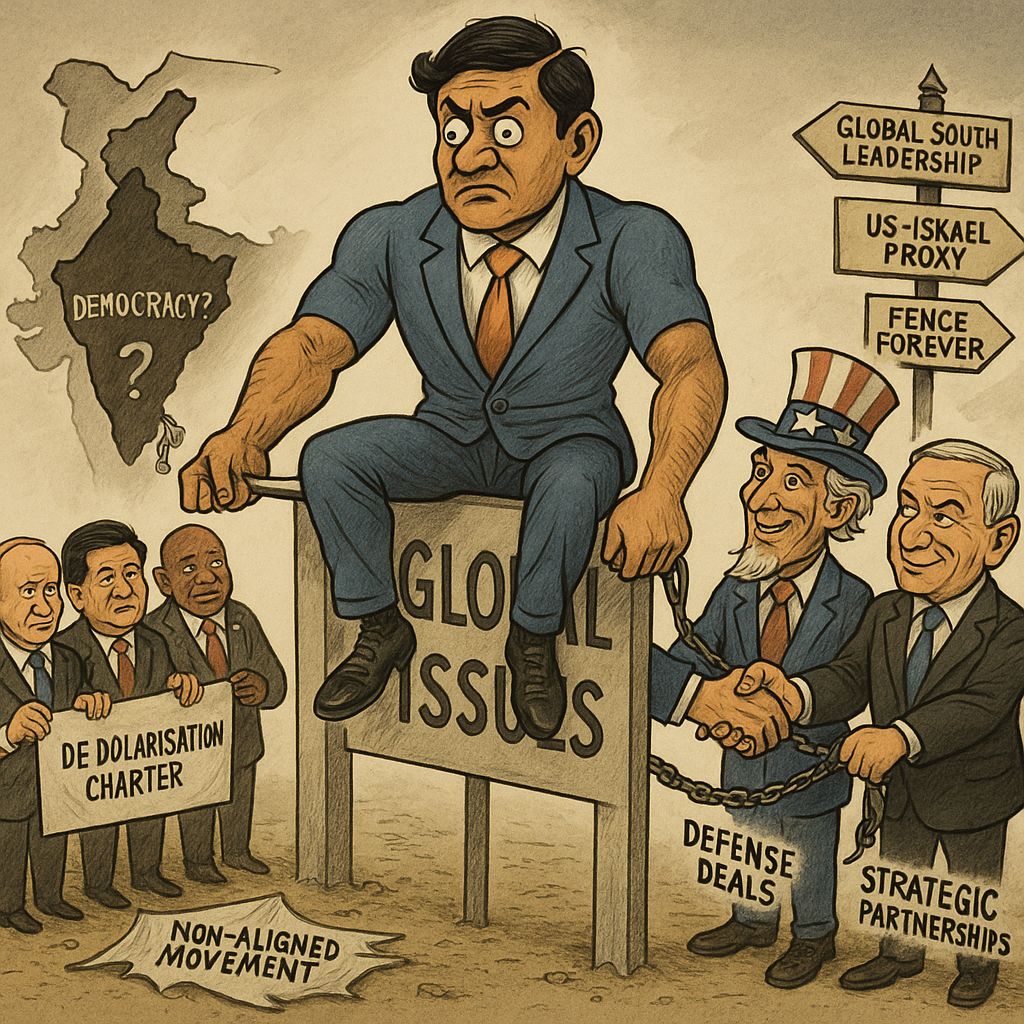

India stands on the cusp of global greatness, boasting the world’s fastest-growing major economy, a formidable military, and a vibrant democracy. It has the population, strategic geography, and cultural capital to emerge as a leading global force. Yet, despite this potential, India remains a faltering superpower, unwilling or unable to take firm stances on pressing global issues. Its indecisiveness, selective alignment, and foreign policy contradictions make it a suspect global actor, less a sovereign pole and more a hesitant satellite circling U.S. and Israeli interests.
India has the population, strategic geography, and cultural capital to emerge as a leading global force….
India’s pattern of fence-sitting is nowhere more evident than in its approach to the Israel-Palestine conflict. While many nations have taken clear positions in the wake of Israel’s bombardments of Gaza, most recently after the October 2023 escalation, India has abstained from several United Nations General Assembly resolutions calling for ceasefires or condemning Israeli actions. For instance, in December 2023, India abstained from a UN resolution demanding an immediate humanitarian ceasefire in Gaza, joining a small club of nations that either supported Israel implicitly or chose silence over solidarity. This non-committal stance contradicts India’s own historical support for the Palestinian cause and the Non-Aligned Movement principles it once championed.
But perhaps the most glaring contradiction to India’s democratic image lies within its own borders, specifically, its continued occupation and militarisation of Jammu and Kashmir. Since the abrogation of Article 370 in August 2019, India has tightened its grip on the region, stripping it of autonomy, detaining political leaders, restricting press freedom, and imposing internet blackouts. These actions have drawn condemnation from international human rights groups, including Amnesty International and the UN Human Rights Council. For a nation that aspires to lead the Global South and champion democracy…
…the suppression of Kashmiri self-determination presents a moral and political black mark, one that undermines its legitimacy as a voice for global justice.
This inconsistency reveals a deeper geopolitical realignment. India has strengthened military and technological ties with Israel, including joint defense production and intelligence sharing. Simultaneously, it has deepened its strategic partnership with the United States under frameworks such as the Quad (with Japan and Australia), signing logistics and military agreements that place it ever closer to the Western bloc. While strategic partnerships are not inherently problematic, India’s moves raise the question: is it forging an independent path or merely positioning itself as a proxy power for U.S. interests in Asia?
Within the BRICS bloc, comprising Brazil, Russia, India, China, and South Africa, India has also displayed an ambivalence that weakens its credibility. As the group explores alternatives to the U.S. dollar and pushes for multipolarity, India has appeared lukewarm, often taking cautious or technocratic positions rather than transformative ones. While Brazil and South Africa advocate social justice and China and Russia push aggressively for de-dollarisation, India often refrains from bold endorsements, citing procedural concerns or economic caution. In doing so, it risks becoming a stumbling block rather than a catalyst within BRICS.
Even in regions where India could exercise significant influence, such as Africa, Southeast Asia, and the Middle East, its engagement remains patchy. While China builds infrastructure through the Belt and Road Initiative, and Turkey and Iran engage assertively across Muslim-majority nations, India’s footprint is restrained. It sends trade envoys but avoids moral leadership. It signs deals but rarely defines visions. The result is a vacuum where Indian influence should have been, leaving space for more determined actors.
India’s reluctance to take categorical positions stems partly from its desire to balance competing interests: the need to maintain U.S. goodwill, protect Gulf remittances, contain China, and manage domestic political optics. However, such balancing, without conviction, dilutes its voice on the global stage.
It creates an image of a nation that talks sovereignty but acts with apprehension—a power with potential but no posture.
India’s missed opportunities matter not only for its own aspirations but also for the wider Global South. Many developing nations look to India as a democratic counterbalance to China or a non-Western leader that can articulate alternative models of development and diplomacy. But when India hesitates—on Palestine, on Kashmir, on BRICS, on climate, it sends the signal that it cannot be relied upon to lead, let alone to stand alone.
Until India develops a coherent, assertive, and principled foreign policy, one rooted in moral clarity rather than transactional calculations, it will remain a power in waiting. And the longer it waits, the more its moment slips away.