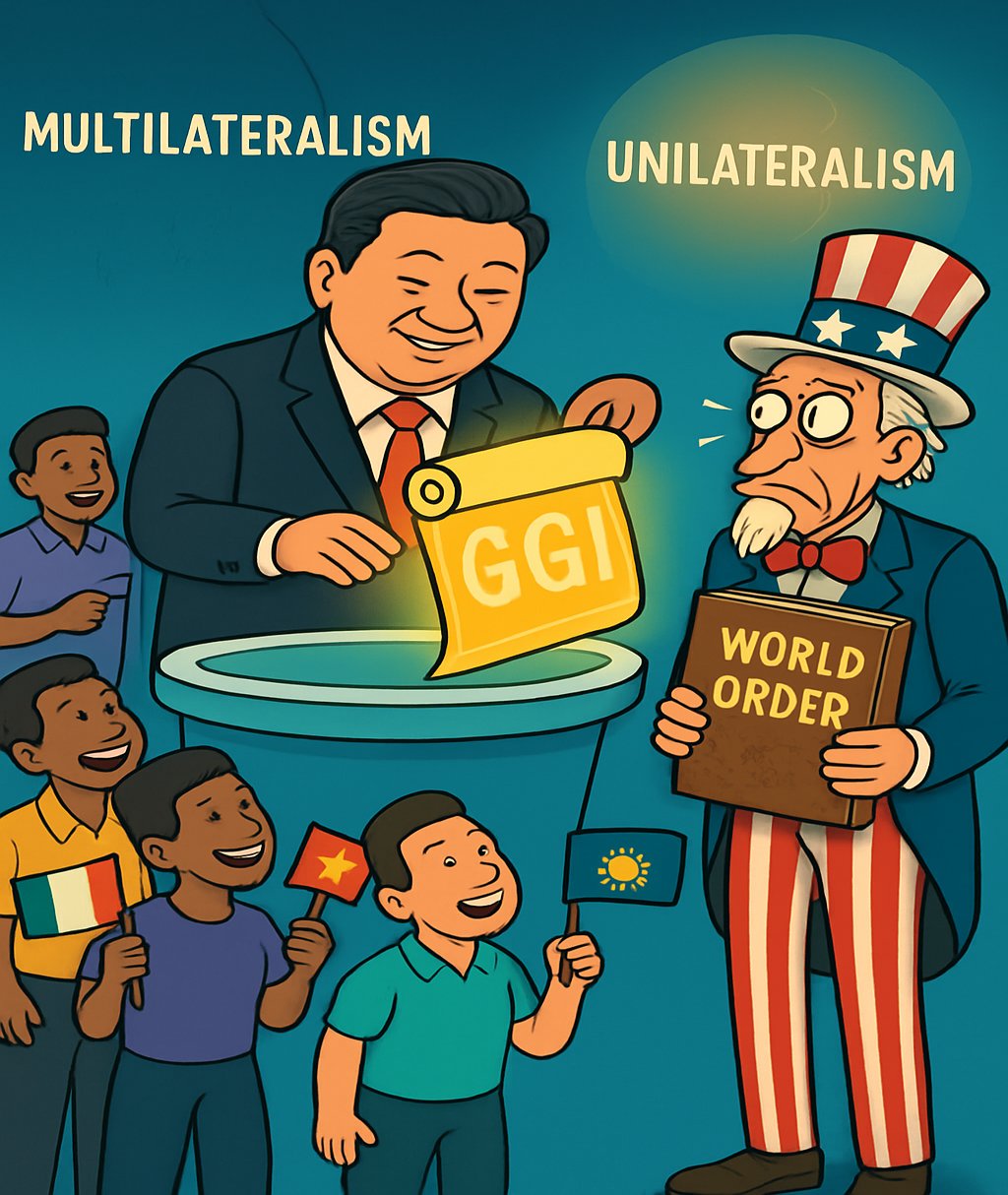

China’s commitment to multilateralism and international co-operation has taken a leap forward with President Xi Jinping’s newly introduced Global Governance Initiative (GGI), which provides for uniformity and sovereign equality in the practice of international governance. That is a direct challenge to the hegemony of the United States.
Key to Xi’s GGI, which he unveiled at the Shanghai Co-operation Organisation meeting in Tianjin recently, are the five principles: adherence to sovereign equality, abiding by international rule of law, practicing multilateralism, advocating a people-centered approach, and focusing on taking real actions.
But the proposal from the Chinese President is, obviously, set to face stiff opposition from the United States and its closest allies, who would read it as a threat to Western domination in the world. This view was confirmed by Johannesburg-based independent political analyst, Sandile Swana, who says the GGI is a direct challenge to US hegemony.
Johannesburg-based independent political analyst, Sandile Swana, says that the GGI is a direct challenge to US hegemony.
“The announcements by Xi Jinping are in fact an announcement on a new world order, there is no question about that. That is a direct challenge to the hegemony of the United States and inviting the nations of the world to be part of a new world order,” Swana says.
According to Swana, the proposal for multilateral action contradicts the existing unilateral order in terms of the international rule of law, the monetary systems that are based on the US dollar, and in terms of conflict-resolution mechanisms where one country becomes a referee and a player at the same time. It goes against actions that saw Trump undermine the sovereignty of other nations, as he did with Greenland, Canada, and Panama—countries that Trump identified as America’s potential modern-day colonies.
He argues that, dictated by the requirement of sovereign equality, the GGI, as it stands, could impact the UN Security Council’s setup, where five founding nations have veto power. “A nation should be respected as a nation regardless of its military or economic power. It should be respected equally like any other nation. In terms of this, every nation should be subject to international law regardless of its power and size. The resolution of conflicts should rest with the UN, not with a single powerful country.
Trump undermines the sovereignty of other nations as he did with Greenland, Canada, and Panama.
Swana interpreted Xi’s proposal for a people-centred approach to mean there must be respect for different cultures, languages, and religious beliefs. “So, Xi Jinping is saying the international community and all the people of the world, on fair and equal terms, should be the ones who solve problems. So, Xi Jinping is offering that and it will be up to the United States to see this as a military challenge,” Swana explains.
Even at its infancy, the initiative is already gaining momentum among several nations of the Global South that see multilateralism as the best way to bring about peace and stability in international systems. The GGI is seen, in general, as an attempt to usher in a new world order that places international governance and multilateralism at the forefront of international relations.
Sovereign equality and inclusivity form the core of the proposal, as encapsulated in President Xi’s statement at the SCO meeting when he said: “I look forward to working with all countries for a more just and equitable global governance system and advancing towards a community with a shared future for humanity.”
Dr. Jan Venter, an international relations specialist at North West University in South Africa, strongly believes the GGI would usher in a new world order while marking the beginning of the end of US-led unilateralism in world affairs. He argues Xi’s proposal demonstrates that there are now two centres of power in world politics – one led by the US and the other by China.
He says although there were attempts even after WWI to create laws guarding against violent wars and to ensure prosperity for everybody, and the post-WWII period introduced robust systems accompanying the establishment of the United Nations and other international organizations, that order operated on the basis of US/European power, involving financial and military dominance.
the basis of US/European power, involving financial and military dominance.
As a result, many countries of the world, including China and the former Soviet Union, never ascribed to the Pax Americana (state of relative peace overseen by the US or UK), and that precipitated the Cold War that ran for decades between the US and the Soviet Union.
Venters says: “The American-led system that we are now seeing the end of was a discriminatory and exploitative system. There was never equality, and there was never an effort to bring the new democracies into the fold. With its new proposal, China is now again suggesting essentially a new centre of gravity, which is inclusive and promotes equality among nations, and that is very important.
“This new centre of gravity will be based around China and India and characterised by a huge economy, with Russia, Iran, and some other developing nations also playing roles in it. So, the new idea that has been flighted by President Xi is actually trying to capture, in a good way, all the dissatisfaction that exists with the Western model. Whether this is going to be good or bad is not for me to say, but it is going to be different,” Venters says.
The GGI proposal came against the backdrop of unprecedented unity of purpose within the Global South around the need for a multilateral approach to the running of international affairs. The question to respect the sovereignty of each nation and abide by international rule of law and operate on a multilateral level had been a refrain among Global South countries.
China, while an economic powerhouse and fast-growing military power as demonstrated by its modern weaponry displays at the recent China Victory Day military parade in Beijing, always pursues multilateral and peaceful solutions to world conflicts. Xi has a long and impressive history of seeking multilateral alternatives to unilateralism, with China always playing a leading role in multilateral co-operation initiatives, efforts to bring world peace and security, trade co-operation, and diplomacy in general. Equity, equality, and fairness always foreground the game.
The GGI, as initiated by Xi, has the potential to usher in a new world order—moving away from conflicts, disrespect of sovereignty of nations, undermining the international rule of law, and leaving out citizens in decision-making. This approach is set to restore confidence in multilateral bodies such as the United Nations and others that were undermined by unilateral decisions and hegemonic manoeuvrings pursued by certain strong powers.
This is despite efforts by the international community as a whole, taking a significant step to establish the UN and other international multilateral fora, thereby introducing a brand-new practice of global governance. The existence of the UN set the stage for the international system, bringing closer the new world order underpinned by international law, striving for the maintenance of peace and development in the world.
The tensions of the last several years or decades, underpinned by a resurgence of the new Cold War, increasing conflicts in various parts of the world, accompanied by the proliferation of dangerous and legal weapons, require new thinking in world governance. It is against this background that the new GGI, as proposed by President Xi, should be welcomed as a contribution to cooperative governance in the world.
the new GGI, as proposed by President Xi, should be welcomed as a contribution to cooperative governance in the world.
Whether Xi’s GGI proposal would be embraced by all nations of the world remains to be seen but judging by the enthusiasm with which it was welcomed by the SCO members and the membership of the developing world, it clearly indicates widespread interest in the proposal. The call for an urgent need to restore the dignity of the UN, strengthen and uphold the international rule of law, and an end to global conflicts, among others, have been repeated. It is now time for action. The GGI appears to be the starting point towards achieving this goal.