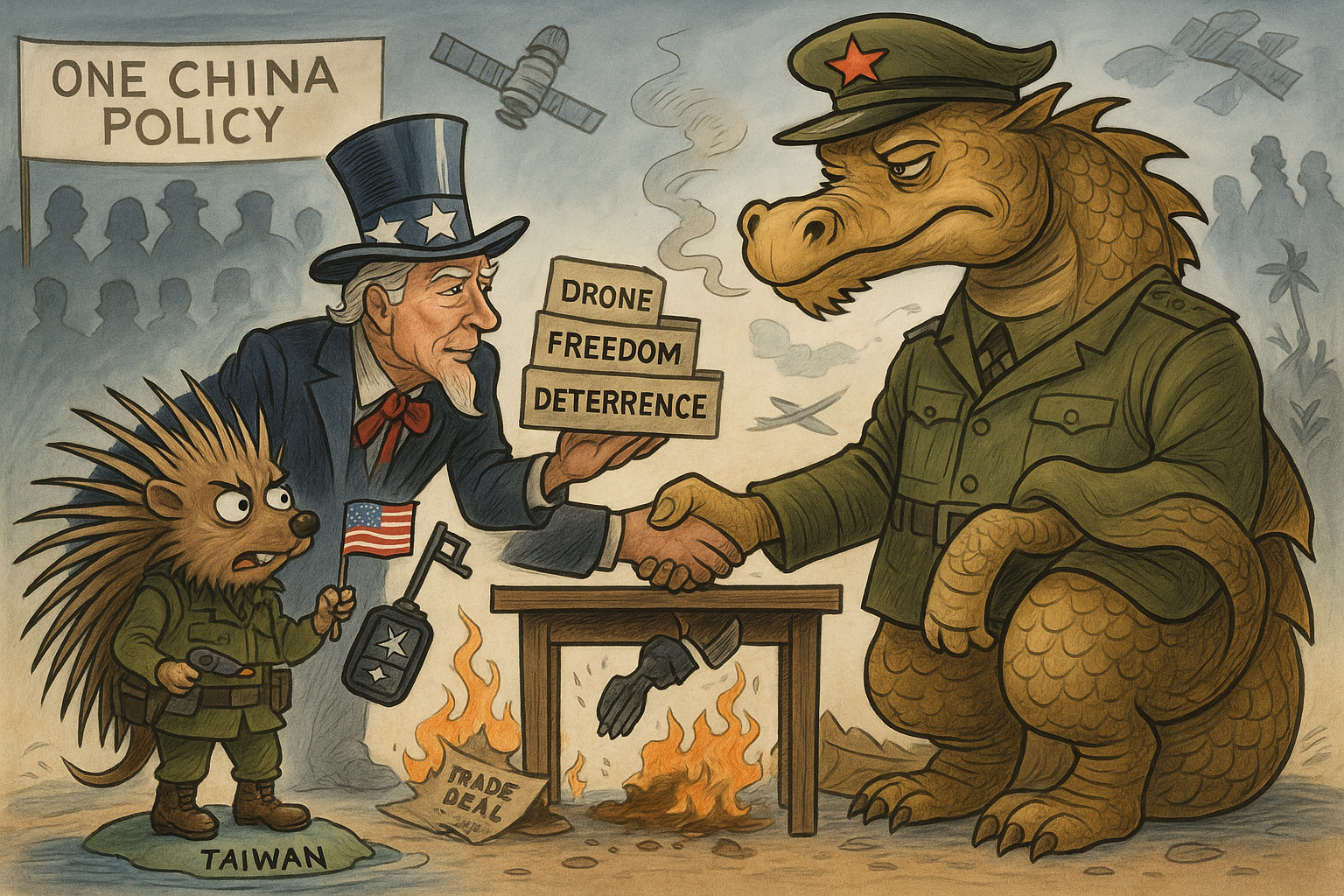
Taiwan, a small island off the coast of mainland China, claims sovereignty despite the UN Resolution 2758 affirming the One-China policy, which recognises Taiwan as part of China. Under President Lai Ching-te, Taiwan continues to push back against Beijing, courting alliances with Western powers like the US. But can Taiwan really stand up to China militarily, or is this just geopolitical wishful thinking?
Johannesburg-based political analyst Sandile Swana warns that if Taiwan provokes war, it risks annihilation by a superior Chinese force. He suggests that
Taiwan should emulate Hong Kong and Macao’s peaceful autonomy under China’s “one country, two systems” model, rather than inviting a devastating conflict.
While Hong Kong and Macao operate under Beijing’s control, they enjoy political and economic freedoms within a semi-autonomous framework. Swana argues Taiwan could maintain its system and thrive economically if it negotiated a similar arrangement with China. Yet Taiwan, fearing a loss of democracy, resists this model, especially under the current DPP-led government which is staunchly anti-China.
Taiwanese politics are deeply divided between pro- and anti-China factions. The ruling Democratic Progressive Party (DPP) champions independence, while the opposition Kuomintang (KMT) and the Chinese Unification Promotion Party favour reunification. A recent informal street survey in Taipei revealed generational divisions: older citizens supported reunification, while younger people preferred independence and democracy.
While the DPP controls the presidency, it lost its parliamentary majority to the KMT, leading to increased tension with China. Under US President Biden, Washington has pledged military support to Taiwan, while former President Trump has shown less commitment, prioritising US-China trade interests. Taiwan recently signed a defence technology deal with German firm Auterion for military drone software, mirroring Ukraine’s strategy against Russia.
The plan aims to enable Taiwan to resist Chinese invasion using Western-backed drone warfare.
But Swana believes this strategy is naïve. “Taiwan is not preparing to fight a small country,” he says, “it’s challenging a global technology and military powerhouse.” He argues that China’s sheer numbers, advanced cyber-warfare capacity, and ability to cripple Taiwan’s infrastructure could overwhelm the island before Western aid arrives.
Cape Town-based defence expert Dr Helmoed Romer-Heitman sees Taiwan’s strategy as a “porcupine approach”, not to deter China, but to make any attack costly. However, even he concedes this would only work with strong allied intervention. Without guaranteed Western support, Taiwan may be quickly overrun.
China, meanwhile, continues to advance technologically and militarily while remaining diplomatically cautious. Its drills in international waters are interpreted as rehearsals for a Taiwan invasion. Yet Beijing denies aggressive intent, accusing the West of provocation.
Swana asserts that Taiwan’s military reliance on the West contradicts the One-China policy endorsed by the US and UK under international law. He adds that even high-tech solutions like drones are not fool-proof:
China’s capacity to jam signals, disrupt telecoms, and launch countermeasures makes a conventional war unwinnable for Taiwan.
Ultimately, he argues, Taiwan must face geopolitical reality. A war with China would likely be catastrophic and unwinnable. A diplomatic settlement, as unpopular as it may seem to Taiwan’s youth or pro-independence leaders, could preserve peace, economic stability, and regional order.

