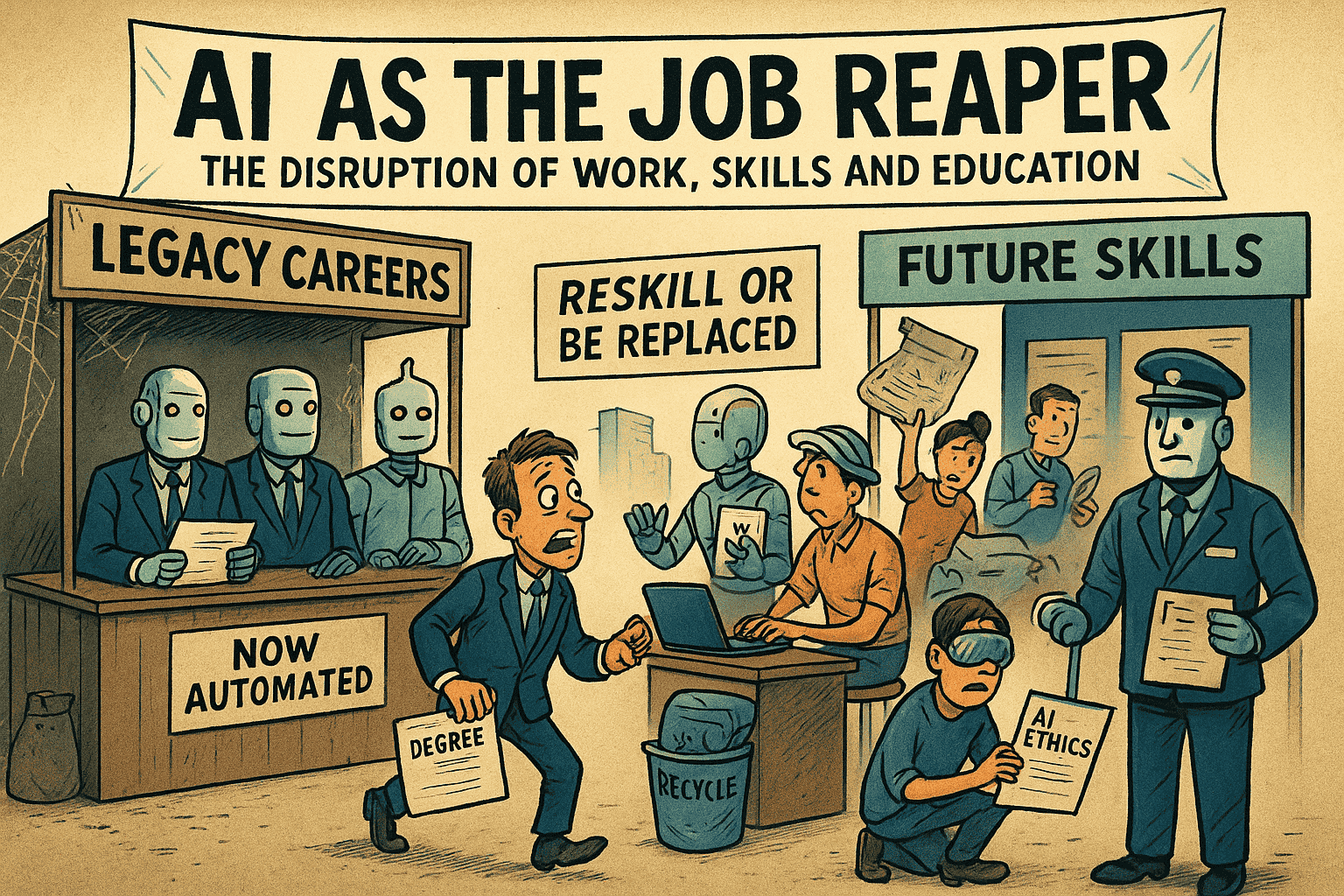

Artificial Intelligence (AI) has rapidly evolved from a niche research field into a global economic force, transforming industries at an unprecedented pace. Once a futuristic concept, AI now influences how we communicate, shop, bank, study, and receive healthcare. While it offers tremendous opportunities for innovation and efficiency, it also poses a direct challenge to the traditional labour market, disrupting professions, altering market dynamics, and forcing society to rethink the way we approach education and skills. For the modern worker, this duality, opportunity and threat, requires one essential response: adapt or be left behind.
Not all careers will survive the AI revolution in their current form. Jobs that are repetitive, rules-based, and heavily dependent on data processing are particularly vulnerable to automation. Data entry clerks, for instance, are increasingly being replaced by automated document processing systems that can handle invoices, forms, and spreadsheets in seconds. In the legal sector, junior research assistants are under threat as AI tools like Casetext and Harvey AI can scan thousands of case files and generate relevant insights instantly. Customer service is also shifting rapidly, with chatbots and voice AI now able to handle basic inquiries around the clock, reducing the demand for human telemarketers. Even creative fields are not immune, platforms like Canva and AI-powered design generators are performing tasks that once required the trained eye of a professional graphic designer. Similarly, basic accounting roles are being reshaped as AI systems automatically categorise transactions, generate financial reports, and flag anomalies without constant human oversight. These shifts also put pressure on certain degree programs, such as traditional journalism, basic accounting, and administrative management, that are tied to functions AI can now perform more efficiently.
Yet AI does not simply take jobs away; it also generates new opportunities. The rise of AI-driven systems has created a demand for roles that did not exist a decade ago. AI ethics and policy specialists are emerging as essential players as governments and corporations grapple with how to regulate and use AI responsibly. The relatively new profession of “prompt engineering” has already become a high-paying niche, as businesses seek experts who can craft effective inputs for AI tools to deliver optimal results. The increasing integration of robotics into manufacturing, healthcare, and service industries is creating opportunities for skilled technicians who can maintain and repair complex machines. In healthcare, AI-powered diagnostics are expanding the need for professionals who can integrate machine intelligence into radiology, pathology, and personalised treatment plans. Cybersecurity is becoming more critical than ever as AI enables more sophisticated cyber threats, creating demand for analysts capable of defending against them. Data scientists and machine learning engineers remain at the heart of this transformation, building, refining, and deploying AI models across industries.
As the employment landscape changes, so too must education. The most future-proof academic pathways now include computer science degrees with AI specialisations, data science and analytics programs, cybersecurity studies, and robotics or automation engineering. There is also a growing need for courses in human-AI interaction and user experience design, ensuring that technology remains intuitive and accessible. On the policy and legal side, degrees that focus on AI ethics, law, and governance are gaining prominence. For those interested in marketing and communications, the integration of AI tools into digital strategy is becoming a vital skillset. Beyond full degrees, shorter certifications in cloud computing, blockchain, bioinformatics, and AI project management can significantly enhance employability, offering a way for workers to stay agile without committing to multi-year programs.
Avoiding job loss in the AI era requires a mindset of proactive adaptability. Workers must continuously upskill, committing to learning at least one new relevant capability each year. Technical knowledge is important, but human-centric skills such as creativity, emotional intelligence, leadership, and complex problem-solving will remain in high demand because they are difficult for AI to replicate. Those who combine technical literacy with these soft skills will thrive. A marketing professional who understands AI analytics, for example, will outperform one who relies solely on intuition. The same is true across professions, those who see AI as a co-worker and productivity partner, rather than as competition, will have an advantage. Real-world experience shows that many copywriters who once feared AI tools like ChatGPT would replace them are now using these tools to brainstorm ideas, draft content, and edit text more quickly, making them more productive and valuable than ever.
Governments and employers also have a responsibility to help workers adapt to these shifts. Training subsidies can support reskilling into in-demand fields, while partnerships between industry and educational institutions can ensure that curricula remain relevant to the changing job market. Public AI literacy programs can help entire populations understand how to interact with and benefit from emerging technologies. Singapore’s SkillsFuture initiative offers a prime example, providing citizens with funds to take industry-relevant courses and thereby ensuring a steady national skill upgrade.
AI is not the first technology to disrupt the labour market, but its speed and scope are unmatched. It is dismantling the socio-economic legacy of many professions while building a new future of work. Those who adapt, by reskilling, embracing AI as a tool, and pursuing forward-looking education, will thrive in the decades to come. The most employable skill in this new era is the ability to learn, unlearn, and relearn at speed. The AI revolution is not a passing trend but a permanent shift, and only those prepared to evolve with it will secure their place in the workforce of tomorrow.