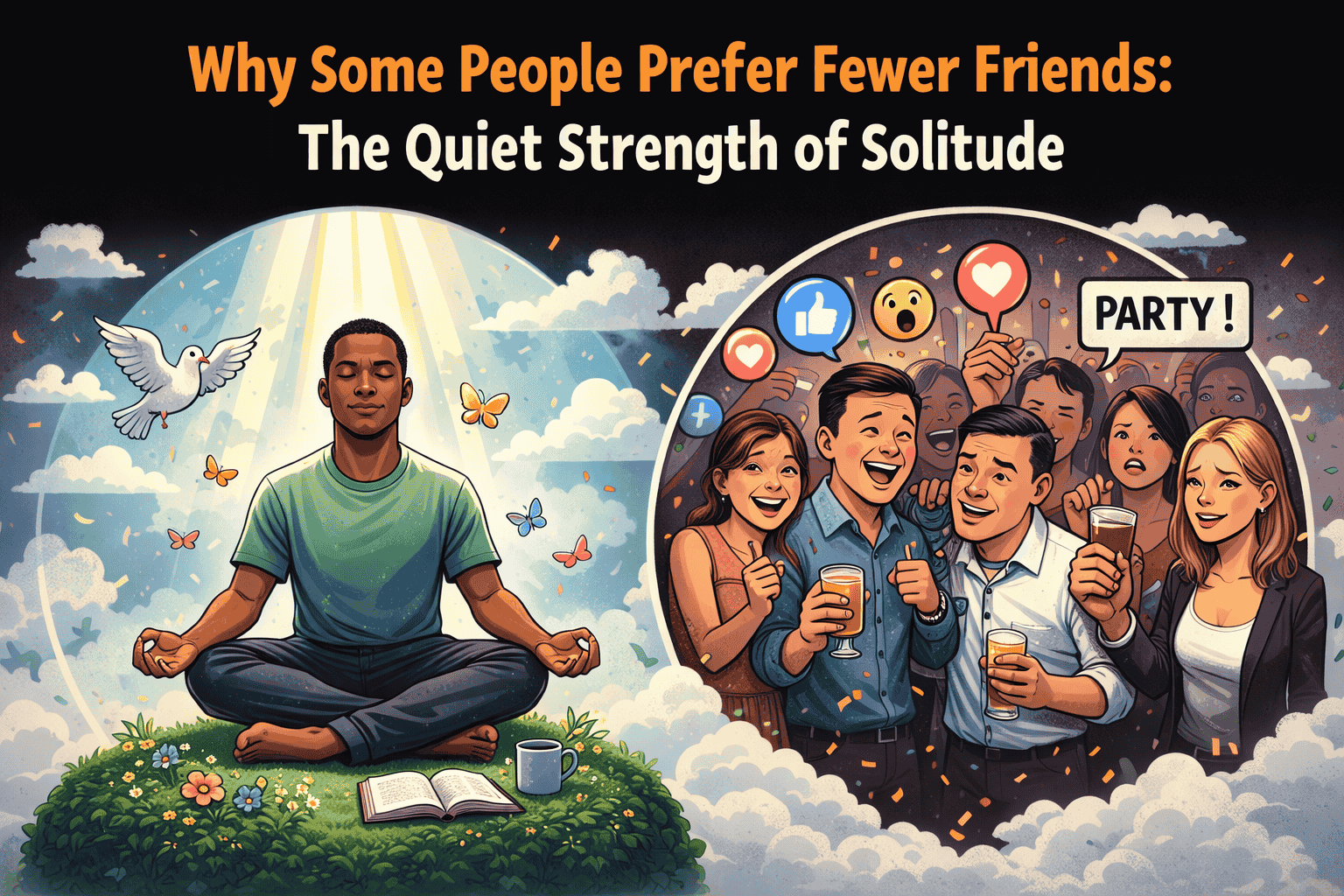
In a culture that celebrates constant connection, packed social calendars, and visible popularity, having few, or no, friends is often misunderstood. It is quietly framed as a deficit, a failure of personality, or a sign of social inadequacy. Yet beneath this assumption lies a growing, rarely acknowledged truth: some people are not lonely because they are alone;
they are alone because they are deeply self-contained, intentional, and internally grounded.
These individuals move through life differently. Their solitude is not accidental, nor is it born of bitterness or rejection. It is chosen, refined, and, in many cases, fiercely protected.
At the core of this way of being is internal validation. People with few friends tend not to outsource their sense of worth to applause, approval, or belonging. They are not driven by the need to be liked, included, or constantly affirmed. Their self-esteem is internally regulated, not socially negotiated. This gives them an uncommon sense of calm. Where others feel unsettled by silence or invisibility, they feel whole. They would rather stand alone in emotional coherence than remain connected in relationships that dilute their peace.
Solitude, for them, is not emptiness; it is a working space.
This is where deep thinking thrives. Without the noise of constant social input, they turn inward, not out of self-obsession, but out of self-inquiry. They use time alone to reflect, to interrogate their beliefs, to refine their values, and to understand their emotional patterns. Instead of using others as mirrors to define who they are, they do the slower, harder work of self-examination. This often leads to heightened clarity, originality of thought, and a strong personal philosophy that is not easily swayed by trends or peer pressure.
Such depth, however, comes with consequences. It often produces strong boundaries.
People who are comfortable alone tend to be uncompromising about their inner life. They are willing to disappoint others rather than betray themselves. They say no without elaborate justification. They walk away from friendships that feel draining, performative, or misaligned. In a world that rewards accommodation and people-pleasing, this can be misread as coldness or arrogance. In reality, it is discernment. They understand that every relationship carries an emotional cost, and they are selective about what, and who, they invest in.
They understand that every relationship carries an emotional cost,
This selectivity is sharpened by heightened intuition. Those who spend significant time alone often become keen observers of human behaviour. They read between words, notice inconsistencies, and sense emotional undercurrents others miss. Surface smiles, polite gestures, and rehearsed friendliness do not easily deceive them. They are attuned to energy, intention, and unspoken tension. As a result, they may withdraw from social spaces not out of fear, but out of clarity. They know when connection is genuine and when it is transactional.
Perhaps most striking is how these individuals respond to loss.
When friendships end or partnerships dissolve, they do not necessarily collapse. Instead, many undergo rapid personal evolution. Where others may spiral into resentment, stress, or prolonged emotional stagnation, they turn inward and rebuild. Separation becomes a catalyst rather than a wound. They reconfigure their identity, refine their purpose, and often emerge more grounded than before. This capacity to transform rather than deteriorate is one of their least visible strengths.
Of course, this path is not romantic or easy. Solitude demands honesty. There is no audience to impress, no group to hide within, no distraction from unresolved emotions. It requires confronting oneself without filters. That is why not everyone can sustain it. But for those who can, it becomes a source of resilience.
In the lifestyle economy of superficial friendships and performative belonging, people with few friends quietly challenge the narrative. They remind us that connection is not measured by numbers, and that solitude, when chosen consciously, is not isolation—it is alignment.
They are not anti-social. They are selectively social.
They are not disconnected. They are deeply connected, to themselves.
And in a world that rarely slows down long enough to listen inward, that may be one of the most radical lifestyles of all.