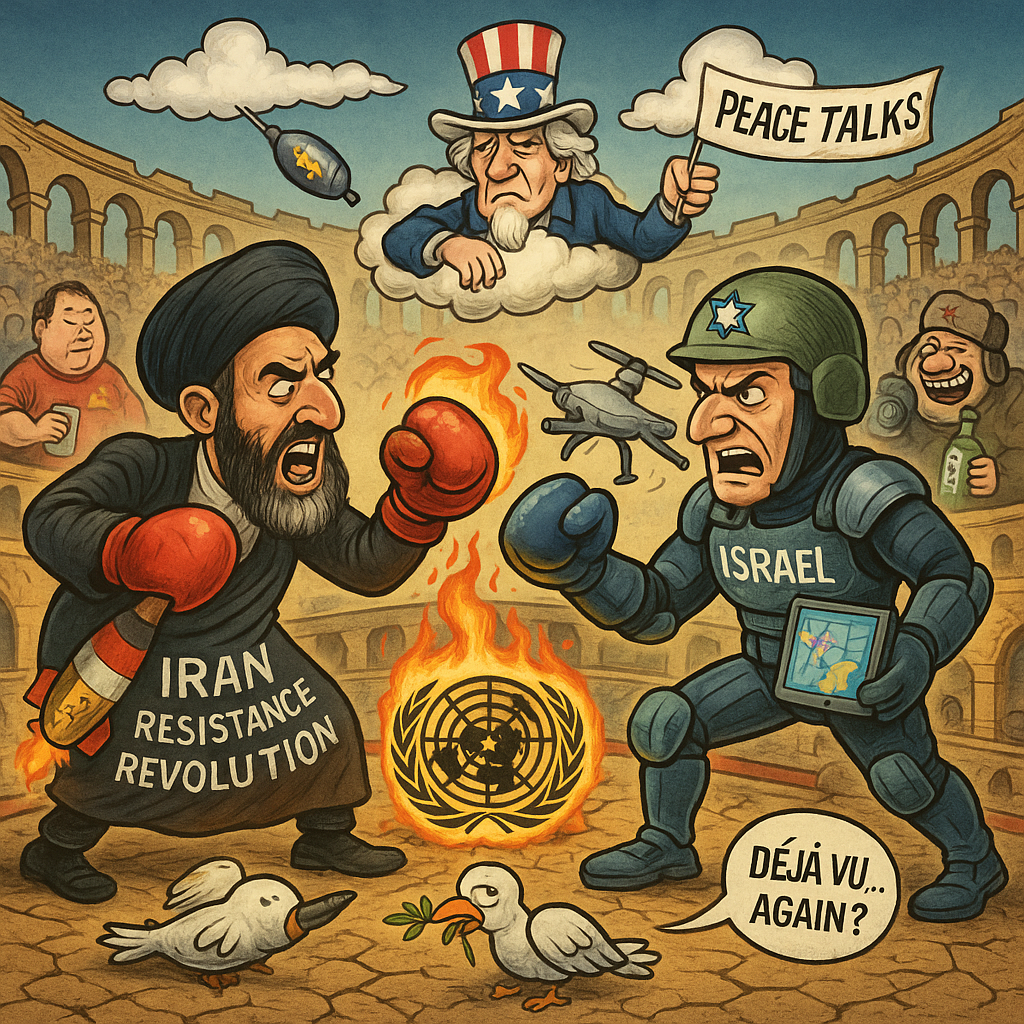

On June 13, 2025, Israel launched Operation Rising Lion, a sweeping airstrike targeting over 100 Iranian nuclear and military facilities, including Natanz, Khondab, and missile factories—as well as high-ranking commanders and nuclear scientists. Among the dead were IRGC chief Hossein Salami, Armed Forces chief Mohammad Bagheri, and scientists like Fereydoun Abbasi-Davani and Mohammad Mehdi Tehranchi. Iran bluntly termed the operation a “declaration of war.”
This decisive attack cannot be disentangled from the decades-old rivalry. Israel’s occupation of Palestinian territories, and Iran’s vocal backing of Hamas, Hezbollah, and Palestinian resistance, has laid the ideological groundwork for this showdown.
What began in shadows through proxy strikes evolved into direct confrontation when Israel struck deep into Iranian soil.
Western governments, particularly the U.S.have long decried Iran’s NPT‑obligated nuclear program, threatening sanctions and military action, yet have turned a blind eye to Israel’s opaque, undeclared nuclear arsenal, itself never signed onto the NPT . Tehran and critics decry this hypocrisy, noting that while Iran faces existential warnings, Israel estimates its arsenal silently. This perceived double standard fuels Iranian resolve to disprove claims of passive victimhood.
The strike triggered an unprecedented reaction. Iran unleashed more than 150 ballistic missiles and drones toward Israel in an operation it styled “Honest Promise III” (aka “Promise III”)a declared symbolic third phase of retaliation involving deep and persistent aerial fire . While Israel’s Iron Dome intercepted the bulk, sirens wailed over Tel Aviv and Jerusalem; at least three Israelis were killed and dozens injured. Supreme Leader Ayatollah Khamenei vowed “severe punishment.”
By penetrating into Iran to eliminate key nuclear program leaders, Israel arguably bit off more than it could chew. Analysts warn this could backfire: rather than delaying Iran’s nuclear ambitions, it may accelerate them, pushing research underground and hardening resolve . U.S. intelligence sources concede that a total demolition of Iran’s program without American help would be near impossible.
Meanwhile, Iran’s newfound national unity strengthens internal narratives of resistance.
There has been a global reaction was swift. Russia condemned the attack as illegal, urging restraint NATO members, the UN, and EU called emergency meetings and pleaded for de‑escalation. Oil prices spiked, airspace closures disrupted travel, and even multinational nuclear talks collapsed amid heightened tensions.
This direct military exchange between two states, rather than proxies, marks a turning point. The region will not go back to the old status quo. Israel’s gamble risks eroding the fragile deterrent balance, prompting Iran to intensify its nuclear efforts and expand alliances with Russia and its proxies. If nuclear breakout accelerates, regional geopolitics would fragment in irreversible ways, escalating conventional proxy wars in Iraq, Syria, Yemen, Lebanon, and complicating Palestinian prospects.
The confrontation that began on 13 June 2025 shattered decades of relative muted deterrence. In daring to strike Iran’s heart, Israel may have triggered the very nuclear threat it sought to crush, and forced Western powers to reveal their own strategic inconsistencies. As Iran’s “Promise III” skies darken over Israel, the Middle East will never be the same.