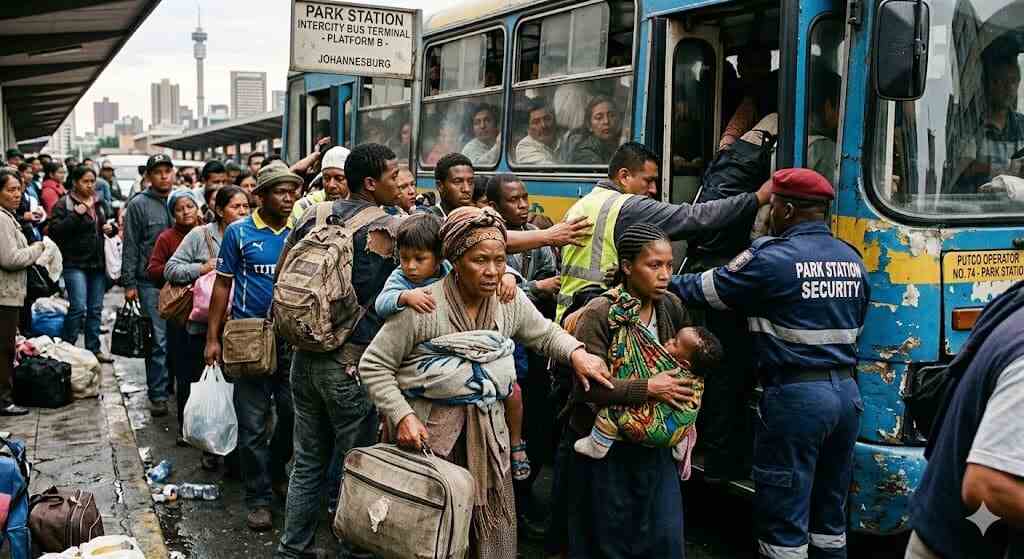
At Park Station in central Johannesburg, South Africa, hundreds of Zimbabweans queue daily to board buses for “voluntary repatriation.” The scene repeats itself: families with luggage, children in tow, waiting to leave the only home many have known for decades. Officials call it voluntary. The reality tells a different story. The Zimbabwean Exemption Permit (ZEP) programme, which provided legal status to approximately 178,000 Zimbabweans, officially ended in June 2023. Despite a 12-month grace period for holders to apply for mainstream visas, the Department of Home Affairs has systematically rejected applications, leaving thousands in legal limbo. Now, with permits expired and no viable pathway to regularisation, Zimbabweans face a stark choice: board the bus or risk arrest, detention, and deportation.
This is not voluntary repatriation. It is administrative violence dressed in bureaucratic language.
The Constitutional Crisis
South Africa’s Constitution guarantees everyone – not just citizens – the right to dignity, freedom of movement, and protection from arbitrary deprivation of property. Section 9 prohibits unfair discrimination, including on the basis of nationality. Yet the ZEP cancellation and subsequent mass removals violate these fundamental rights.
The South African Human Rights Commission’s provisional report on migration and xenophobia documented how immigration enforcement has become a tool of exclusion rather than regulation. The report found that foreign nationals are routinely denied due process, with deportations occurring without proper hearings or access to legal representation. The ZEP cancellation follows this pattern: a blanket policy that treats an entire community as disposable, regardless of individual circumstances.
Many ZEP holders have lived in South Africa for 15 to 20 years. They have built businesses, raised children who attend South African schools, and contributed to their communities. Under international law, prolonged residence creates legitimate expectations of continued stay. The abrupt termination of their legal status, without adequate alternative pathways, constitutes arbitrary interference with their right to family life and dignity.
The “Special Skills” Myth
Home Affairs Minister Leon Schreiber and Deputy Minister of Sport, Arts and Culture Gayton McKenzie have both emphasised that only foreign nationals with “special skills” will be permitted to remain. McKenzie recently told departmental officials: “Nobody in this room has a special skill that you can’t find in this country.”
This rhetoric divides the working class along national lines, obscuring the structural causes of unemployment. South Africa’s unemployment rate is the highest in the world, a crisis rooted in decades of economic policy failures, deindustrialisation, and inadequate investment in education and skills development. Blaming foreign workers for this crisis is both factually incorrect and constitutionally impermissible.
In South Africa it’s normal for our government spending, rates, and taxes to go towards debt servicing costs that now outweigh our health spending. So, if you go to hospital here, as a Zimbabwean, you will be left to die. It’s normal, in South Africa, for 75% of Black South Africans to earn less than R2635 (UBPL) a month. It’s normal for our nutritional stunting levels in children under five to reach 30%.
Research consistently shows that migration does not cause unemployment. The TIPS Vision 2035 report on achieving full employment identifies the real barriers: insufficient economic growth, skills mismatches, spatial inequality, and labour market rigidities. Removing 178,000 Zimbabweans will not create 178,000 jobs for South Africans. It will destroy livelihoods, separate families, and undermine social cohesion.
The “special skills” requirement reveals a fundamental misunderstanding of how economies function. Economies need workers at all skill levels. The domestic worker, the street vendor, the construction labourer – these jobs require knowledge, experience, and often entrepreneurial ingenuity. Dismissing them as replaceable reveals contempt not just for foreign workers, but for all workers at the bottom of the economic hierarchy.
Divide and Conquer
Unemployment has become so naturalised in South Africa that people fight each other for precarious work at the bottom. This is the logic of divide and conquer: when the majority Black working class is set against itself along national lines, the structural causes of poverty and unemployment remain unchallenged.
Operation Dudula and similar movements have mobilised around the narrative that foreign nationals are stealing jobs and resources. Yet as the Socio-Economic Rights Institute noted, these movements target the most vulnerable while leaving untouched the economic elites who profit from low wages and precarious employment.
The ZEP cancellation fits this pattern. It is politically expedient, allowing government to appear decisive on unemployment while avoiding the difficult work of economic transformation. It scapegoats a vulnerable population while leaving intact the systems that produce mass unemployment.
What the Law Requires
South Africa’s obligations under domestic and international law are clear. The Immigration Act requires that deportations be carried out with due process. The Constitution requires that administrative action be lawful, reasonable, and procedurally fair. The Promotion of Administrative Justice Act mandates that affected persons be given notice, an opportunity to make representations, and reasons for decisions.
The mass processing of Zimbabweans through Park Station fails these tests. There is no individualised assessment, no consideration of family ties or length of residence, no meaningful opportunity to challenge removal. This is administrative convenience, not constitutional compliance.
The Way Forward
South Africa needs immigration reform, but not this kind. A constitutional approach would regularise long-term residents, create accessible pathways to legal status, and address labour market challenges through economic policy rather than deportation.
The buses at Park Station represent a failure of imagination and a betrayal of constitutional values. Until we recognise that unemployment is a structural problem requiring structural solutions, we will continue to sacrifice the vulnerable on the altar of political expediency.
There is nothing voluntary about being forced to choose between deportation and departure. And there is nothing constitutional about it either.