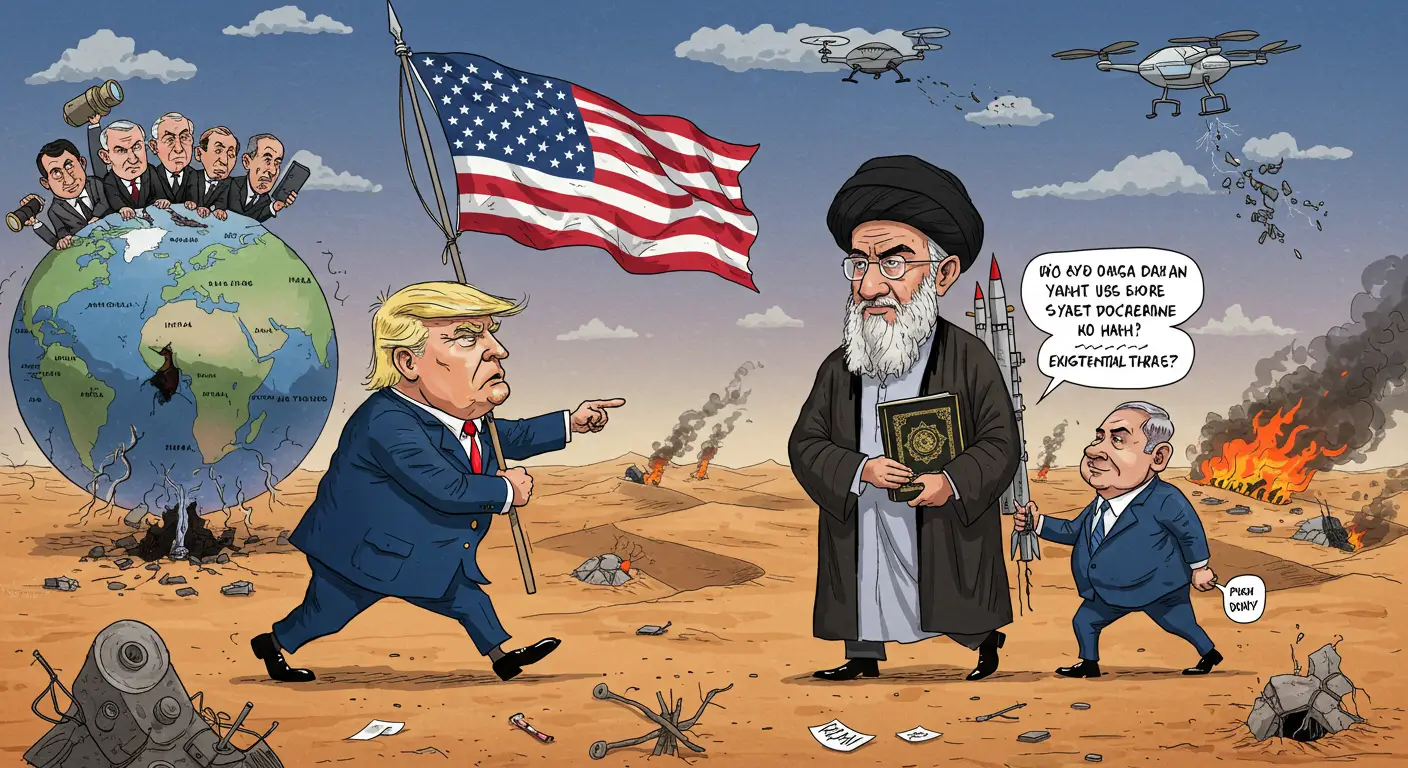
When Israeli Prime Minister Benjamin Netanyahu called upon the United States, led once again by Donald Trump, for direct intervention in Israel’s war with Iran, it was a sobering acknowledgment that Israel is not winning. More importantly, it was a signal to the world that this war is not another Six-Day lightning strike. It is not 1967. Iran is not Syria. And this conflict, unlike Israel’s past military campaigns, may well prove to be a war that Israel cannot win, certainly not swiftly, and perhaps not at all.
An Unexpected Back Foot
For decades, Israel’s military doctrine has been premised on speed, shock, and superior firepower.
In wars against Egypt, Jordan, and Syria, this doctrine yielded spectacular, if short-lived, victories. But Iran, with its vastly different geopolitical architecture and military philosophy, has presented an entirely different challenge.
Within the first weeks of the conflict, Iranian missile barrages rained down on Tel Aviv, Haifa, Ashdod, and even Jerusalem’s outskirts. Hundreds of precision-guided munitions launched from Iranian territory, Hezbollah bases in southern Lebanon, and Houthi-controlled parts of Yemen created chaos across Israel’s civilian and strategic infrastructure. For the first time in decades, Israel’s famed Iron Dome was overwhelmed, its defenses tested not by amateurs with makeshift rockets, but by a state actor with a well-developed ballistic and cruise missile program.
Most shocking of all was the obliteration of one of Israel’s most prized assets: the Haifa Research and Innovation Institute, an institution that had stood as the intellectual backbone of Israeli defense and nuclear innovation for 70 years. Iranian officials made it clear that this was retaliation for the Mossad-linked assassinations of its own scientists over the past decade. The symbolic weight of this loss was not lost on Israelis: this was more than just a building; it was the burning of a national brain trust.
Why Iran Isn’t Another Arab Army
Unlike the conventional Arab militaries of the 20th century, Iran has spent the last three decades perfecting a strategy of strategic patience and decentralized deterrence. Its elite Quds Force, cyber divisions, and network of regional proxies form a kind of multi-pronged resistance ecosystem. Its military doctrine doesn’t rely on tanks rolling across borders, but on asymmetric warfare, striking when the enemy is most vulnerable and then melting away before retaliation can land a fatal blow.
As Vali Nasr (2023) recently noted, “Iran’s strength lies not in overpowering Israel but in outlasting it.” While Israel seeks to end conflicts in days, Iran plays in decades.
Trump’s initial hesitation to commit full-scale U.S. forces to this war highlights another shift. Washington, scarred by Iraq and Afghanistan, is no longer eager to shed blood for Tel Aviv’s strategic missteps, especially not in an election year. While Netanyahu has long believed in America’s unconditional military umbrella, Trump is transactional, and U.S. voters are war-weary.
A Strategic Miscalculation
Israel and the U.S. may have misjudged Iran’s resolve, mistaking its public restraint for military weakness. But the Islamic Republic has been preparing for this moment. It has developed a hardened defense industry, endured brutal sanctions, and built deep ties with Russia, China, and various non-state actors in the region. Its missiles now reach farther and strike with more precision than ever before. And despite internal dissent, Iran’s ruling elite has been united by the war in ways sanctions never could.
The current Israeli campaign, originally expected to mirror its successful campaigns against Hezbollah or Hamas, has spiraled into a war of attrition. But unlike Gaza, Iran fights back in real time and on multiple fronts. A leaked report from RAND Corporation (2024) warned that “any war against Iran will not end on Tel Aviv’s terms. It will end when Iran decides to stop retaliating, or when both parties are too exhausted to continue.”
A New Strategic Reality
The notion of Israeli military invincibility is fading. Netanyahu, once seen as the region’s grand strategist, now finds himself begging Trump for support while Israeli citizens watch their cities turn to rubble. The illusion of security built on quick wars, preemptive strikes, and military deterrence has been punctured. What replaces it is unclear, but it will not resemble the old regional order.
The notion of Israeli military invincibility is fading. Netanyahu, once seen as the region’s grand strategist, now finds himself begging Trump for support while Israeli citizens watch their cities turn to rubble.
Trita Parsi (2023), vice president of the Quincy Institute, argues that “Israel’s current posture is a relic of another era, one where Arab states were weak and Iran was isolated.” Today, Israel’s enemies are coordinated, technologically equipped, and ideologically fortified. Iran, despite its internal contradictions, has shown the capacity to resist not just survive.
Conclusion: A War That Redefines Power
This war may not only reshape the Middle East, it may redefine what power means in modern warfare. Israel, for all its high-tech weaponry, has discovered the limits of military supremacy in the face of distributed resistance and long-term strategic planning. The U.S., meanwhile, stands at a crossroads: back Israel into an unwinnable war, or seek de-escalation in a region already on fire.
Netanyahu’s gamble, that Trump will once again act as Israel’s saviour, may not pay off. And Israel, for all its military brilliance, has now met a foe that doesn’t blink, doesn’t break, and doesn’t go away.
Israel, for all its military brilliance, has now met a foe that doesn’t blink, doesn’t break, and doesn’t go away.
This is not a six-day war. It is the slow unraveling of assumptions forged in 1967, now tested in the fires of a much more dangerous world.