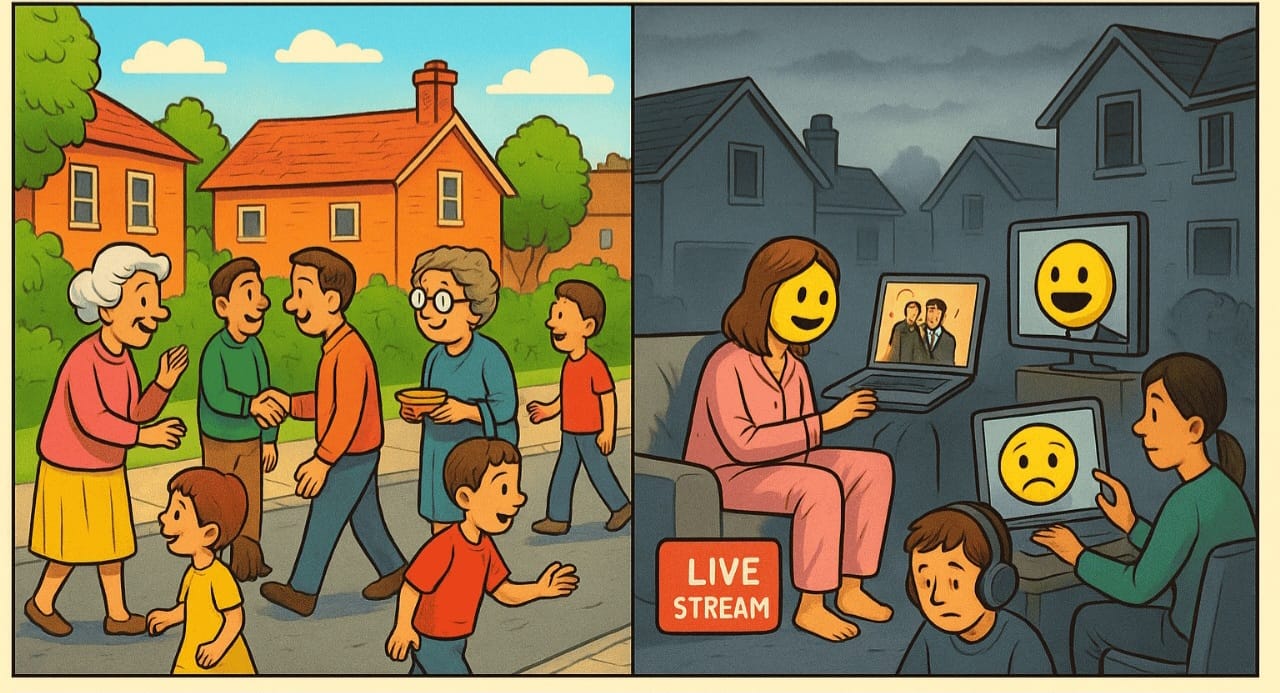

It begins subtly. You miss a cousin’s wedding because you “attended” via live stream. A neighbour’s father dies, and you send a sad emoji instead of walking across the street to comfort them. Your best friend falls sick, and rather than showing up with a bowl of homemade soup, you join a five-minute video call between tasks.
What feels like convenience is, in truth, the slow erosion of our most human traditions.
For centuries, families and communities thrived on proximity and presence. A grandmother would walk miles with a basket of bread to see her sister in the next village. Neighbours would sit under a tree on a summer evening, exchanging stories as children played. A wedding was not just a ceremony but a communal event, where distant relatives camped at the family home days in advance to cook, decorate, and celebrate together.
Today, much of that rich fabric of human connection is fraying under the strain of technological convenience.
The Rise of the Virtual Substitute
Social media platforms and digital communication tools have transformed how we connect—but not necessarily for the better. Platforms like Facebook, Instagram, and TikTok promise community, yet deliver curated snapshots rather than lived experiences. Visiting a sick friend now means sending a “Get well soon” GIF, while attending a funeral often involves clicking a link to watch the service on YouTube. Even major life events—engagements, birthdays, graduations—are increasingly mediated by screens, wthe dead are honoued by posting their pictures on our social media status, rather than attending the burial.
While these tools can connect us across continents, they also encourage a dangerous substitution: replacing personal presence with digital presence. A WhatsApp video call may be easier than navigating traffic to visit a friend, but it lacks the warmth of shared silence, the reassurance of a hand squeeze, or the comfort of physical proximity.
The Shrinking of Social Capital
Sociologists describe social capital as the networks of relationships and trust that enable societies to function cohesively. Traditionally, social capital is built through face-to-face interaction—helping a neighbour fix a roof, attending a community meeting, or sharing meals.
Digital alternatives, while efficient, strip these interactions of depth.
Consider a hypothetical example: in a small town 30 years ago, if a local farmer’s barn burned down, neighbours would gather within hours to rebuild it, sharing tools, labour, and food. Today, that same tragedy might inspire hundreds of Facebook “likes” on a donation post—yet far fewer people would physically show up to help. The appearance of solidarity is mistaken for the reality of it.
Convenience Over Commitment
We have grown accustomed to valuing efficiency over engagement. Technology offers instant gratification without the “inconvenience” of travel, conversation, or emotional labour. A nephew’s graduation? Watch the highlights on Instagram Stories. Your brother’s newborn? Like the baby photos on Facebook instead of visiting. A childhood friend in distress? Send a heart emoji instead of making time to meet.
This shift is not just changing how we interact; it is altering who we are. We are becoming participants in a world where relationships are transactional and fleeting, where presence is measured in notifications rather than time spent.
Bridges Turning into Ridges
Ironically, while digital platforms claim to connect us, they often deepen divides. Online interactions can be filtered, edited, and curated, hiding flaws and reducing authenticity. Arguments flare more quickly over WhatsApp than in person because the subtle cues of tone and body language are lost.
Communities that once knew each other’s histories now know only each other’s headlines.
Even within families, the distance grows. A household might be under one roof yet disconnected—each member in a separate room scrolling through TikTok, replying to friends on Instagram, or binge-watching Netflix alone. The living room, once the heart of the home, is now just a charging station for devices.
A Call Back to Humanity
Technology is not inherently the villain. It has allowed us to stay connected during pandemics, bridge long distances, and share knowledge instantly. But it becomes corrosive when it replaces, rather than complements, real human contact.
Reclaiming our social capital requires intentional action. Visit that sick friend in person. Show up at the funeral even if the live stream is available. Put down the phone at dinner. Organise a neighbourhood braai instead of a WhatsApp group chat. Walk—like your grandparents did—miles if you must, not just for exercise, but for connection.
Because in the end, the true measure of our humanity is not in the speed of our messages, but in the depth of our presence. And no emoji, no matter how perfectly chosen, can replace the warmth of a human touch.