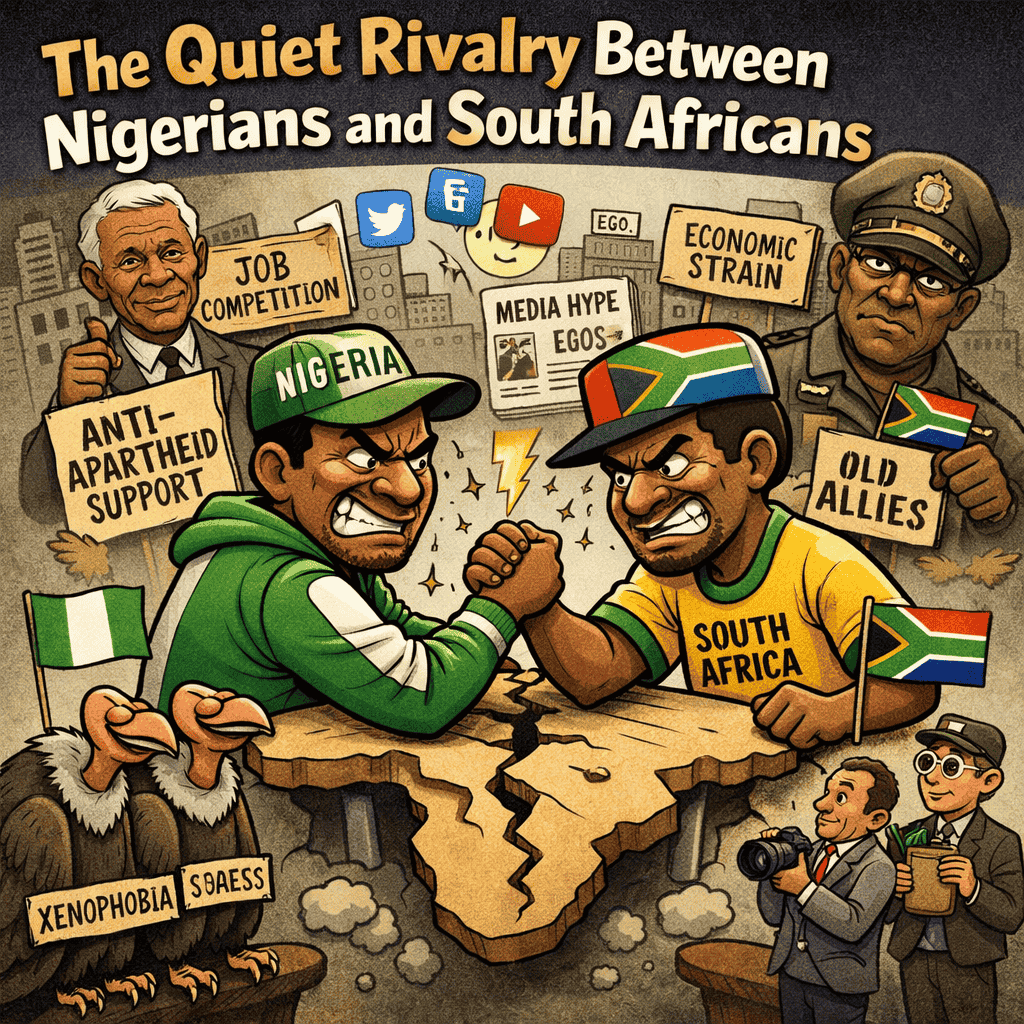
Across Africa’s two largest economies, a quiet but persistent tension lingers—not in official communiqués or diplomatic standoffs, but in everyday conversations, social media exchanges, and informal economic spaces. Nigerians and South Africans, bound by shared histories of colonialism and liberation, often find themselves framed as rivals rather than partners. This rivalry is unofficial, citizen-driven, and largely unspoken, yet it carries real social and psychological weight.
Nigerians and South Africans, often find themselves framed as rivals
Importantly, this is not a clash between governments. At the state level, Nigeria and South Africa have maintained largely cooperative relations, anchored in trade, multilateral diplomacy, and shared commitments within the African Union. The friction emerges instead among citizens, shaped by socio-economic pressures, historical memory, migration dynamics, and competing narratives of continental leadership.
To understand this dynamic, one must return to the apartheid era. While South Africans were internally engaged in resisting and dismantling an oppressive system, Nigeria emerged as one of Africa’s most vocal and influential champions of the anti-apartheid struggle. At continental and global levels, Nigeria positioned itself as Africa’s political and moral “big brother,” using diplomacy, economic pressure, and cultural influence to isolate the apartheid regime. Nigerian resources supported liberation movements, Nigerian leaders amplified Africa’s voice in international forums, and Nigeria’s stance against apartheid became a defining feature of its continental identity.
DURING APARTHEID, Nigeria positioned itself as Africa’s political and moral “big brother
The fall of apartheid in 1994 fundamentally altered this balance. A democratic South Africa quickly assumed global legitimacy, economic prominence, and symbolic authority as a post-apartheid success story. In doing so, it entered a leadership space Nigeria had long occupied, creating an unspoken recalibration of continental influence. This was not a formal power struggle between states, but rather a silent negotiation of status, pride, and identity. Two countries, each accustomed to seeing itself as Africa’s leading voice, now existed as peers. The shift subtly transformed solidarity into comparison, and comparison into quiet competition.
This historical transition continues to shape contemporary attitudes. For some Nigerians, there is a lingering sense that past sacrifices and leadership have been overlooked. For some South Africans, there is a strong desire to assert post-apartheid autonomy and leadership on their own terms. These unresolved narratives operate beneath the surface, influencing how citizens interpret each other’s presence, success, and visibility.
Economic pressure intensifies these sentiments. South Africa’s high unemployment, deep inequality, and slow growth have created a climate in which competition for opportunity feels acute. In such contexts, migrants, particularly those perceived as economically successful, often become symbols of scarcity. Nigerians, visible in informal trade, technology, entertainment, and small business sectors, are frequently framed as competitors, despite evidence that migration contributes to economic activity and job creation. Structural challenges are thus personalised, and frustration is redirected.
These unresolved narratives operate beneath the surface
Migration visibility also intersects with stereotyping and selective attribution. Criminal activity, which exists in all societies, is sometimes disproportionately associated with foreign nationals in public discourse. Nigerians, in particular, have been subjected to reductive narratives that collapse a diverse population into narrow caricatures. These perceptions are amplified by sensationalist media coverage and viral online content, where nuance rarely survives algorithmic urgency.
Media and digital platforms play a central role in sustaining the rivalry. Isolated incidents are generalised, while collaborative successes receive limited attention. Cultural exchange, innovation, and everyday cooperation rarely trend. Instead, emotionally charged narratives circulate faster than facts, reinforcing mistrust and defensiveness on both sides.
Nigerians, in particular, have been subjected to reductive narratives that collapse a diverse population into narrow caricatures.
Yet the rivalry is deeply paradoxical. Nigerian and South African cultures are profoundly intertwined. Music, film, fashion, sport, and digital creativity flow freely between the two societies, especially among younger generations. Artists collaborate, audiences overlap, and mutual admiration is evident in consumption patterns—even as online rhetoric sometimes suggests hostility. This contradiction underscores a critical point: the rivalry is not organic; it is socially constructed.
Another key factor is the absence of sustained people-to-people engagement. While governments engage through summits and agreements, ordinary citizens have few structured platforms for dialogue, shared problem-solving, or cultural exchange. In the absence of contact, perceptions are shaped by hearsay rather than experience. Where interaction does occur—in workplaces, neighbourhoods, and creative industries, it often dismantles stereotypes rather than confirms them.
Framing this tension purely as rivalry risks obscuring deeper systemic issues. Economic inequality, youth unemployment, governance challenges, and uneven development affect both societies. Redirecting frustration toward “the other” may offer temporary emotional release, but it delays meaningful solutions and undermines the broader African project, which depends on cooperation among its leading states.
Ultimately, Nigerians and South Africans are not natural adversaries. They are societies navigating similar pressures from different historical starting points. The silent rivalry says less about inherent incompatibility and more about how economic anxiety, historical memory, identity politics, and media narratives shape social relations. Recognising this complexity is the first step toward replacing distance with understanding, and competition with continental solidarity.
Framing this tension purely as rivalry risks obscuring deeper systemic issues.