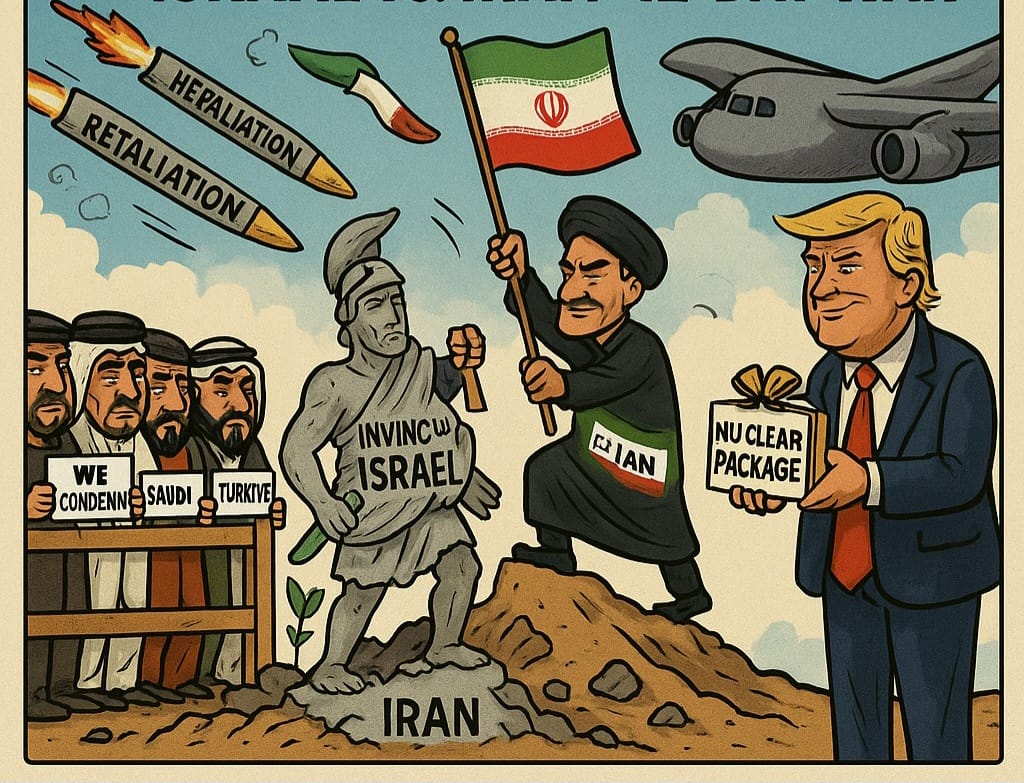
The war that began on June 16, 2025, with Israel’s audacious surprise strike on Iran, will be remembered not just for its intensity, but for how it shattered long-standing assumptions about military power in the Middle East. By 28 June 2025, the unthinkable had happened: Israel—long perceived as the region’s untouchable military titan, was nearly brought to its knees, and Iran emerged from the rubble as a redrawn regional superpower.
The aftermath of the war signals a tectonic shift in regional power. Iran is no longer just a rogue state with a defiant posture,
The First Strike and the Myth of Invincibility
The Israeli strike, executed with clinical precision, reportedly killed several of Iran’s top military commanders and nuclear scientists. Western media initially framed it as a decisive blow, reinforcing the image of Israel’s strategic supremacy. Yet that view proved dangerously premature. Iran’s Supreme Leader, Ayatollah Ali Khamenei, immediately vowed revenge, not mere rhetoric, but a prelude to a calculated, sustained counteroffensive that stunned the world.
Within 48 hours, Iranian missiles rained down on Tel Aviv, Haifa, Be’er Sheva, and even near Dimona. Israel’s vaunted Iron Dome struggled under the sheer volume and sophistication of the Iranian assault. Western observers, many of whom doubted Iran’s capability to sustain a high-tech offensive, were forced to recalibrate their assessments. It became clear that Iran had built a war machine not only for defense but for retaliation, and it worked.
Arab States: The Hypocrisy of Condemnation and Collusion
As images of devastated Israeli cities began circulating, the Middle East watched in stunned silence. Publicly, countries like Qatar, Saudi Arabia, Turkey, and Jordan issued condemnations of Israel’s initial strike. But behind the scenes, some of these same states reportedly assisted in intercepting Iranian missiles, not out of loyalty to Israel, but out of fear that a weakened Israel could shift the regional balance and embolden Tehran.
This duplicity has not gone unnoticed. Across Arab streets, from Amman to Ankara—young people are asking why their governments paid lip service to solidarity while covertly shielding Israel. Pakistan, notably, stood alone in offering real support to Iran, reportedly expressing willingness to share nuclear assets if the war escalated further, marking a bold and symbolic alignment.
But behind the scenes, some of these same states reportedly assisted in intercepting Iranian missiles,
The Collapse of a Narrative
For decades, Israel operated with near-impunity across the region, bombing Syria, assassinating scientists, and enforcing a brutal blockade on Gaza, all under the protective umbrella of U.S. power and Western diplomacy. But the 12-day war laid bare a sobering truth: Israel can be hit, and hit hard.
The narrative of Israeli military invincibility, so often reinforced by Hollywood, the Pentagon, and Western think tanks, collapsed under the weight of Iran’s resolve. The war ended not because Israel triumphed, but because the United States stepped in to broker an unconditional ceasefire, concerned more about regional escalation than ideological loyalty.
Winners and Losers
Iran walks away from this war battered but emboldened. It has proved that deterrence can go both ways. Its ability to strike back, and force a ceasefire, has earned it newfound respect, even from its adversaries. In contrast, Israel emerges militarily diminished and diplomatically isolated, reliant once again on Washington’s intervention to avert collapse.
The biggest losers, however, may be the Arab regimes that now look both weak and disingenuous. Their failure to stand firm, either with Israel or Iran—has left them strategically exposed and morally compromised. In hindsight, many of them may now wish they had backed Iran or, at the very least, remained neutral.
A New Middle East Order
The aftermath of the war signals a tectonic shift in regional power. Iran is no longer just a rogue state with a defiant posture, it is now a demonstrated military force capable of altering the calculus of war and peace in the region. Israel, once feared, is now seen as vulnerable. And Arab states are forced to rethink decades of strategic alignment.
What the 12-day war revealed is that no military myth lasts forever, and no superpower, regional or otherwise, is beyond reach. A new Middle East is emerging, messy, multipolar, and more dangerous. But it is also evident that Iran has claimed a new kind of power: the power to retaliate, reshape, and redefine.