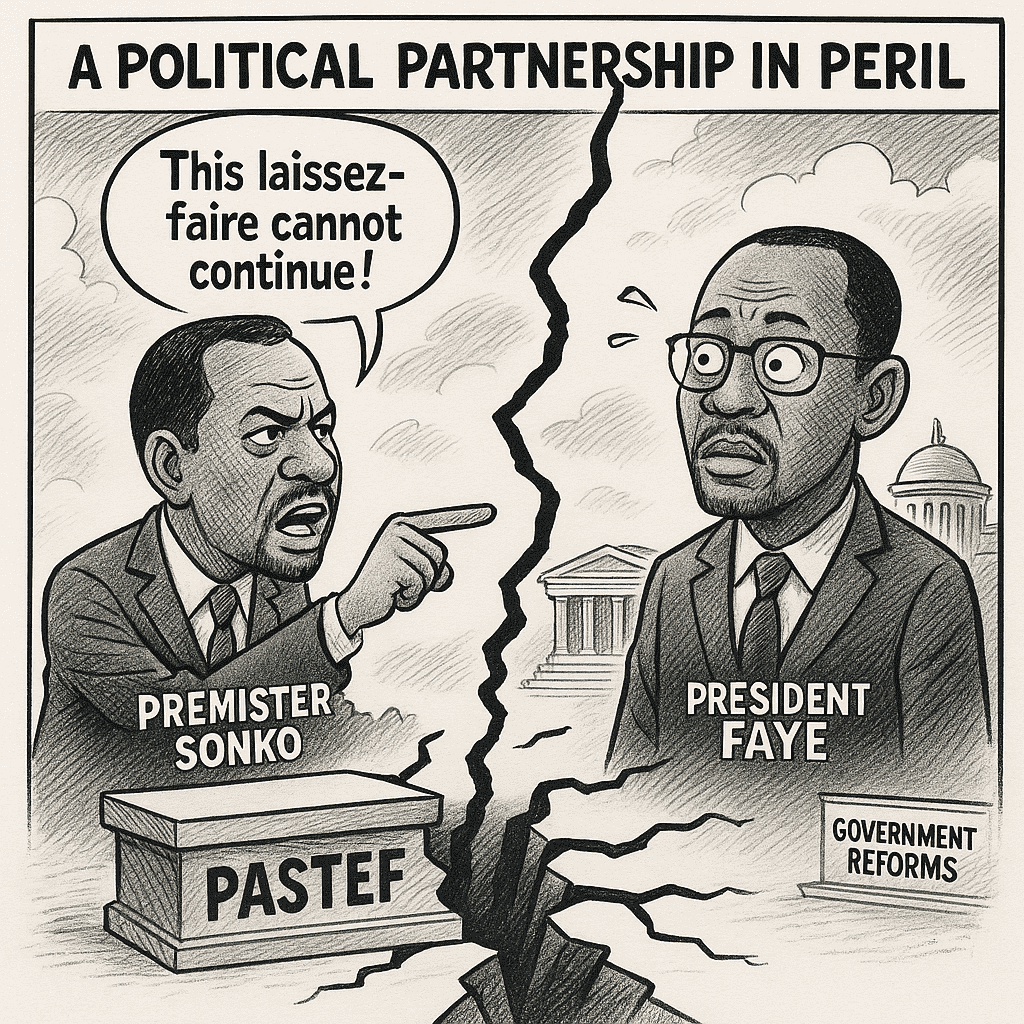
In a move that has sent ripples through Senegalese politics, Prime Minister Ousmane Sonko has openly criticized President Bassirou Diomaye Faye, challenging not only the presidency but also the fragile foundation upon which their political alliance was built. What began as a visionary partnership to reshape Senegal’s governance now appears to be fracturing under the weight of power dynamics, unmet expectations, and unresolved roles.
Senegal’s governance now appears to be fracturing under the weight of power dynamics,
Speaking before members of the Pastef party—once a tightly knit political movement born out of resistance and hope, Sonko accused President Faye of failing to show authority and neglecting to defend him amid mounting public attacks. “This laissez-faire cannot continue,” he declared with barely veiled frustration. For a party that rode into office on the wave of anti-establishment energy and promises of transparency and transformation, such internal dissent is more than symbolic; it signals a potential unraveling of the reformist momentum.
internal dissent is more than symbolic; it signals a potential unraveling of the reformist momentum.
To understand the magnitude of Sonko’s criticism, one must revisit the circumstances that brought Faye to the presidency. In 2024, Sonko, a charismatic populist and opposition leader, was legally barred from running for office due to court cases widely viewed as politically motivated. In response, he handpicked his close ally Bassirou Diomaye Faye, a low-key figure from within Pastef, to carry the torch. Riding Sonko’s popularity and a shared platform, Faye won the presidency in a stunning upset, promising systemic reform, economic sovereignty, and institutional renewal.
But it now appears the roles were never fully defined. Sonko, while sidelined by law, continued to embody the revolutionary fire of the movement, while Faye, occupying the presidential seat, was expected to operationalize those ideals within the constraints of state machinery. The latest remarks from Sonko reveal a deep tension between the ideological vision and the political pragmatism of governance.
This is more than just a spat between two leaders. It raises existential questions about how transformative political movements transition from resistance to rule. Sonko seems frustrated not only by perceived personal abandonment, but also by what he views as a dilution of the very reforms that brought Pastef to power. His statements suggest that he feels boxed in—holding a powerful title but with limited actual power to effect change. The prime minister’s message was clear: the revolution is being lost in the corridors of compromise.
The implications are serious. First, this fracture risks weakening the credibility of Pastef as a unified force for change. Senegalese citizens, especially the youth who mobilized for this political shift, may begin to lose faith in the very movement they helped to elevate. Second, the public rift emboldens opposition forces and casts doubt on the government’s ability to deliver on its promises. Factions within Pastef and the wider political ecosystem may begin to splinter, leading to institutional paralysis or even early realignment.
At the core of this crisis is a classic dilemma in politics: what happens when a movement is built around a personality rather than a process? Sonko’s rise was meteoric because he spoke truth to power; Faye’s legitimacy rested largely on that borrowed charisma. But as Faye begins to assert his independence, Sonko’s expectations of loyalty and alignment clash with the constitutional and political reality of presidential authority.
Sonko’s expectations of loyalty and alignment clash with the constitutional and political reality of presidential authority.
Still, it is not too late. This crisis could be a turning point—not an end. If Sonko and Faye can recalibrate their relationship based on clear governance principles and mutual respect, they may yet preserve the moral core of their movement. But if this divide deepens, Senegal risks watching another promising democratic project succumb to infighting and disillusionment.
What is at stake is not just a friendship or a political party. It is the credibility of a reformist era and the hopes of millions who believed that Senegal could lead the way in reimagining African leadership. Whether Sonko and Faye find a path forward, or break it irreparably, remains to be seen. But the clock is ticking.

The writer, Dr. Tiema Haji is an academic, researcher, author, journalist, communication specialist and an accomplished poet.