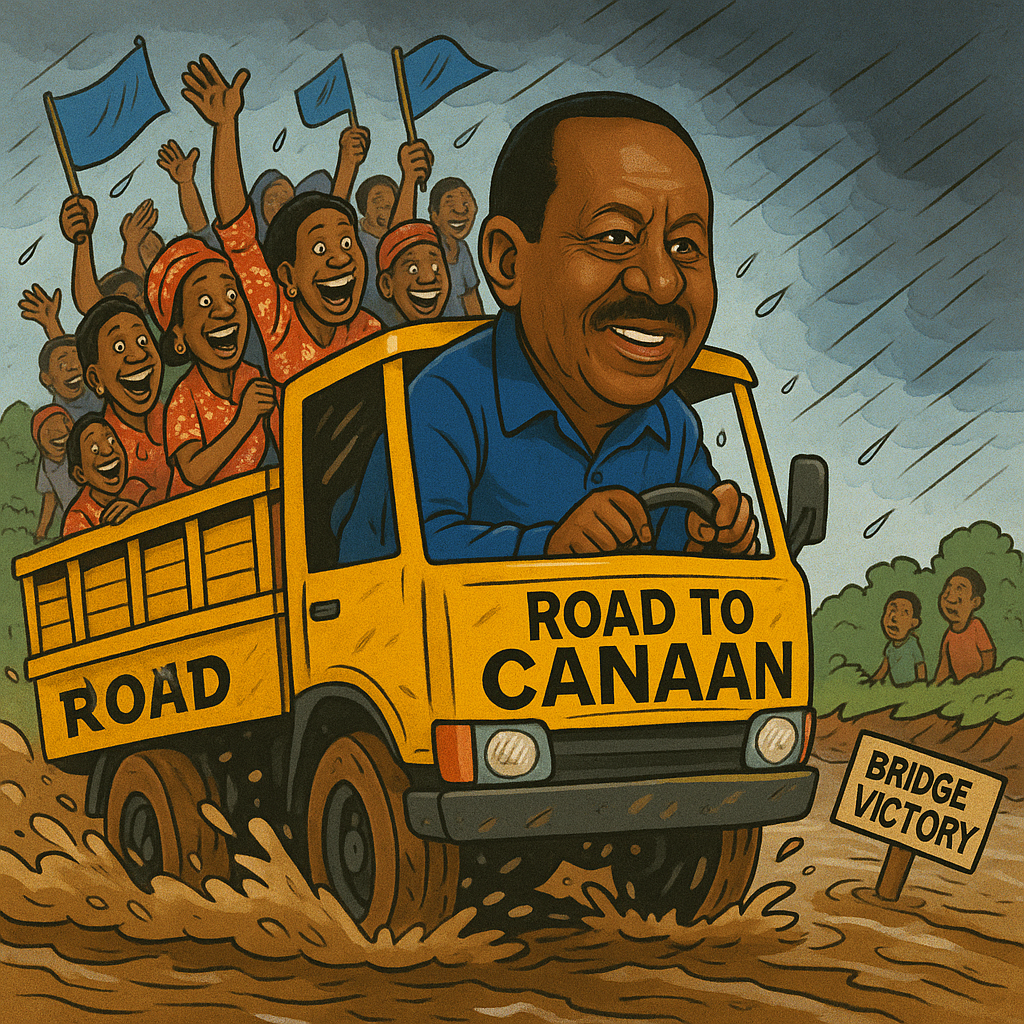

By all measures, Raila Odinga remains one of the most iconic political figures in post-independence Kenya. He is revered for his role in pushing back against authoritarianism, enduring detentions, and agitating for multiparty democracy. For millions, he symbolizes resilience and resistance. But with each election cycle and every surprise handshake, the question grows louder: Is Raila Odinga truly leading his supporters to the promised land, or simply taking them on a never-ending political pilgrimage for his own survival?
From Moi to Ruto: The Politics of Convenience?
Raila’s political journey reads like a complex script of shifting alliances. After vocally opposing President Daniel arap Moi during the dark days of single-party rule, Raila shocked many when he joined KANU in 2001. That handshake with Moi was rationalized as a strategic move, but it alienated some of his reformist allies.
He later broke away to form the Liberal Democratic Party, aligning with Mwai Kibaki under the NARC coalition in 2002. That alliance soured quickly, and by 2005, Raila led a victorious campaign against the draft constitution, a move that fractured the Kibaki-Raila coalition. In 2007, Raila nearly clinched the presidency, only for the election to be marred by violence and accusations of rigging. His entry into a power-sharing deal with Kibaki as Prime Minister (2008–2013) was another ‘handshake’ moment, framed as a necessity for national peace.
Then came the 2018 “Handshake” with President Uhuru Kenyatta after the bitter 2017 contest. It marked a new chapter, one that seemed to abandon opposition politics in favour of elite consensus. Many of Raila’s supporters, especially from his Nyanza stronghold, welcomed it, believing it would finally lead to long-awaited development and political inclusion. But others saw betrayal.
Now, in the post-2022 terrain, hints of reconciliation between Raila and President William Ruto have surfaced. Whispers of new alignments and strategic overtures suggest that Raila may again pivot, if politically convenient. This has provoked a fresh round of introspection: Is Raila building coalitions for the people, or is he simply trying to stay relevant?
This has provoked a fresh round of introspection: Is Raila building coalitions for the people, or is he simply trying to stay relevant?
Where Is the Development Track Record?
One must ask a difficult but necessary question: What social and economic transformation has Raila brought to the people who have stood by him for decades? Despite his long-standing influence, counties like Siaya, Kisumu, and Homa Bay, his political strongholds, still struggle with underdevelopment, youth unemployment, and poor infrastructure.
While some roads have been tarmacked and a few schools built, these cannot be squarely credited to Raila’s direct political interventions. Indeed, his critics argue that he has focused more on national political gamesmanship than on targeted community empowerment or grassroots economic programs. The concept of “development politics”, as practiced by leaders like Mwai Kibaki, who invested heavily in roads, education, and ICT, seems less visible in Raila’s legacy.
The Myth of the Messiah and the Reality of Fatigue
For years, Raila Odinga has been cast in the messianic light—a liberator destined to one day ascend to the presidency and deliver Kenya from its systemic injustices. This mythology has created an almost unshakeable emotional bond with his support base. But with every lost election and political pivot, fatigue sets in.
The phrase “Road to Canaan” that he famously used in 2017 now feels tragically ironic. Instead of crossing the Jordan, his supporters have found themselves stranded in the political wilderness. How many more resurrections can he pull off before his credibility begins to crumble?
2027: The Final Act?
As we inch closer to the 2027 elections, all eyes will be on Raila once more. Will he run again? Will he endorse someone new? Or will he surprise us with yet another political handshake, perhaps even formalizing a pact with President Ruto? Whatever happens, 2027 could be the final chapter in Raila’s decades-long political odyssey.
If he wins, it could validate everything his supporters have endured for years. But if he loses or compromises again, the risk is that his legacy may no longer be one of principled resistance, but of endless repositioning.
A Question of Legacy
History will always remember Raila Odinga as a titan of Kenyan democracy. But the verdict on whether he was a transformational leader or a perennial opposition figure still hangs in the balance. Leadership is not just about resistance; it is about results. The time has come for Raila to ask himself: Will I be remembered as the leader who brought my people to Canaan, or the one who got lost along the way?