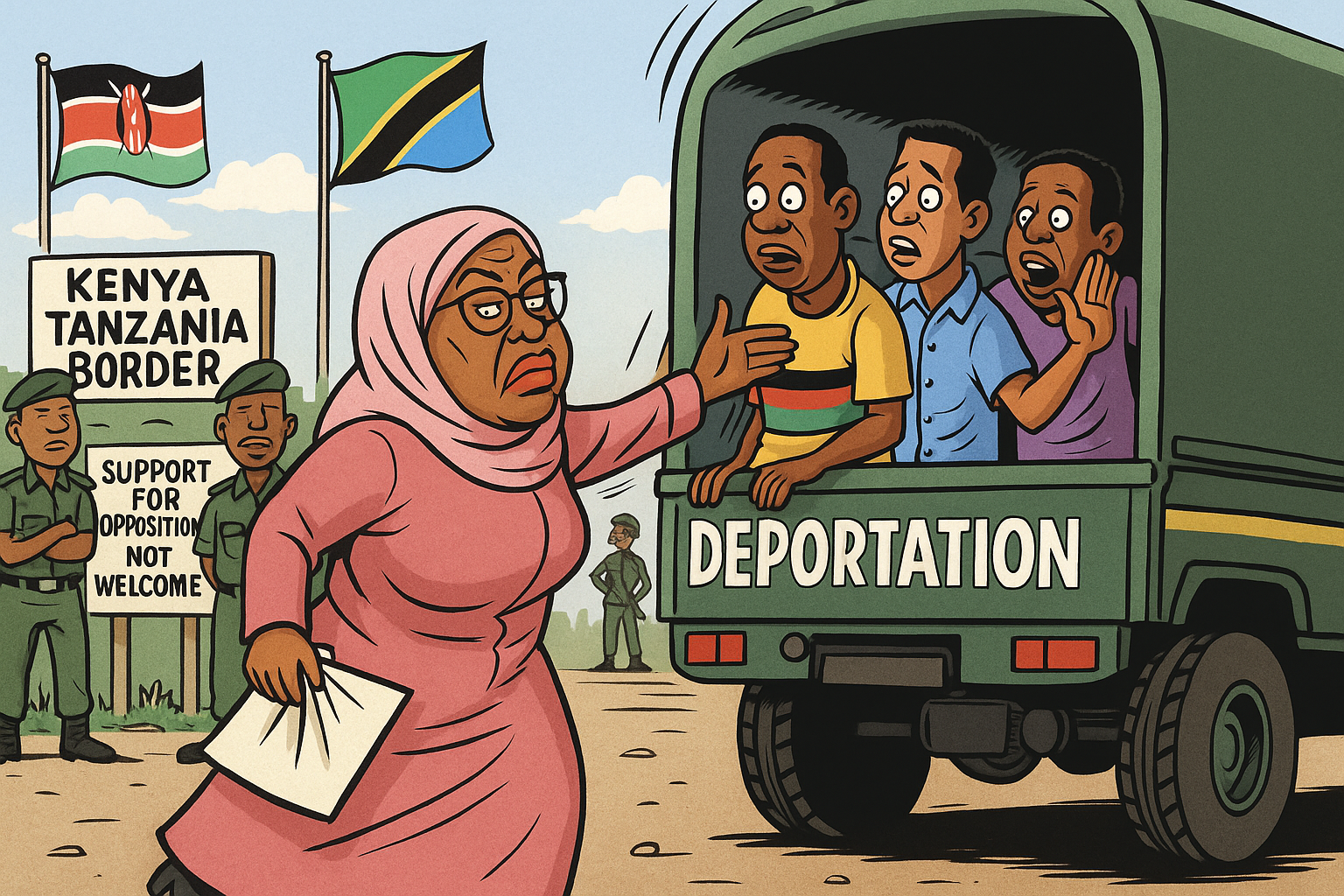
The deportation of Kenyan activists from Tanzania in May 2025 has reignited simmering tensions between East Africa’s two powerhouse nations—Kenya and Tanzania. What began as an act of cross-border solidarity has spiraled into a diplomatic standoff, with strong undercurrents of suspicion, nationalism, and conflicting views on civil liberties. At the heart of the matter is a deeper regional struggle over influence, sovereignty, and divergent governance philosophies. On May 18, 2025, Kenyan politician and lawyer Martha Karua was arrested and deported upon arrival at Julius Nyerere International Airport in Dar es Salaam. She had traveled to Tanzania to represent opposition leader Tundu Lissu, who is facing treason charges after calling for electoral reforms.
Subsequently, on May 20, Kenyan activist Boniface Mwangi and Ugandan lawyer Agather Atuhaire were arrested in Dar es Salaam while attempting to attend Lissu’s court hearing. Initially believed to have been deported, they were instead held by the Tanzanian Immigration Department. Mwangi was later released at the Kenyan border, alleging that both he and Atuhaire were subjected to torture during their detention. Atuhaire was released at the Uganda border after being held since May 19.
Interference or Solidarity?
The question that now hovers over this incident is complex: Were these activists meddling in Tanzanian politics, or were they simply exercising cross-border solidarity in the spirit of Pan-African democratic values? For Tanzania, a nation historically sensitive to external influence—especially after years of insular leadership under the late John Magufuli—this move was consistent with its nationalist posture.
President Suluhu, despite ushering in a relatively more open era, still operates within a political ecosystem that frowns upon overt foreign political participation.
From Kenya’s side, the move is seen differently. Kenya prides itself on a vibrant civil society, vocal media, and an activist culture that frequently crosses borders in pursuit of social justice. For Kenyan activists, regional solidarity is not an intrusion—it is a duty.
Flexing Muscles or Guarding Sovereignty?
The deportation also surfaces a long-running regional rivalry. Kenya, with its relatively open economy and assertive foreign policy, has often been perceived as the “big brother” of East Africa. Tanzania, on the other hand, has traditionally adopted a more cautious and inward-looking approach to diplomacy. Critics argue that Kenya sometimes behaves like a regional bully—asserting its models, values, and voice louder than its neighbors would prefer. Tanzania’s recent action, viewed through this lens, is not just a law enforcement measure but a flex of national muscles—a clear signal that it will not tolerate Kenya’s perceived overreach.
At the same time, Kenya’s government has chosen a careful diplomatic stance, avoiding public escalation while civil society voices grow louder in condemnation. This cautious approach suggests Nairobi is treading a fine line between protecting its citizens and respecting Tanzanian sovereignty.
Human Rights: A Mirror Held to Two Faces
The incident has inevitably led to comparisons between the two countries’ records on human rights and civil liberties. Kenya, despite frequent corruption scandals and police brutality, maintains a relatively free press and a judiciary that occasionally asserts its independence. Civil society plays a visible role in public discourse, and opposition politics are robust—even if messy.
Tanzania, while stable and generally peaceful, has had a more fraught relationship with political opposition, especially during the Magufuli era. The surveillance of journalists, restriction of political gatherings, and limited space for dissent have drawn criticism.
President Suluhu has made reforms, but these are still viewed as cautious steps rather than systemic change.
However, neither country is immune to extremes. In Kenya, activists have faced disappearances and extra-judicial killings. In Tanzania, even minor criticism of the state can result in harassment or imprisonment. Both nations wear the façade of democracy, but each carries democratic contradictions within.
The Road Ahead
This incident should be a wake-up call—not for conflict, but for cooperation. East African integration under the East African Community (EAC) promises open borders, shared values, and mutual respect. But when political tensions arise, these ideals are often sidelined by nationalism and mistrust.
There is an urgent need for diplomatic engagement at the highest level. Civil society organizations across the region should also initiate forums for dialogue, not just between governments but between people. Mutual respect, not mutual suspicion, must define the new chapter of East African relations.
Moreover, both nations must reflect inward. Kenya must recognize the importance of diplomatic sensitivity, especially in volatile political environments. Tanzania, meanwhile, must balance its sovereignty with openness to legitimate international scrutiny.
In the end, this is not just about deportations or diplomatic rows. It’s about the soul of East African unity—whether it is built on shared power or shared principle. If both countries can move beyond rivalry and toward reform, then the region’s future may yet live up to its Pan-African promise.